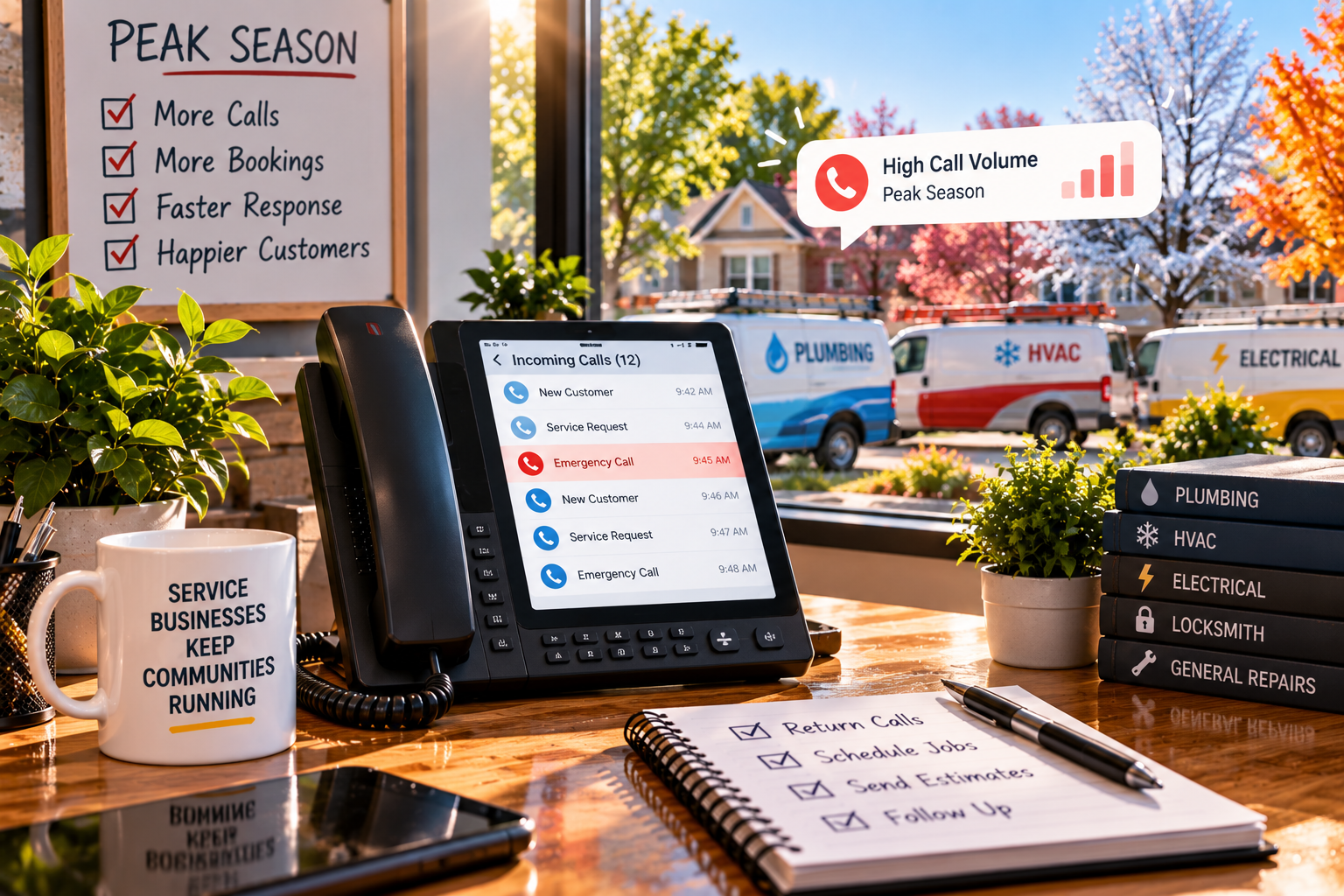
The forecast said 14 degrees overnight, and every plumber in town knew what that meant. By 7:30 the next morning the office line at a four-truck shop has rung forty-one times. Gloria, who runs the front desk and also does the books and also somehow orders the parts, has a phone on each ear and a legal pad that’s already on its third page. Somebody’s kitchen pipe split under the sink. Somebody else has no water at all and two kids who need to get ready for school. A guy who owns three rentals calls twice in ten minutes because he hasn’t heard back yet, and honestly, who could blame him? Gloria is great at her job. She’s also one person, and the phone does not care.

Every trade has its version of this week
Plumbers get the first hard freeze, plus the day after Thanksgiving (the trade calls it Brown Friday, and if you know, you know). HVAC shops get the first 98-degree week of June when every ten-year-old condenser in the county gives up at once. Pest control companies have termite swarm season, roofers get the hailstorm, and tax preparers spend most of April wondering why anyone thought a single phone line was enough. Different trigger every time, but the shape of the week stays the same. Demand doubles overnight, the crew doesn’t, and the phone turns into the bottleneck way before the trucks do.

Why the phone breaks before anything else
You can stretch a crew in a pinch. Guys work late; you push a few non-urgent jobs to next week. Maybe you borrow a tech from your buddy’s shop across town. The phone doesn’t stretch like that. One person on a line can only talk to one caller, and every minute spent with Mrs. Patel walking through where her shutoff valve is (it’s behind the laundry room panel; it’s always behind some panel) is a minute three other people are hearing a busy signal or a voicemail greeting. And peak season callers are the least patient people on earth. They’re cold, or hot, or wet. They’ve got a second plumber’s number pulled up before yours even finishes ringing.
Triage, the old-school way
Shops that survive these weeks usually have some kind of system, even if it’s a messy one. Gloria’s runs on a color-coded pen trick she came up with years ago. Red means water’s actively coming out, blue means no water but nothing’s flooding, and black means we can wait till Thursday. The reds get a truck. The blues get a callback within the hour. Black gets a polite We’ll be in touch. It works, kind of, right up until the volume gets to a point where she can’t pick up fast enough to even ask the question that decides the color. That’s the spot where a lot of shops lose the jobs that matter most. The red call never makes it onto the pad.
Getting help on the front end
So the fix most owners reach for first is another body. A seasonal temp to answer phones, a spouse, and the tech who threw his back out and is “on light duty.” Those can help for a few days. The trouble is training somebody to ask the right triage questions takes time you don’t have in the middle of a cold snap. That’s partly why more shops are trying an AI receptionist for plumbers during the crunch. The appeal is pretty simple when you picture call number forty-two. Instead of ringing out, it gets picked up right away, and the caller hears something like “Is water leaking right now, or is it more that you’ve lost water?” It sorts the reds from the blacks like Gloria would, grabs the address, books what can be booked, and flags the urgent stuff to whoever’s dispatching. It can take six calls at once without breaking a sweat (no sweat glands, which helps). What it can’t do is know your rules unless you set them up, like that you don’t do well pumps, or that anything north of the river costs extra, so a little prep work before the season hits goes a long way.
Don’t forget the calls going out
The inbound flood gets all the attention, but the outbound side quietly matters just as much. Every time we’ll call you back within the hour” is a promise, and when you’re slammed, a lot of those promises slip. Then the customer calls again, which adds to the flood, or worse, calls someone else. Confirmations are the other half of it. You booked twenty-two jobs for tomorrow, and if four of those people already got their pipe fixed by a competitor last night, your tech is driving to empty driveways. A big chunk of what’s been written about AI phone systems inbound outbound focuses on exactly this pairing. The same system that answers the incoming rush can turn around and make the follow-up calls: confirming tomorrow’s appointments, telling the black-pen folks you’ll be there Thursday, or calling down a waitlist when a job cancels. Nobody on your team has time to dial forty numbers during a freeze. Having those calls go out on their own keeps the promises you already made from turning into angry reviews.
Get ready before the forecast turns
Peak season isn’t a surprise. You know roughly when it’s coming, even if you don’t know the exact day. So use the slow weeks. Pull last year’s call log from the week of the first freeze and look at how many calls came in versus how many got answered (brace yourself a little). Write down the five questions that sort an emergency from a Thursday job. Decide who answers what, and what happens when that person is already on another call. Then test it with a fake surge, even if it’s just you and two buddies calling the line at the same time on a Tuesday afternoon.
The phone is the front door
When the cold snap hits, the shop with the most trucks doesn’t automatically come out ahead. Usually the winner is whoever kept their phone working while everybody else’s pipes stopped working. Gloria and her color-coded pens will always have a place, and a good dispatcher is worth her weight in copper fittings. But giving her backup on call forty-two, and on the follow-ups nobody has time to make, can be the difference between a record week and a week of “sorry, we went with somebody else.