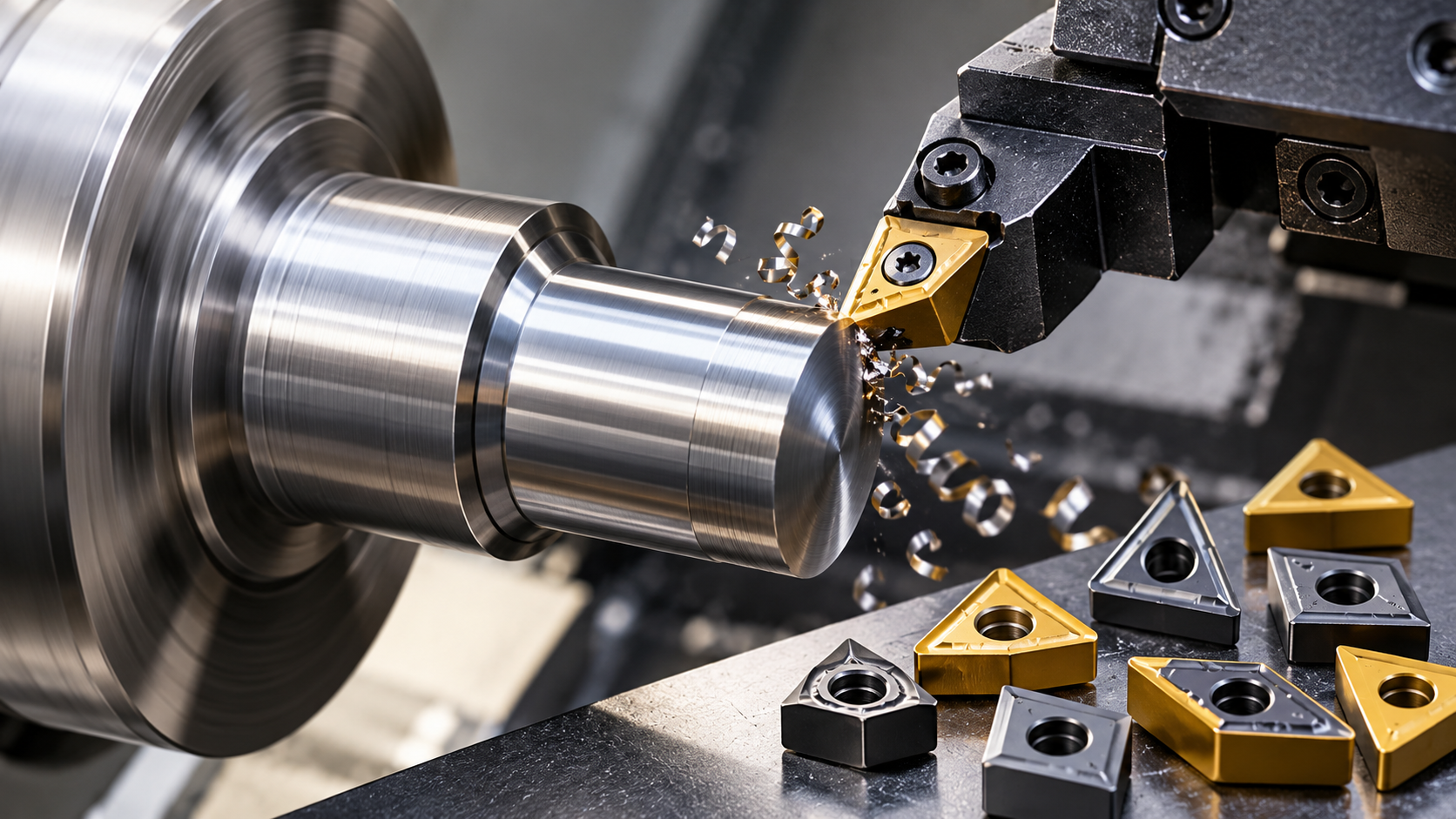
Choosing the right carbide insert for lathe turning operations is essential for achieving accurate dimensions, consistent surface finishes, and longer tool life. The wrong insert can cause excessive wear, poor chip control, vibration, and unnecessary production costs.

Whether you operate a manual lathe or a CNC turning machine, selecting an insert requires careful consideration of the workpiece material, cutting conditions, insert geometry, and machine stability. Khokhawala Trading LLC understands the importance of selecting suitable industrial cutting tools for reliable machining performance.

If you are comparing buy lathe machine cutting tools uae or looking for turning inserts, understanding the specifications can help you make a more informed purchasing decision.
Table of Contents
- Understand the Workpiece Material
- Select the Right Insert Shape
- Choose the Correct Carbide Grade and Coating
- Consider the Chipbreaker and Nose Radius
- Check Insert Size and Toolholder Compatibility
- Frequently Asked Questions
- Conclusion and CTA
1. Understand the Workpiece Material
The first step is identifying the material you need to machine. Different metals require different insert grades and cutting geometries.
- Steel: Often requires a carbide grade that balances wear resistance and cutting-edge strength.
- Stainless steel: Benefits from suitable grades and geometries that manage heat and reduce work-hardening.
- Cast iron: Often requires wear-resistant inserts designed to handle abrasive chips.
- Aluminum: Generally benefits from sharp cutting edges and suitable chip-control geometry to reduce material adhesion.
Always check the exact material grade and hardness before selecting an insert.
2. Select the Right Insert Shape
Insert shape influences cutting-edge strength, accessibility, and the types of turning operations you can perform.
| Insert Shape | Typical Application | Main Benefit |
|---|---|---|
| CNMG | General turning and roughing | Strong, versatile cutting geometry |
| DNMG | Profiling and finishing | Better access to detailed contours |
| TNMG | General turning and profiling | Multiple usable cutting corners, depending on design |
| WNMG | Production turning and roughing | Multiple cutting edges and good productivity |
| CCMT | Light turning and boring | Positive geometry with lower cutting forces |
These are general examples, not universal recommendations. The correct insert depends on the holder, workpiece geometry, and cutting conditions.
3. Choose the Correct Carbide Grade and Coating
Carbide grades differ in hardness, toughness, and wear resistance. Coatings can further improve performance when matched to the workpiece and application.
Carbide Grade
For stable, continuous turning, a wear-resistant grade may provide longer tool life. For interrupted cuts or less stable setups, a tougher grade may help reduce edge chipping.
Insert Coating
Common coating technologies include titanium nitride (TiN), titanium carbonitride (TiCN), and aluminum-titanium-nitride-based coatings. Each has different characteristics, and suitability depends on the insert grade and machining conditions.
Choose a grade and coating recommended by the insert manufacturer for your specific material and operation rather than selecting based on coating name alone.
4. Consider the Chipbreaker and Nose Radius
Chipbreaker Selection
A chipbreaker helps control chip shape and direction, improving safety and reducing the risk of chips damaging the workpiece or tool.

- Finishing: Select geometry designed for lighter cuts and controlled chip formation.
- Semi-finishing: Choose a chipbreaker that supports a balanced range of feed rates and depths of cut.
- Roughing: Use a robust geometry designed to handle heavier cutting loads.
The chipbreaker must match the actual feed rate and depth of cut.
Nose Radius
The nose radius affects surface finish, cutting-edge strength, and cutting forces. A smaller radius may suit light finishing and detailed profiles, while a larger radius can support stronger cutting edges and higher feeds under stable conditions. However, a larger radius may also increase vibration on slender workpieces.
5. Check Insert Size and Toolholder Compatibility
Before purchasing, verify that the insert fits your toolholder and machine setup.
Check these specifications:
- Insert designation and dimensions
- Insert thickness and nose radius
- Clamping method and seat compatibility
- Toolholder orientation and clearance
- Required cutting speed, feed rate, and depth of cut
- Machine rigidity and workpiece stability
Businesses planning to buy lathe machine cutting tools uae should compare specifications and application suitability, not just price. Correct compatibility helps prevent installation problems and unexpected machining interruptions.
6. Frequently Asked Questions
Q1. Which carbide insert is best for general lathe turning?
CNMG inserts are commonly used for general turning because of their versatile shape and strong cutting geometry. The appropriate grade and chipbreaker still depend on the workpiece and operation.
Q2. Which insert is suitable for stainless steel?
Select a grade and geometry specifically recommended for the stainless steel grade being machined. Heat management, chip control, and avoiding excessive rubbing are important.
Q3. What causes carbide inserts to wear quickly?
Common causes include incorrect cutting speed, unsuitable grade, poor chip control, excessive heat, and unstable workholding.
Q4. Does a larger nose radius improve surface finish?
Not always. A larger radius can support higher feed rates in stable conditions, but it may increase cutting forces and vibration. The best choice depends on the setup and required finish.
Q5. Can one carbide insert machine every metal?
Some inserts cover multiple materials, but no single insert is ideal for every application. Material-specific grades and geometries can improve performance.
7. Conclusion and Call to Action
Selecting the right carbide insert for lathe turning involves matching the workpiece material, insert shape, carbide grade, coating, chipbreaker, nose radius, and toolholder. A suitable combination improves tool life, chip control, dimensional accuracy, and overall machining efficiency.
Need reliable industrial cutting tools for your workshop? Contact Khokhawala Trading LLC to discuss your machining requirements and explore suitable tooling options for your operations.