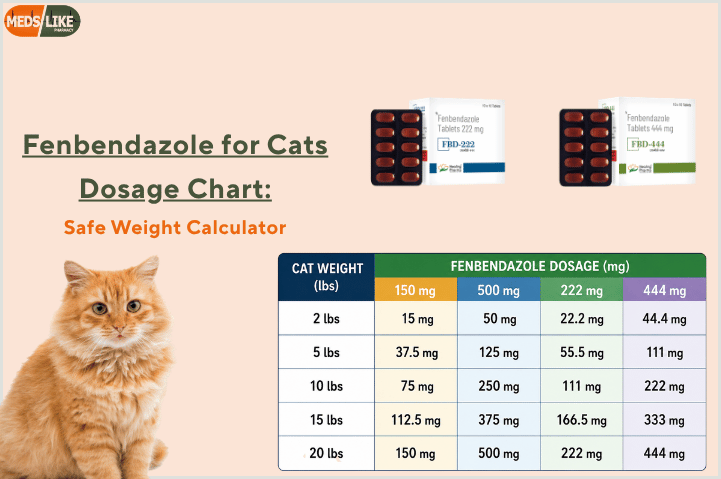
Fenbendazole is a broad-spectrum antiparasitic medication that veterinarians may use to treat certain intestinal and respiratory parasites in cats. Because the correct dose depends on the cat’s weight, the parasite involved, the formulation being used, and the treatment schedule, it is important to use a veterinarian-approved regimen rather than estimating a dose at home. Veterinary references commonly describe fenbendazole at 50 mg/kg by mouth once daily for several days for certain feline parasite infections, but this should not be treated as a universal dose for every condition.

If you are comparing treatment information or looking for veterinary medication resources, medslike.com can also be used as a general medication-information reference. However, online dosage charts should complement—not replace—advice from your veterinarian, particularly when treating kittens, pregnant cats, older cats, or cats with other health problems. Fenbendazole use in cats may be considered off-label in some countries, and veterinary instructions can differ depending on the diagnosis and product.

How is fenbendazole used in cats?
Fenbendazole is an anthelmintic, meaning it works against certain parasitic worms. Veterinary references list its use against several feline parasites, including some roundworms, hookworms, tapeworms, and lungworms. The exact regimen varies according to the parasite.
For example, Merck Veterinary Manual lists fenbendazole at 50 mg/kg orally for 2–5 days for Aelurostrongylus abstrusus, a feline lungworm. Other feline parasite infections may have different treatment durations. This is why a dosage chart based only on body weight cannot determine the complete treatment plan.
A veterinarian may first recommend a fecal examination or other diagnostic testing to identify the parasite. This can prevent unnecessary treatment and helps determine whether fenbendazole is an appropriate medication.
Why does your cat’s weight matter?
Fenbendazole dosing is calculated according to body weight. Giving too little medication may result in inadequate treatment, while giving an inappropriate amount can increase the risk of adverse effects or medication errors.
A cat’s weight should be measured as accurately as possible before calculating any medication dose. This is particularly important for kittens because even a small change in body weight can substantially change the calculated amount.
It is also important to distinguish milligrams (mg) from milliliters (mL). Milligrams describe the amount of active drug, while milliliters describe the volume of liquid. The two cannot be treated as interchangeable. Always check the concentration printed on the product packaging before measuring a liquid medication.
How should fenbendazole be given?
Fenbendazole is available in different formulations, including oral granules and liquid suspensions. VCA Animal Hospitals notes that Fenbendazole for Cats Dosage Chart by Weight is administered orally and that liquid formulations should be measured carefully. Giving it with food may help reduce gastrointestinal upset.

Follow the veterinarian’s instructions for the exact amount, frequency, and duration. Do not change the treatment schedule simply because symptoms improve. Some parasites require a specific number of treatment days, and different infections can require different protocols.
Possible side effects
Fenbendazole is generally considered well tolerated when used appropriately, but cats can experience gastrointestinal effects such as vomiting, diarrhea, reduced appetite, or stomach upset. Any unusual or severe reaction should be discussed with a veterinarian.
If a cat develops persistent vomiting, severe diarrhea, marked weakness, difficulty breathing, collapse, or another concerning symptom after receiving medication, seek veterinary attention promptly.
Can kittens take fenbendazole?
Fenbendazole may be used in some kittens, but age, weight, parasite type, and overall health all matter. Merck Veterinary Manual includes fenbendazole among treatments used for certain parasites in cats and kittens, but the appropriate regimen depends on the infection being treated.
Young kittens can become dehydrated quickly when they have diarrhea or vomiting, so treating the underlying problem should not be delayed. A veterinarian can determine whether deworming, supportive care, fecal testing, or another treatment is appropriate.
Important safety information
Do not assume that a fenbendazole dosage used for a dog is automatically appropriate for a cat. Although fenbendazole is used in veterinary medicine, VCA notes that its use in cats can be off-label or extra-label, meaning the veterinarian’s directions may differ from instructions found on a product label.
The dosage chart above is therefore best viewed as a calculation reference, not a substitute for veterinary diagnosis. The correct treatment may differ according to the parasite, the cat’s age and health, and the formulation being used.
Final thoughts
Fenbendazole can be a useful antiparasitic medication for certain feline infections when it is selected and dosed appropriately. A commonly referenced regimen is 50 mg/kg once daily, but the number of treatment days varies by parasite and condition.
Before giving fenbendazole to a cat, confirm the diagnosis, product concentration, calculated dose, and treatment duration with a veterinarian. Never convert a milligram dose into milliliters without checking the product’s exact concentration. For kittens, pregnant cats, elderly cats, or cats taking other medications, professional veterinary guidance is especially important.