Online retail has never stood still for very long.

From basic online storefronts to mobile commerce and marketplaces, every major shift has changed how businesses sell and how customers shop. Now, artificial intelligence is driving the next phase of that evolution. But unlike previous technology trends, AI is becoming deeply embedded into everyday commerce operations rather than existing as a standalone feature.

The future of online retail is not about replacing people with AI. It’s about making every interaction, decision, and business process smarter.
AI Is Becoming the Foundation of Modern Commerce
Artificial intelligence is no longer limited to chatbots or product recommendations.
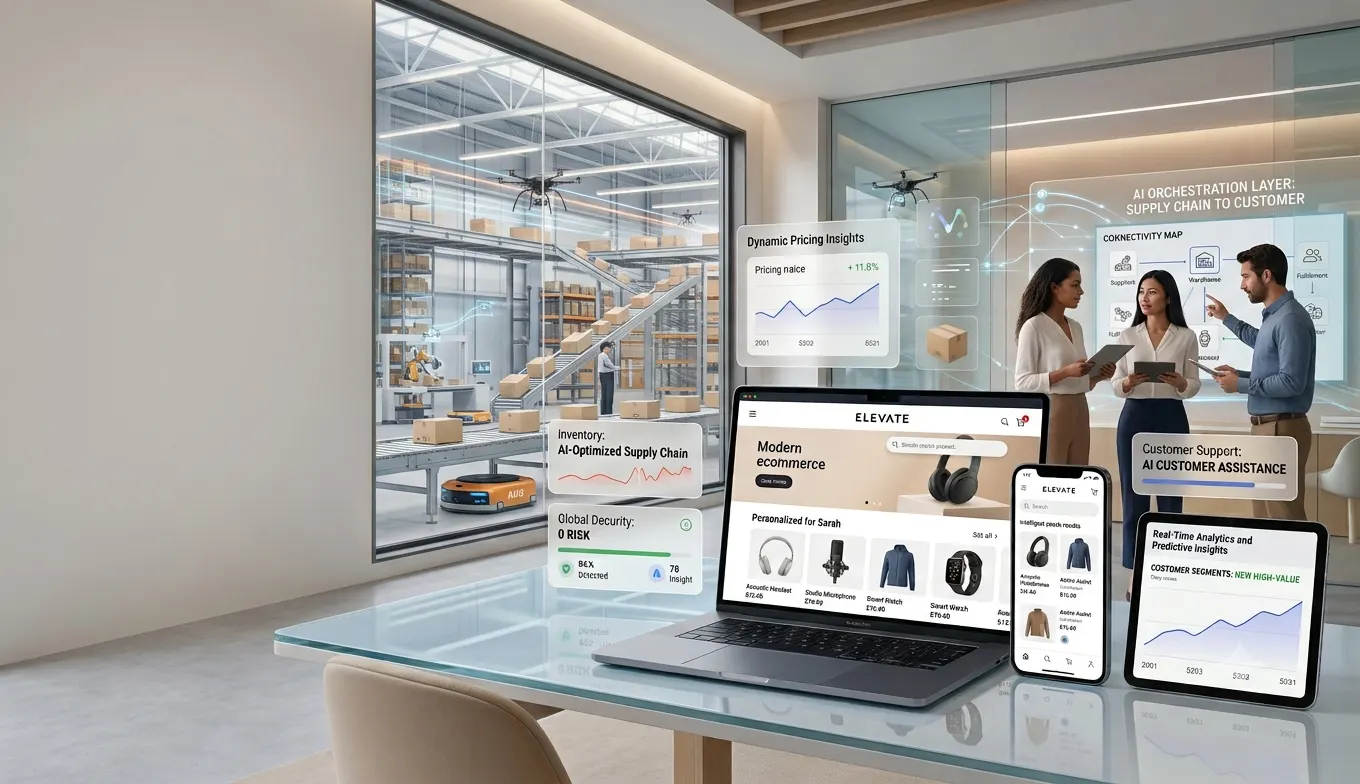
Today, it supports everything from search and inventory management to pricing, fraud detection, customer service, and demand forecasting. Businesses are increasingly integrating AI into their AI eCommerce Platform to automate repetitive tasks while improving customer experiences.
The result is a commerce environment that adapts much faster to changing customer behavior.
Shopping Experiences Are Becoming More Personal
Customers now expect platforms to understand what they’re looking for without having to search endlessly.
AI analyzes browsing history, purchase behavior, product preferences, and real-time interactions to deliver more relevant recommendations. Instead of showing the same storefront to every visitor, platforms can personalize product listings, promotions, and search results for each individual shopper.
That creates a smoother buying journey while helping businesses improve engagement and conversions.
Smarter Search Is Redefining Product Discovery
Search has become one of the most important applications of AI in ecommerce.
Modern search engines understand customer intent rather than simply matching keywords. They consider spelling mistakes, previous behavior, product popularity, inventory availability, and purchasing patterns before displaying results.
This allows shoppers to find relevant products faster while reducing frustration during product discovery.
AI Improves Operational Efficiency
Behind every successful online store is a complex network of operations.
AI helps businesses optimize:
- inventory forecasting,
- warehouse planning,
- demand prediction,
- order routing,
- pricing decisions,
- fraud detection.
Instead of relying only on historical reports, businesses can react to live data and changing market conditions more quickly.
That operational efficiency often translates into lower costs and better customer service.
Customer Support Is Becoming More Intelligent
AI-powered assistants now handle many routine customer interactions, including:
- order tracking,
- return requests,
- product questions,
- shipping updates,
- account support.
Human agents continue to play an important role, but AI reduces response times by resolving common issues instantly.
Customers receive faster support while service teams can focus on more complex requests.
Data Is Driving Better Decisions
Every customer interaction creates valuable information.
Modern AI systems process enormous amounts of behavioral and operational data to identify patterns that would be difficult to detect manually.

Businesses use these insights to:
- optimize marketing campaigns,
- forecast demand,
- improve inventory planning,
- personalize customer experiences,
- identify operational bottlenecks.
As online retail continues growing, data-driven decision-making will become even more important.
AI Supports Both B2C and B2B Commerce
Although AI is often associated with consumer shopping, its impact extends well beyond retail.
Consumer-focused businesses use AI to improve personalization, recommendations, and engagement.
Business-focused commerce platforms rely on AI for procurement workflows, account-based pricing, inventory optimization, and purchasing automation.
Regardless of the business model, AI helps simplify complex processes while improving efficiency.
Trust and Security Remain Essential
As AI becomes more integrated into commerce, security and trust become even more important.
AI helps detect fraudulent transactions by identifying unusual purchasing behavior and payment patterns in real time. At the same time, businesses must maintain strong data governance and transparent privacy practices to build customer confidence.
Successful AI adoption depends on balancing innovation with responsible data management.
The Future Will Be More Predictive
One of the biggest changes over the next few years will be predictive commerce.
Rather than simply reacting to customer actions, AI will increasingly anticipate future needs.
Platforms will recommend products before customers search for them, optimize inventory before demand spikes, and identify operational issues before they affect the business.
This shift from reactive to predictive commerce will reshape how retailers operate.
Building for the Future
Businesses investing in a modern ecommerce platform are increasingly considering AI capabilities from the beginning rather than adding them later.
Scalable infrastructure, quality data, and flexible system architecture make it easier to introduce new AI features as customer expectations continue evolving.
Companies that build with future adaptability in mind will be better prepared for the next generation of digital commerce.
Also Read: How eCommerce Development Companies Are Preparing Businesses for AI Search
Conclusion
AI-powered commerce is changing online retail by making customer experiences more personalized and business operations more intelligent.
From smarter search and predictive inventory management to automated support and data-driven decision-making, AI is becoming a core part of modern ecommerce infrastructure.
As the technology continues to evolve, the businesses that combine AI with strong operational strategy and customer-focused experiences will be best positioned for long-term growth.