The first time most travelers see the Taj Mahal, they expect a monument. What they don’t expect is silence.
At sunrise, before the crowds arrive and before the heat sets in, the white marble seems to hold its breath. The light shifts by the minute — soft pink, then gold, then a blinding, pure white. It’s one of those rare travel moments that photographs never quite capture.

But here’s what many first-time visitors don’t realize: standing in front of the Taj Mahal and understanding it are two very different experiences. Without context, it’s a beautiful building. With the right guidance, it becomes a 17th-century love story carved in stone, a masterpiece of engineering, and a window into Mughal India.
This is where a private tourist guide changes everything. Not as an upsell, not as a luxury add-on, but as the difference between seeing a monument and actually experiencing it.
This guide walks through exactly why sunrise timing matters, what a private guide really does on the ground, and how the small details — the ones easy to miss on your own — shape a trip you’ll actually remember years later.
Why Sunrise is the Best Time to Visit the Taj Mahal
Agra gets hot. By mid-morning in most seasons, the marble courtyard is already baking under direct sun, and by afternoon, both the heat and the crowds make it hard to enjoy the site at a relaxed pace.
Sunrise avoids all of that.
The gates typically open around 6:00 AM (timings shift slightly with the season), and the first hour inside is unlike any other part of the day. The temperature is cooler, the light is softer for photography, and — most importantly — the crowds haven’t built up yet.
There’s also a quieter, more personal reason sunrise matters. The Taj Mahal was designed to change appearance with the light. Mughal architects understood that white marble reflects color rather than staying static. Watching that transformation happen in real time, from soft grey to blush pink to brilliant white, is something no photo or documentary fully replicates.
For anyone weighing whether early mornings are worth the effort, the honest answer from someone who has watched this happen hundreds of times: yes, every time.
What Does a Private Tourist Guide Actually Do?
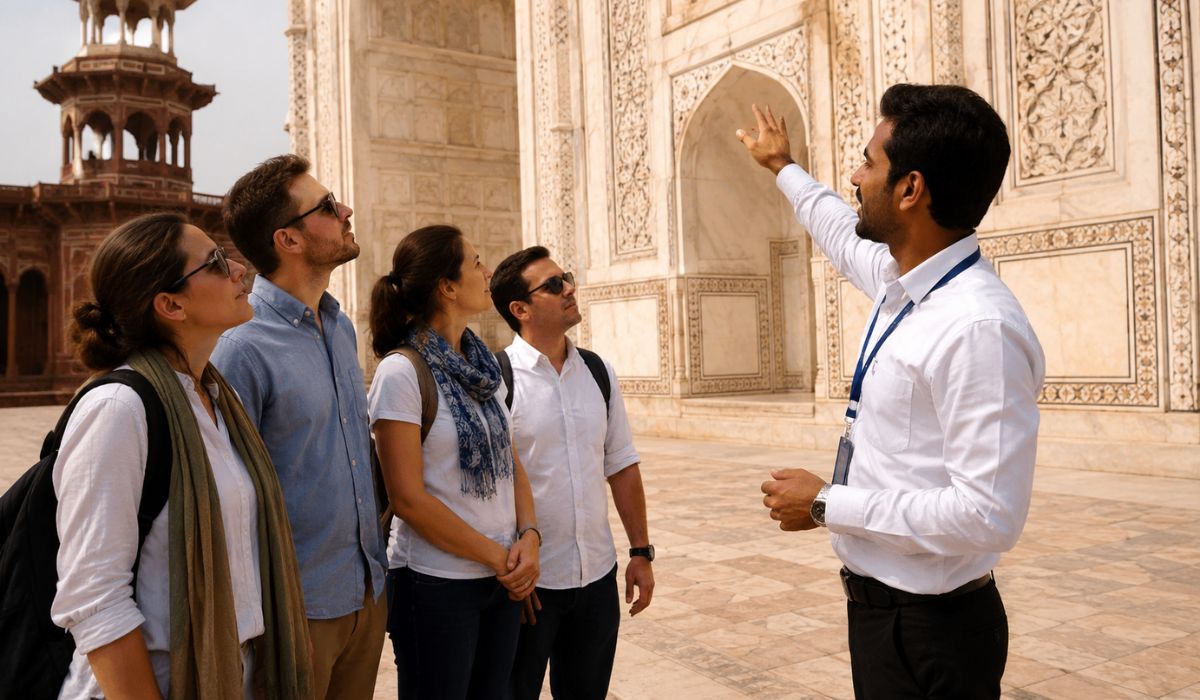
A common misconception is that a guide simply walks alongside you and repeats facts from a brochure. In practice, a good private guide does far more.
They manage the practical logistics — entry lines, ticket categories, security checkpoints — so you’re not the one figuring it out on the spot. They pace the visit around your interests, whether that’s photography, history, architecture, or simply wanting a slower, quieter walk through the grounds.
They also act as a translator of meaning, not just language. Anyone can read that the Taj Mahal was built by Emperor Shah Jahan for his wife Mumtaz Mahal. A guide explains why that story still resonates, how the tomb’s symmetry reflects Islamic paradise gardens, and what specific inscriptions on the walls actually say.
For travelers planning a broader circuit, a well-structured Taj Mahal Sunrise Tour often connects naturally into a wider Golden Triangle itinerary covering Delhi, Agra, and Jaipur, which is worth considering if you have more than a day or two in the region.
Hidden Stories You Would Probably Miss Without a Local Guide
Every monument has an official history and an unofficial one — the stories passed down locally that rarely make it into guidebooks.
A knowledgeable guide might point out the deliberate asymmetry in the four minarets, built to lean slightly outward so that in the event of an earthquake, they would fall away from the main tomb rather than onto it. That’s not a detail most travelers stumble onto by reading a plaque.
Or they might explain why the calligraphy inscribed around the main archway appears to be a uniform size from the ground, even though the letters actually get larger toward the top — an optical illusion built into the design centuries before anyone had the term “forced perspective.”
These aren’t dramatic revelations. They’re small, specific facts that make the building feel less like a tourist attraction and more like a puzzle someone designed on purpose, four hundred years ago.
Architectural Details Most Tourists Never Notice
Most visitors spend their entire visit looking at the Taj Mahal from a distance. Fewer stop to notice what’s happening up close.
The pietra dura inlay work — semi-precious stones set into marble to form floral patterns — took years of specialized craftsmanship, and it changes appearance depending on the angle of light. In early morning sun, the stones (jasper, jade, lapis lazuli, and others) catch light differently than they will by midday.
The four minarets, the reflecting pool, the red sandstone gateway, even the positioning of the mosque and guest house on either side of the main tomb — all of it follows a strict geometric symmetry that’s easy to miss unless someone points out the pattern.
A private guide typically walks you through these layers in order, rather than letting you wander and potentially miss half of what’s actually there.
Best Photography Spots During Sunrise
Photography is one of the main reasons people specifically choose sunrise over any other time slot.
The classic front-facing shot from the reflecting pool is iconic for a reason, but it’s also the most crowded spot within the first thirty minutes of opening. Arriving early and moving quickly to this spot before it fills up makes a real difference.
The Diana bench — made famous by a well-known photograph from the 1990s — is a popular secondary spot, though it draws a line of its own.
Less obvious, but often more rewarding, are the side gardens and the raised marble platform near the mosque, which offer a different angle without the same congestion. A guide familiar with the daily rhythm of the site usually knows which of these spots will be least crowded on any given morning and adjusts the walking route accordingly.
Skip Common Tourist Mistakes
A few mistakes come up again and again with first-time visitors.
The most frequent one is arriving without pre-booked tickets, which leads to unnecessary time lost in queues. Another is not knowing which entry gate to use — the East Gate and West Gate have different wait times depending on the day and season.
Bringing prohibited items (certain electronics, food, tripods beyond a certain size) is another common issue that results in items being confiscated or left at the entrance.
Underestimating the walking distance from the parking or drop-off point to the actual entrance is also common, particularly for families traveling with young children or older relatives.
None of these mistakes are serious, but they do eat into the limited golden window after sunrise — exactly the time you don’t want to lose to logistics.
Cultural Etiquette Every Visitor Should Know
The Taj Mahal is an active mausoleum, not just a historical site, and it’s respectful to treat it accordingly.
Modest clothing is appreciated, particularly for anyone planning to enter the small mosque on the grounds. Loud conversation directly inside the main mausoleum chamber, where the actual tombs are located, is generally discouraged, as is prolonged use of flash photography in that inner space.
Shoe covers are provided (or required) before entering the marble platform, both for hygiene and to protect the stone surface from erosion.
None of this is complicated, but for first-time visitors unfamiliar with the norms, having someone explain it beforehand avoids any awkward moments.
Time-Saving Benefits of Hiring a Private Guide
Time is the one resource sunrise visitors can’t get back. Once the golden light fades and the crowds swell, that particular window is gone until the next morning.
A private guide typically knows which entry gate has shorter lines on a given day, how to move efficiently between sections of the complex, and how to time the visit so you’re not stuck waiting behind a large tour group blocking a doorway or viewpoint.
This matters more than it might sound. On a self-guided visit, it’s easy to spend the first twenty minutes just figuring out where to go, which is exactly the twenty minutes when the light and crowd conditions are best.
Personalized Experience vs Group Tours
Group tours have their place, particularly for larger budgets-conscious groups, but they come with a fixed pace that doesn’t suit everyone.
If you’re a photographer, you likely want more time at certain angles than the group schedule allows. If you’re traveling with elderly parents or young children, you probably need a slower pace with more breaks. If you’re a solo traveler who wants to ask detailed historical questions, a large group setting makes that difficult.
A private tour adjusts to you, rather than the other way around. That flexibility alone is often the deciding factor for travelers who’ve done both group and private tours and can compare the difference directly.
Safety, Comfort, and Local Assistance
Agra, like any major tourist destination, has its share of touts, unofficial “guides,” and minor scams targeting first-time visitors — particularly around ticket counters and souvenir shops near the entrance.
Working with a government-approved guide in Agra removes most of this friction. Official guides carry verified credentials, and their presence alone tends to discourage the more persistent street vendors and unofficial guides who target tourists near the gates.
Beyond that, having someone who speaks the local language and understands the city means faster problem-solving if anything unexpected comes up — a closed gate, a schedule change, or simply needing recommendations for where to get water or use a restroom nearby.
Who Should Consider a Private Sunrise Tour?
A private sunrise tour tends to make the most sense for a few specific types of travelers.
Couples and honeymooners often want a slower, quieter experience without a crowd of strangers nearby. Families traveling with children or older relatives usually need more flexibility around pace and breaks. Photography enthusiasts benefit from a guide who understands lighting and can plan the route around it.
Solo travelers and first-time visitors to India often appreciate having someone to answer questions in real time rather than piecing together information from multiple sources. And luxury travelers, who are prioritizing time and comfort over cost savings, tend to find the arrangement well worth it.
If you fall into any of these categories, booking through a proper Taj Mahal Sunrise Tour with a licensed operator is generally the more comfortable route, rather than trying to coordinate everything independently on arrival.
Frequently Asked Questions
What time does the Taj Mahal open for sunrise visits? Gates typically open around 6:00 AM, though exact timings shift slightly by season. It’s worth confirming the current schedule a day or two before your visit.
Do I need to book tickets in advance for a sunrise visit? Yes. Advance booking is strongly recommended, especially during peak season (October to March), to avoid long queues at the gate.
Is a private guide worth it if I’ve already researched the Taj Mahal online? Online research covers general facts. A private guide adds real-time context, answers spontaneous questions, and adjusts the visit pace to your interests — something static research can’t do.
How long does a typical sunrise tour last? Most sunrise visits last two to three hours, covering the main mausoleum, gardens, and surrounding structures at a comfortable pace.
Which entry gate is best for sunrise visits? It depends on the day and where you’re staying, but the East Gate is often quieter early in the morning. A local guide can confirm the best option on the day of your visit.
What should I wear for a Taj Mahal sunrise visit? Light, modest clothing is recommended. Mornings can be cool, especially in winter, so layering works well.
Can I bring a tripod or professional camera equipment? Large tripods are generally restricted. Handheld cameras and phones are allowed. It’s best to check current rules before arrival, as policies occasionally change.
Is the Taj Mahal closed on any particular day? Yes, the Taj Mahal is closed on Fridays for visitors, as it remains open only for prayer at the mosque within the complex.
How crowded is the Taj Mahal at sunrise compared to later in the day? Sunrise is consistently the quietest period. Crowds build steadily through the morning and peak by mid-to-late morning.
Do government-approved guides charge a fixed rate? Rates are generally set within a standard range, though they can vary based on tour length, group size, and specific inclusions. Confirming details in advance avoids confusion.
Final Thoughts
The Taj Mahal doesn’t need embellishment. It’s already one of the most recognizable buildings on earth. What changes the experience isn’t the monument itself — it’s how much of it you actually understand while standing there.
A private guide doesn’t just narrate facts. They help you notice what you’d otherwise walk past, avoid the small mistakes that eat into your limited morning window, and move through the site at a pace that matches why you came in the first place.
If there’s one piece of practical advice worth taking from this: book your entry early, arrive before the light shifts, and consider bringing along a private guide who knows the site well enough to help you actually experience it, not just see it.
Written by Mohd Imran Khan
Mohd Imran Khan is a travel expert based in Agra, specializing in Taj Mahal tours, Indian heritage travel, and personalized visitor experiences across the Golden Triangle. With years of on-ground experience guiding international travelers through Agra’s monuments, he focuses on helping visitors understand the history and craftsmanship behind the sites they visit, rather than simply checking them off a list.