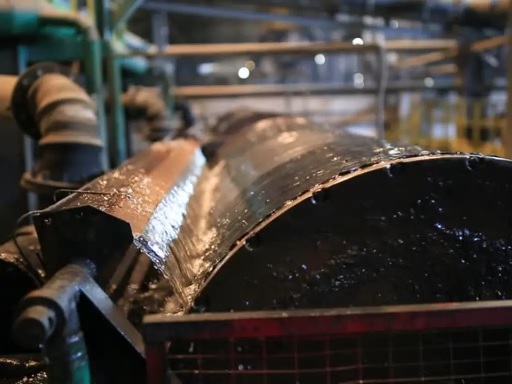
Vibration tables are important industrial machines for concrete precast production. Precast concrete manufacturing involves producing precast concrete components in moulds, but this process requires consistent compaction to achieve the desired shape, surface finish, and structural quality.
In the process, there’s a mould filling stage where air can get trapped within the concrete mix. This trapped air leads to air pockets that create voids in the precast concrete, leading to uneven surfaces and inconsistencies in the finished product.

Vibration tables, also known as compaction tables, generate controlled vibrations that help settle, compact, and densify the precast concrete in moulds. In this article, let’s find out how a vibration table improves density and reduces air voids in this application.
Why Concrete Compaction Matters in Precast Production
Fresh concrete contains a mixture of cement, aggregates, water and, in some applications, admixtures. When the mix is placed into a mould, air gets trapped between particles or around reinforcement and mould surfaces.
Through proper compaction, the concrete settles into the mould and improves contact between the mix and the mould walls. This is important for achieving consistent dimensions, surface quality and concrete properties. Because if there’s insufficient compaction, it can contribute to:
- Surface voids and honeycombing
- Poor surface finish
- Incomplete filling of mould corners
- Uneven density within the component
- Reduced quality and increased rejection rates
How Vibration Tables Work in Concrete Precast Manufacturing
A vibration table consists of a platform that supports concrete-filled moulds. These tables generate vibrations through an unbalanced vibrating motor that produces controlled movement of the platform.
These vibrations are transferred to the mould and the concrete inside it, helping particles rearrange and allowing entrapped air to rise toward the surface and escape. The concrete mix gradually settles into the available space, helping it fill the mould more uniformly.
The vibration cycle depends on several factors, including:
- Concrete mix consistency
- Aggregate size and distribution
- Mould dimensions and shape
- Total mould and concrete weight
- Vibration frequency and amplitude
- Duration of vibration
The correct settings should be established through process testing, because a vibration cycle that works for a small paving block may not be suitable for a large precast component.
How Vibration Tables Improve Concrete Density
Here are some ways a vibratory table improves concrete density:
-
Helping Concrete Settle Uniformly
The first way a vibrating table improves concrete density is by generating vibrations that let the concrete mix move and settle within the mould. This helps reduce gaps between particles and supports more uniform filling, particularly around mould corners and detailed sections.
-
Reducing Entrapped Air
It’s very easy for air to get trapped during mould filling, which will lead to inconsistent finishing across products. That’s where controlled vibrations of vibratory tables help move the particles to remove air pockets. This can improve the appearance and consistency of the finished component, although vibration cannot remove every type of pore or air void in concrete.

-
Supporting Better Surface Finish
Precast concrete manufacturing needs perfect surface finishes in products. If the precast concrete is properly settled in the mould surface, the finished product may have fewer surface imperfections and a more consistent appearance.
-
Improving Repeatability
Vibrating tables help apply similar compaction conditions across different multiple production batches. By maintaining consistent vibration settings, mould filling procedures, and concrete mix properties, this supports repeatable production outcomes.
Applications of Vibration Tables in Precast Concrete Production
There are several precast concrete manufacturing applications where vibration tables are used, such as:
-
Concrete Paver Blocks and Tiles
In this production, vibration helps concrete settle within block and tile moulds, supporting consistent mould filling and surface quality.
-
Precast Concrete Components
For suitable precast components, vibration tables help consolidate concrete inside moulds and reduce the likelihood of trapped air pockets.
-
Concrete Mould Compaction
Vibration tables are also used where the mould itself is placed on a vibrating platform. The table transfers vibration to the mould and the concrete contained within it.
Reliable Vibration Table Solutions from Electro Flux Equipments
Electro Flux Equipments is among the leading providers and manufacturers of industrial machines in India. They provide a wide range of products such as a furnace charger, vibratory equipment, electromagnetic equipment, and machinery spare parts.
They have extensive knowledge about different applications and their requirements; to fulfil these requirements, they provide customisation solutions. They also help the client with technical support, installation support, and after-sales services.
Conclusion
Vibration tables play an important role in concrete precast production by helping concrete settle within moulds, reducing entrapped air and supporting more consistent compaction.
When the vibration cycle of a vibration table is properly matched to the concrete mix and mould design, it improves density uniformity, surface finish and production consistency.
If you are interested in buying one for your application, contact Electro Flux Equipments. They will provide a detailed quotation and meet your specific requirements.