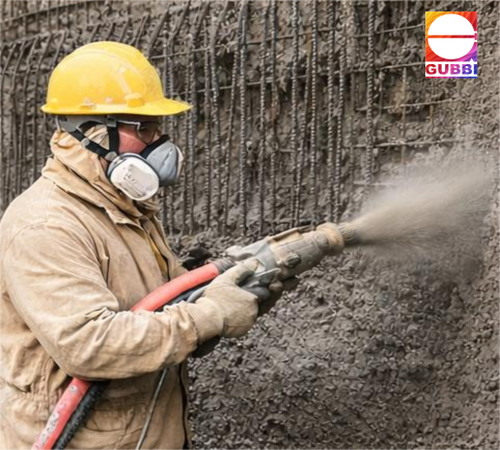
Guniting is a specialised concrete application technique used for repairing, restoring, protecting, and strengthening existing structures. It involves pneumatically projecting a cementitious material onto a prepared surface at high velocity, allowing the material to form a dense layer with strong adhesion. The method is particularly useful where conventional concreting is difficult because of restricted access, vertical surfaces, overhead areas, irregular geometry, or the need for controlled repair thickness.
Why Guniting Is Used for Concrete Repair
Concrete structures can deteriorate because of moisture exposure, reinforcement corrosion, chemical attack, weathering, mechanical damage, poor construction, or long-term service conditions. Simply covering visible damage may not address the underlying problem. Guniting can be considered when deteriorated concrete has been removed and the remaining substrate requires restoration. The sprayed application helps rebuild damaged sections while providing a continuous repair layer over suitably prepared concrete surfaces.

Guniting Services for Existing RCC Structures
Guniting services are commonly considered for deteriorated RCC members where conventional repair methods may be difficult to execute efficiently. Columns, beams, slabs, walls, retaining structures, and other concrete elements can require surface restoration after damage or deterioration. The suitability of guniting depends on structural assessment, substrate condition, reinforcement condition, required thickness, exposure environment, and the engineering repair methodology. Therefore, application should be planned according to actual site requirements.
Guniting and Structural Rehabilitation
Structural rehabilitation is more than repairing visible cracks or damaged concrete. It requires understanding why deterioration occurred and determining how the repaired member should perform after intervention. Guniting can form one part of a broader rehabilitation system when specified appropriately. Depending on the structure, it may be combined with reinforcement treatment, corrosion protection, crack repair, grouting, jacketing, waterproofing, or protective coatings to address different deterioration mechanisms and improve the overall repair strategy.
Where Guniting Work Is Commonly Required
Guniting work can be useful across industrial, commercial, and infrastructure environments where concrete surfaces require rehabilitation or protective treatment. Typical applications may include industrial structures, retaining walls, tunnels, underground structures, water-retaining elements, bridges, culverts, damaged RCC surfaces, and difficult-to-access concrete areas. The exact method depends on the structural condition and project requirements, making an initial technical evaluation important before deciding whether guniting is the appropriate repair solution.
Guniting for Industrial Structures
Industrial facilities often operate continuously, making repair planning particularly important. Concrete deterioration around plants, process areas, utility structures, foundations, walls, platforms, and other components can interfere with operations if repairs are poorly planned. Guniting can be useful where access is restricted or where traditional shuttering and concreting would require extensive preparation. For industrial projects, the repair methodology should consider operating conditions, shutdown windows, safety requirements, surface preparation, material compatibility, curing, and inspection.
Guniting for Infrastructure Rehabilitation
Infrastructure structures are exposed to demanding environmental and service conditions throughout their operational life. Bridges, culverts, retaining structures, tunnels, water-related structures, and other concrete assets may develop surface deterioration, spalling, erosion, or localised damage. Guniting can be incorporated into rehabilitation programmes where the existing substrate can be suitably prepared and the required repair profile can be achieved. Proper assessment helps determine whether sprayed concrete, conventional repair, strengthening, or another technique is more appropriate.
Guniting for Difficult-to-Reach Areas
One important reason contractors consider guniting is its ability to place repair material on surfaces where conventional concrete placement becomes challenging. Vertical and overhead applications can be performed using specialised equipment and trained operators, reducing dependence on extensive formwork in suitable situations. This can be valuable in confined spaces, underground areas, irregular surfaces, and rehabilitation zones where access limitations make traditional construction methods difficult. Site accessibility and safety still need careful planning before execution.
How Guniting Differs from Conventional Concrete Repair
Traditional concrete repair often involves shuttering, mixing, placing, compacting, and finishing concrete manually or mechanically. Guniting changes the placement approach by projecting the material through a hose onto the prepared surface. This can reduce the need for extensive formwork in appropriate applications and allows controlled application over irregular profiles. However, guniting is not automatically a replacement for conventional concreting. The choice should depend on structural requirements, thickness, access, geometry, material specification, and site conditions.
Dry-Mix Guniting Process Explained
In dry-mix guniting, the dry ingredients are conveyed pneumatically through a hose toward the nozzle, where water is introduced immediately before projection. The nozzle operator controls the water addition and spraying process while directing the material onto the prepared substrate. This requires skilled operation because material consistency, nozzle distance, angle, air pressure, and water control influence the quality of the application. Proper equipment setup and operator experience are therefore important for achieving a consistent and well-compacted repair layer.
Surface Preparation Before Guniting
Surface preparation is one of the most important stages of guniting work because the sprayed material must bond effectively with the existing substrate. Loose, weak, contaminated, or deteriorated concrete should be identified and removed according to the repair specification. Dust, laitance, oil, coatings, and other contaminants may also need to be addressed. Where reinforcement is exposed, its condition should be evaluated and appropriate treatment carried out. A properly prepared surface provides a better foundation for subsequent guniting application.
Importance of Mix Design and Material Selection
The performance of a guniting repair depends significantly on selecting materials suitable for the project. Cementitious composition, aggregate grading, water requirements, admixtures, fibres, and other specified components may vary according to application and design requirements. Material selection should consider required strength, exposure conditions, thickness, substrate compatibility, shrinkage characteristics, and service environment. Guniting work contractors should follow the approved specification rather than treating every project with the same material mix or application procedure.
Role of Guniting Equipment
Specialised equipment is essential for controlled guniting application. Depending on the selected method, equipment may include a material delivery system, air compressor, hoses, nozzle assembly, water supply, and related accessories. Equipment capacity should match the project requirements and application conditions. Poorly maintained equipment can affect material flow, water control, pressure, rebound, and application consistency. Experienced guniting contractors therefore pay attention not only to materials but also to equipment calibration, maintenance, setup, and operating conditions.

Guniting Application Technique
The application technique directly influences the quality of the finished repair. The nozzle should generally be operated at an appropriate distance and angle to achieve effective compaction and minimise unnecessary rebound. Application may be completed in controlled passes depending on the required thickness and specification. The operator must maintain consistent movement rather than concentrating material excessively in one location. Skilled application helps create a uniform repair profile and reduces the possibility of voids, weak areas, uneven thickness, or poor bonding.
Curing and Finishing After Guniting
Guniting does not end when the sprayed material reaches the required thickness. Curing and finishing are important parts of the repair process and should follow the project specification and material requirements. Appropriate curing helps control moisture loss and supports the development of the intended material properties. Surface finishing may also be required depending on the final application. The completed area should be inspected for visible defects, thickness consistency, bonding, surface quality, and compliance with the specified repair requirements.
Common Problems That Can Affect Guniting Quality
Several factors can reduce the performance of guniting if they are not properly controlled. Poor surface preparation, incorrect water addition, unsuitable material proportions, inadequate air pressure, improper nozzle technique, excessive rebound, insufficient curing, and inconsistent application thickness can all affect the finished work. Environmental conditions may also influence application and curing. This is why selecting experienced guniting work contractors is important for projects where structural performance, repair quality, and long-term service conditions are significant considerations.
How to Select Guniting Contractors
Choosing guniting contractors should involve more than comparing quotations. Clients should consider the contractor’s experience with similar structures, technical understanding, equipment capability, trained workforce, quality-control practices, safety procedures, and ability to work within project constraints. Previous experience with industrial and infrastructure rehabilitation can be particularly valuable when the site has difficult access or operational restrictions. A suitable contractor should also be able to understand the repair specification and coordinate guniting with related structural rehabilitation activities.
Guniting Contractors for Industrial and Commercial Projects
Industrial and commercial projects may require a different approach from small-scale repair work because of project size, access restrictions, safety requirements, and operational schedules. Guniting contractors working in these environments should understand how repair activities interact with plant operations and other construction teams. Proper planning can help coordinate surface preparation, reinforcement treatment, spraying, curing, inspection, and finishing. For complex rehabilitation projects, contractors should also be capable of following engineering drawings, method statements, specifications, and quality-control procedures.
Cost Considerations for Guniting Work
The cost of guniting work varies according to several factors rather than being determined by a single per-square-foot or per-square-metre rate. Project size, surface condition, required thickness, material specification, access, scaffolding, equipment requirements, reinforcement treatment, surface preparation, curing, location, and working conditions can all influence the overall cost. Comparing only the initial application rate may therefore give an incomplete picture. A proper site assessment can help establish the actual scope and reduce unexpected changes during execution.
When Should Guniting Be Considered?
Guniting should generally be considered when an existing concrete surface requires restoration and the project conditions suit sprayed application. It can be particularly useful for vertical, overhead, irregular, confined, or difficult-to-access areas. However, visible deterioration does not automatically mean guniting is required. The cause of damage, structural significance, substrate condition, reinforcement status, environmental exposure, and required performance should first be evaluated. The selected repair method should address the actual engineering problem rather than only improving the appearance of the concrete.
Guniting as Part of a Complete Repair Strategy
A successful rehabilitation project may require multiple repair techniques rather than one isolated treatment. Guniting can be combined with concrete removal, reinforcement protection, crack injection, grouting, structural strengthening, waterproofing, or protective coatings when these measures are required by the project. The objective should be to restore the required performance of the structure and reduce the possibility of recurring deterioration. A coordinated repair strategy also helps ensure that individual treatments do not conflict with one another during execution.
Why Experienced Guniting Work Contractors Matter
The quality of guniting depends on more than the material being sprayed. Surface preparation, equipment operation, nozzle control, water adjustment, application sequence, thickness, curing, and inspection all influence the final outcome. Experienced guniting work contractors can identify practical site challenges before application begins and organise the work accordingly. For industrial, commercial, and infrastructure rehabilitation, selecting a contractor with appropriate technical experience can help improve execution control and ensure that the repair follows the project’s specified requirements.
Choosing a Guniting Service Provider
When evaluating guniting services, clients should ask practical questions about the proposed repair methodology, material system, surface preparation, equipment, application thickness, curing procedure, inspection process, and project experience. It is also useful to understand whether the contractor can manage related repair activities when required. For projects involving complex structural deterioration, Gubbi Civil Engineers Limited can be considered for technical evaluation and rehabilitation requirements, particularly where guniting forms part of a wider structural repair or strengthening strategy.
Guniting can be a practical technique for concrete repair, rehabilitation, surface restoration, and selected strengthening applications when the structure and site conditions are suitable. Its effectiveness depends on proper assessment, substrate preparation, material selection, equipment control, skilled application, curing, and quality inspection. Instead of selecting a repair method based only on appearance or price, project owners should consider the cause of deterioration and required structural performance. Sprayed Concrete Rehabilitation can provide value when correctly planned and executed for the intended application.