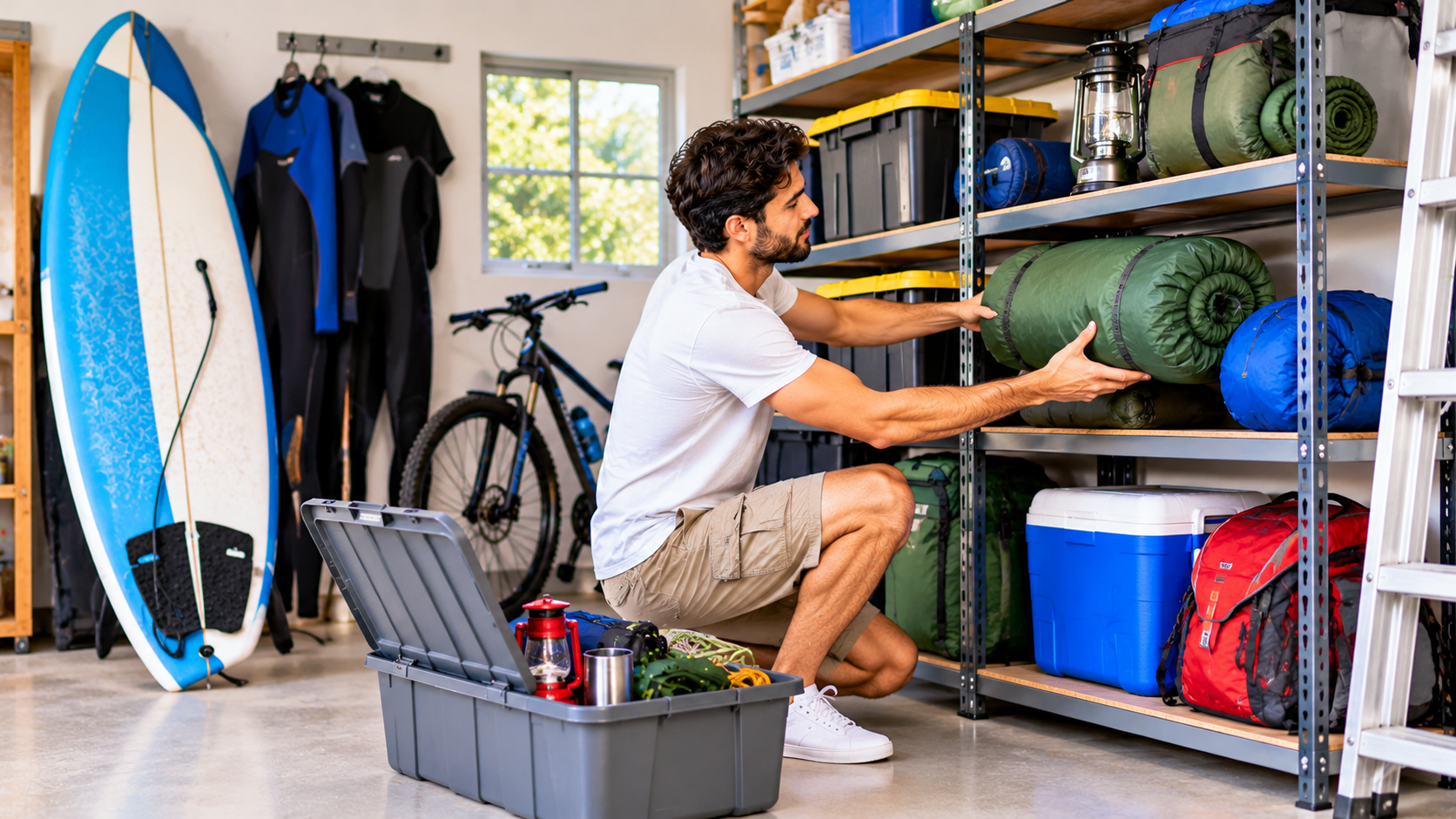
Gear fails in the off-season, not on the trip. The tent that went away damp comes out spotted with mould, the wetsuit that sat folded for months has a permanent crease, and the board left against a hot garage wall has a soft patch under the wax. Most of it is avoidable with an afternoon of prep. And if the garage is already full, it helps to know when storage units Perth sites rent out are worth paying for and when they aren’t.
Work out what you own and when you’ll use it
1. Sort by season
Pull everything out and make piles: summer, winter, year-round and “I’ll get to it”. Camping gear in one corner, surf gear in another, Christmas boxes in a third. It looks worse before it gets better.

You’ll find duplicates. Three head torches, two half-used gas canisters, a pump that fits nothing you own.
2. Cull the broken and the unused
If it’s broken, fix it now or bin it. If you haven’t used it in two seasons and can’t name the next time you will, sell it or give it away. Every item you keep takes up shelf space, and shelf space is the thing you’re short of.
Gear that has reached the end
Zips that split, tent poles that crack, foam that has gone crumbly, neoprene that tears at the seams. Storing it carefully doesn’t bring it back. Put the money towards something that works.
3. Pick the spot before you buy shelves
Walk the garage, the shed and the spare room, and look for the driest, coolest, shadiest corner. That’s where the heat-sensitive gear goes. Measure it, then decide what shelving or racks to buy, not the other way round.
Camping gear
1. Tents and tarps
Dry them completely before packing, even if it means pitching the tent in the backyard for a day. Packing a damp tent is how mould starts, and the smell never fully leaves. Brush off sand and dirt, and shake out the groundsheet.
Store the tent loosely in a breathable bag, not squashed hard into its stuff sack. Tight folding along the same lines for months weakens the coating. Keep poles and pegs in their own bag so they don’t scratch the fabric.
2. Sleeping bags and mats
Don’t store a sleeping bag in its compression sack. Compressed insulation loses loft over time. Use a big cotton or mesh bag, or hang it loosely in a wardrobe. Wash it first if it needs it, and make sure it’s bone dry.
Self-inflating mats should be stored with the valve open and rolled loosely, or flat if you have the space.
3. Stoves, lanterns and gas
Clean the burners and wipe down the stove. Take batteries out of torches and lanterns, because they leak over time. Store them in a labelled bag next to the device.
Gas bottles and fuel
Keep gas canisters and fuel out of the house, upright, and away from heat and ignition sources. Many storage facilities won’t allow them at all, so don’t plan on putting them in a locker or a unit. Check your local rules and the maker’s guidance for safe storage.
Surfing gear
1. Rinse everything first
Salt and sand are the enemies. Rinse boards, wetsuits, leashes, fins, boots and bags in fresh water after every session, and again before long-term storage. Salt left on a wetsuit eats at the neoprene, and salt on a board’s fittings corrodes them.
Dry everything in the shade, not in direct sun, which fades and weakens the materials.
2. Boards
Store boards upright on a padded rack, or flat on a rack with the fin side up, away from walls and heat. Don’t lean them at an angle for months or stack heavy things on top. Use a board bag if the garage gets hot. Take the wax off or at least scrape it, since wax melts and makes a mess in warm weather.
Never leave a board in a parked car. Heat can delaminate a board in a few hours, and you’ll see bubbles in the deck. It’s worth a few dollars for a board sock and a shaded corner.
3. Wetsuits, leashes and fins
Hang a wetsuit on a wide hanger, or drape it over a rail by the middle, not by the shoulders. Thin hangers stretch the neoprene. Don’t fold it for months, because creases become permanent weak spots.
Coil leashes loosely and don’t wrap them around a board, since that kinks the cord. Store fins flat, not leaning, so they don’t warp.
Other seasonal items
1. Christmas decorations
Sturdy plastic tubs with lids beat cardboard, which softens in damp and attracts pests. Wrap breakable baubles in paper, label the lid on the side as well as the top, and pack the lights loosely around a piece of cardboard so they don’t tangle. Take the batteries out of anything that runs on them.

2. Winter and summer clothing
Wash everything before it goes in, because stains set over months. Use breathable bags, not sealed plastic, for wool and leather. Cedar blocks or lavender help against moths, though neither is a guarantee. Rotate the boxes when the seasons change, and check the ones you’re storing for signs of damp.
3. Fans, heaters and garden gear
Clean heaters and fans, wrap the cords and store them in their original boxes if you have them. Drain and dry pool toys, hoses and sprinklers. Empty the fuel from petrol-powered garden gear before storage, and check the manual for the right way to do it.
Protect it all from heat, damp and pests
1. Respect the Perth heat
A garage or shed in a Perth summer can get hotter than the air outside, and heat softens glues, warps plastics and kills batteries. Keep boards, wetsuits, tents and anything with an adhesive away from the roof and the western wall. A bit of shade cloth over a tin shed helps more than people expect.
2. Stop damp before it starts
Keep everything off the floor on pallets, shelves or racks. Concrete can sweat, and winter rain finds low spots. Leave a few centimetres from the wall so air can move, and put silica gel sachets or a moisture absorber tub in closed containers.
3. Keep rodents and insects out
Don’t store food, pet food or anything with a strong smell near your gear. Seal gaps, use lidded tubs and place bait traps near doors. Check a few times a season, because rats and mice chew through tents and sleeping bags with little effort.
Set up the garage or shed
1. Use the walls and ceiling
Heavy duty hooks, wall-mounted racks and ceiling-mounted platforms free up the floor. Anchor anything tall, and check the weight limit before you load it. Bikes, boards and kayaks all hang well, as long as the wall behind them is solid.
2. Label and list everything
Write the contents on the side of each tub, not just the top. Keep a list on the wall or the inside of the door. When you’re rushing to pack for a long weekend, “camping kitchen” is a lot more useful than “misc”.
3. Keep a gear-ready shelf
Put the things you’ll grab most often, such as the stove, the head torches and the sunscreen, on one shelf near the door. It saves twenty minutes of digging on the morning of every trip.
When the garage runs out of room
1. Decide what moves out
Look at what you haven’t touched in three months and what only comes out for one season. Christmas boxes in July, the winter tent in summer, the spare boards. Those can live somewhere else.
2. Choose a locker or a unit
For a few tubs, a tent and a couple of sleeping bags, storage lockers Perth facilities rent are compact and cheaper, and they suit tidy boxes. For boards, kayaks, bikes and a pile of tubs, storage units Perth providers run offer more room. Ask for the internal dimensions, the door width and the ceiling height before you book, because “small” and “medium” mean different things at different sites.
A steel unit with no insulation gets hotter than the air outside, so ask about an internal or climate-controlled unit for boards, wetsuits and tents. For tubs of Christmas decorations, a basic unit is fine.
Insurance and billing
Check your home contents policy to see whether it covers gear in storage, since some policies cap the amount or exclude it. Many facilities won’t insure what’s inside your space unless you buy their cover, so ask what theirs includes. Then ask for the total over your dates, including admin fees, locks and the notice period, and whether the last month is billed in full or pro-rata. Compare storage lockers Perth sites quote on the same size and the same dates.
3. Pack the off-site load
Make sure everything is clean and dry before it goes in. Use lidded tubs, label every side and lift everything off the floor on pallets or planks. Heavy boxes go at the bottom, boards go upright against a wall on padding, and a narrow aisle lets you reach the back. Photograph the loaded space and tape a list inside the door. Is it worth paying for storage for gear you use twice a year? I can’t answer that for you. It depends on how much room the garage frees up and what that room is worth.
Conclusion
Gear lasts when you rinse it, dry it and give it room. Sort by season, cull what’s finished, and store each type the way it likes: tents loose and dry, sleeping bags uncompressed, boards upright and shaded, wetsuits on wide hangers. Watch the heat, the damp and the rodents, and use the walls. When the garage is full, a small locker or a larger unit can hold the overflow, as long as the terms are clear and the space matches the gear. Do it once, properly, and the next trip starts with a quick grab, not a rescue mission.
FAQs
1. How do I store a tent so it doesn’t go mouldy?
Dry it completely, brush off dirt and store it loosely in a breathable bag in a cool, dry place off the floor. Check it once or twice a season.
2. How should I store a surfboard in a garage?
Upright or flat on a padded rack, away from walls and direct heat, with the wax scraped or removed. Use a board bag in hot garages, and never leave it in a parked car.
3. Can I put camping gear in storage lockers Perth facilities rent?
Yes, for tents, sleeping bags, mats and tubs, if everything is clean and dry. Gas bottles and fuel aren’t allowed at most sites, so check the terms and keep them at home.
4. Are storage units Perth providers offer suitable for surfboards?
Usually, if the unit is long enough and shaded or climate-controlled. A steel unit with no insulation gets hot in summer, which can damage boards and wetsuits.
5. What’s the best way to store a wetsuit?
Rinse it in fresh water, dry it in the shade and hang it on a wide hanger or drape it over a rail by the middle. Don’t fold it for months.