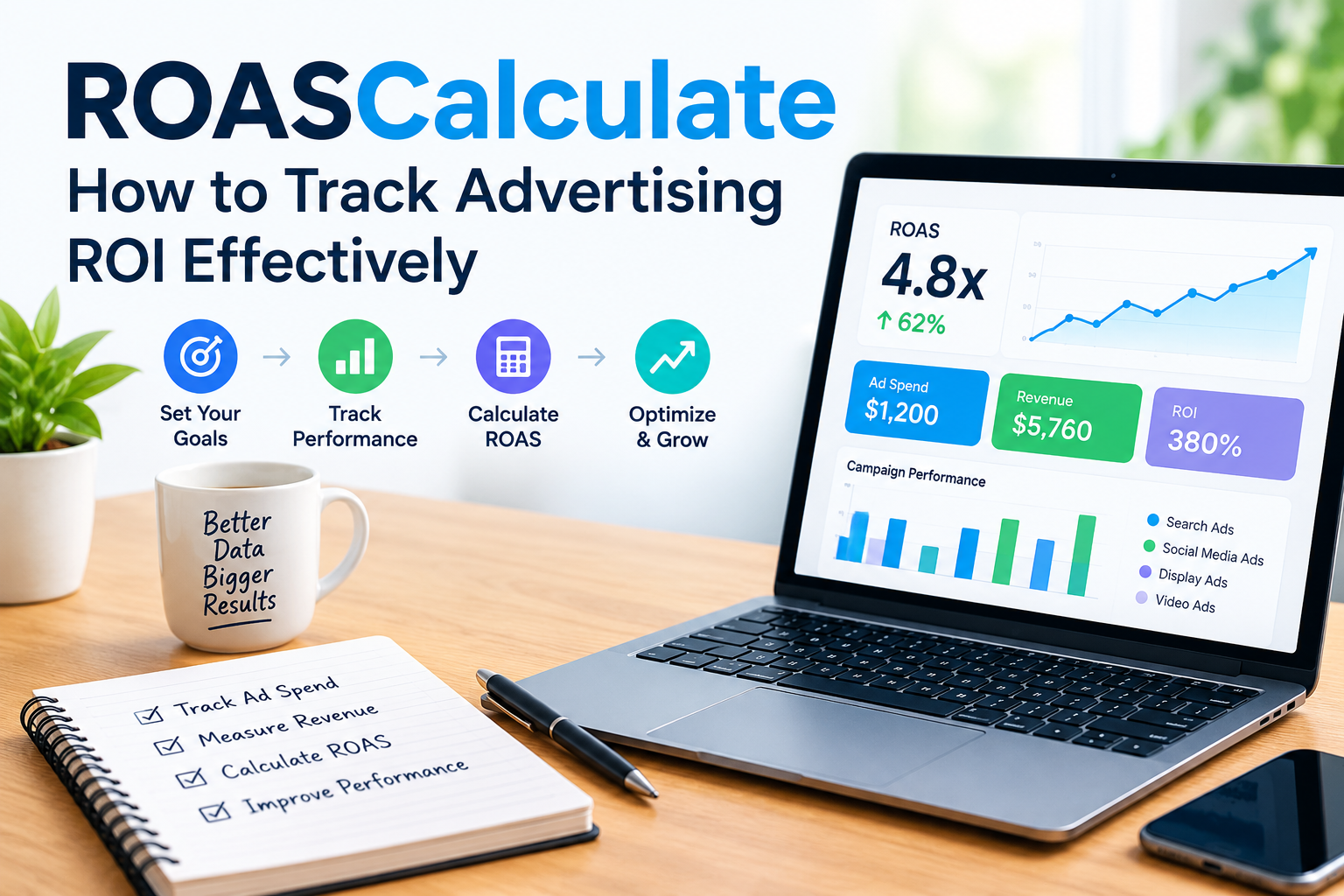
Introduction to Advertising ROI
Advertising can bring new customers, increase sales, and support business growth, but marketers need reliable data to understand whether their spending is producing useful results. Tracking advertising ROI helps businesses connect campaign costs with the revenue generated from those campaigns. Return on Ad Spend (ROAS) is one practical metric for this purpose. It shows how much revenue a business generates for each dollar invested in advertising. With consistent tracking, marketers can compare campaigns, review trends, and make informed budget decisions. RoasCalculate can help marketers understand the numbers behind advertising performance and build a simple process for measuring campaign results.

What Is Advertising ROI?
Advertising ROI refers to the return generated from money invested in promotional activities. While different businesses may calculate ROI in different ways, ROAS is commonly used to measure advertising revenue against advertising expenditure.

For example, if a company spends $1,000 on an online campaign and receives $4,000 in attributed sales, its ROAS is 4:1. This means the campaign generated $4 in revenue for every $1 spent on advertising.
However, ROAS should not be confused with net profit. Advertising revenue still needs to cover product costs, shipping, salaries, software, taxes, and other expenses. Therefore, businesses should consider their complete financial picture when evaluating campaign performance.
Understanding the ROAS Formula
The ROAS formula is simple:
ROAS = Advertising Revenue ÷ Advertising Cost
Consider a campaign that generates $8,000 in attributed revenue from $2,000 in advertising costs.
$8,000 ÷ $2,000 = 4
The campaign therefore has a 4:1 ROAS.
This calculation gives marketers a consistent way to review advertising results. When comparing multiple campaigns, businesses should use consistent revenue definitions and attribution periods. Otherwise, differences in tracking can make campaign comparisons less reliable.
Why Tracking ROAS Matters
Without regular measurement, advertising decisions can become based on assumptions rather than actual performance. Tracking ROAS gives marketers a numerical reference when reviewing campaign results.
ROAS tracking can help businesses:
- Compare advertising campaigns.
- Identify changes in campaign performance.
- Monitor advertising efficiency.
- Review budget allocation.
- Set measurable campaign targets.
- Identify campaigns that need further testing.
For example, an online retailer might run two campaigns with similar budgets. If one produces substantially more attributed revenue, the marketing team can investigate factors such as audience targeting, creative performance, landing-page experience, and conversion rates.
How to Calculate ROAS Step by Step
Learning to calculate ROAS manually is useful even when using automated tools.
Step 1: Identify Advertising Revenue
First, determine the revenue attributed to the advertising campaign. Use a consistent attribution method so that the figure can be compared with other campaigns.
Step 2: Identify Advertising Cost
Record the actual advertising expenditure for the same reporting period. Include the campaign costs that are relevant to the measurement.
Step 3: Apply the Formula
Divide attributed advertising revenue by advertising cost.
For example:
Advertising revenue = $15,000
Advertising cost = $3,000
ROAS = $15,000 ÷ $3,000 = 5:1
This means the campaign generated $5 in attributed revenue for every $1 spent on advertising.
Using a ROAS Calculator
A ROAS calculator can make the calculation faster when marketers regularly review multiple campaigns. Instead of performing the division manually, users can enter advertising revenue and advertising cost to determine the ROAS.
For example, consider these campaign figures:
Campaign A: $5,000 revenue / $1,000 ad spend = 5:1
Campaign B: $7,200 revenue / $2,000 ad spend = 3.6:1
Campaign C: $9,000 revenue / $1,500 ad spend = 6:1

These numbers provide a starting point for comparing campaign efficiency. However, marketers should also review conversion volume, customer value, profit margins, and attribution before making major budget changes.
RoasCalculate can be used as a reference for understanding these calculations and maintaining a consistent approach to advertising measurement.
The Importance of an Ad Spend Calculator
An ad spend calculator can support campaign budgeting by helping marketers understand how much money is being allocated to advertising. Budget planning becomes easier when businesses establish spending limits and measurable revenue targets.
Suppose a business plans to spend $5,000 on advertising and wants to generate $20,000 in attributed revenue. The required ROAS would be:
$20,000 ÷ $5,000 = 4:1
This gives the marketing team a numerical target to monitor. Actual campaign performance may differ, so the target should be reviewed alongside historical results and business economics.
How to Track Advertising ROI Effectively
Effective tracking involves more than calculating one number. Businesses should create a repeatable measurement process.
Track Consistent Metrics
Monitor advertising spend, attributed revenue, conversions, cost per acquisition, conversion rate, and ROAS. Using the same definitions across reporting periods makes trends easier to understand.
Use Reliable Conversion Tracking
Incorrect conversion tracking can distort advertising reports. Make sure purchases, leads, or other valuable actions are recorded correctly and avoid duplicate conversion events.
Review Campaign Performance Regularly
A campaign should not be judged from a single data point. Review performance over an appropriate period based on conversion volume and sales cycles.
Compare Similar Campaigns
Compare campaigns with similar objectives, attribution settings, and time periods. This creates a more useful basis for analysis.
Ways to Improve Advertising ROI
Once performance data is available, marketers can test different approaches to improve results.
Improve Audience Targeting
Review which audience segments produce meaningful conversions. Some groups may generate more sales or higher customer value than others.
Test Ad Creatives
Experiment with different headlines, images, videos, offers, and calls to action. Track the resulting conversions rather than relying only on impressions or clicks.
Optimize Landing Pages
A campaign may generate strong traffic but weak conversions if the landing page is confusing or poorly matched to the advertisement. Clear messaging and simple navigation can support a better user experience.
Monitor Costs
Increasing advertising costs can reduce ROAS if revenue does not increase at the same rate. Monitor cost per click, cost per conversion, and total campaign expenditure.
Common ROAS Tracking Mistakes
One common mistake is assuming that a high ROAS automatically means high profit. Businesses should account for all major costs before evaluating profitability.
Another mistake is mixing different attribution models. A platform may report revenue differently from a website analytics system. Using inconsistent data can create confusing results.
Marketers should also avoid making major decisions from very small datasets. Campaigns with limited conversions can experience large fluctuations, so additional data may be needed before identifying a reliable trend.
Conclusion
Tracking advertising ROI gives businesses a clearer view of how their marketing budgets are performing. The ROAS formula provides a straightforward way to compare attributed revenue with advertising costs, while a ROAS calculator can simplify repeated calculations. An ad spend calculator can also help with budget planning and campaign targets.
The most useful approach combines ROAS with other business metrics, including profit margins, conversion rates, acquisition costs, and customer value. With consistent tracking and regular analysis, RoasCalculate can support a practical process for understanding advertising performance and making data-based campaign decisions.
Frequently Asked Questions
1. What is ROAS?
ROAS stands for Return on Ad Spend. It measures attributed advertising revenue compared with advertising expenditure.
2. How do I calculate ROAS?
Divide attributed advertising revenue by advertising cost. For example, $5,000 revenue divided by $1,000 ad spend produces a 5:1 ROAS.
3. What does a ROAS calculator do?
A ROAS calculator uses advertising revenue and advertising cost to calculate the campaign’s return on ad spend.
4. Is ROAS the same as profit?
No. ROAS measures advertising revenue relative to ad costs. It does not account for all business expenses.
5. Why use an ad spend calculator?
An ad spend calculator can help marketers plan advertising budgets and estimate spending against specific campaign targets.