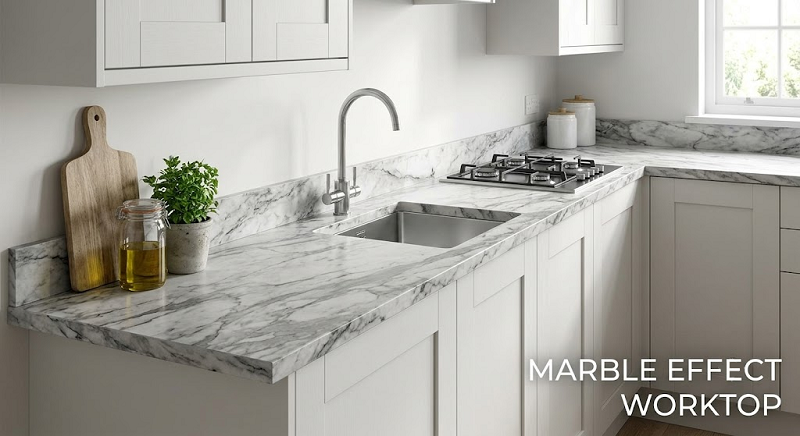
Everyone loves the look of veined marble, but not everyone loves the maintenance that comes with it. That tension is exactly why a marble effect worktop has become one of the fastest-growing categories in UK kitchen design, and why so many homeowners now weigh it directly against real quartzite worktops before deciding.
Two Different Ways to Get a Similar Look
A marble effect worktop is engineered quartz, manufactured to replicate the veining, depth and translucency of natural marble using advanced printing and layering techniques during production. Quartzite worktops, meanwhile, are the real thing; a genuine natural stone that happens to share marble’s pale, veined aesthetic while being chemically and structurally something else entirely, formed from sandstone fused under intense heat and pressure.

The visual comparison has gotten genuinely difficult in recent years. Premium quartz manufacturers have invested heavily in replicating the depth and randomness of real veining, to the point where a well-made marble effect worktop can be hard to distinguish from natural stone at a glance, even for people in the trade.
Where the Differences Actually Show Up
The gap opens once you look past the surface pattern. A marble effect worktop is non-porous by design no sealing, ever, and full resistance to staining from wine, oil or acidic food. Quartzite worktops, despite having very low porosity compared to marble, still benefit from occasional sealing to stay fully protected, typically on an annual basis.
Consistency is the other major difference. Because a marble effect worktop is manufactured, every slab in a given design matches precisely, which matters enormously for larger kitchens or islands where you need multiple pieces to align seamlessly.
Quartzite worktops, being a natural material, carry the same slab-to-slab variation as any quarried stone; genuinely beautiful, but something you need to view and select in person rather than order sight unseen.
Durability
It would be wrong to say quartz has fully caught up. Quartzite sits close to granite on the Mohs hardness scale and tolerates significantly higher heat before showing damage. A marble-effect worktop, like all quartz, still carries resin, and manufacturers generally recommend keeping direct heat below around 150°C. If you’re a serious cook who routinely puts hot pans straight onto the surface, quartzite worktops remain the more forgiving natural choice.
Price
This is usually the deciding factor for UK buyers. A well-specified marble effect worktop typically costs less than genuine quartzite, since quartzite’s rarity and difficult quarrying locations push its price upward. If budget is a real constraint but you don’t want to compromise on the veined aesthetic, marble effect quartz gets you remarkably close to the look for a noticeably lower outlay.
Which is right for your kitchen?
If low maintenance, consistent colour matching across a large kitchen, and a lower price point matter most, a marble effect worktop delivers nearly all of the aesthetic appeal with far less ongoing care. If you specifically want the authenticity of natural stone (the knowledge that your worktop was formed by geology rather than a factory, and you’re willing to invest a little more for genuine heat and scratch performance), quartzite worktops remain the more premium, more resilient choice.
At Koliqi, we stock both marble effect quartz and natural quartzite worktops, and we’ll always show you samples of each side by side under proper kitchen lighting so you can judge the difference for yourself, rather than relying on a photograph or a small chip sample.
Both are genuinely excellent options; it simply comes down to how much authenticity matters to you versus how much maintenance you’re willing to take on.