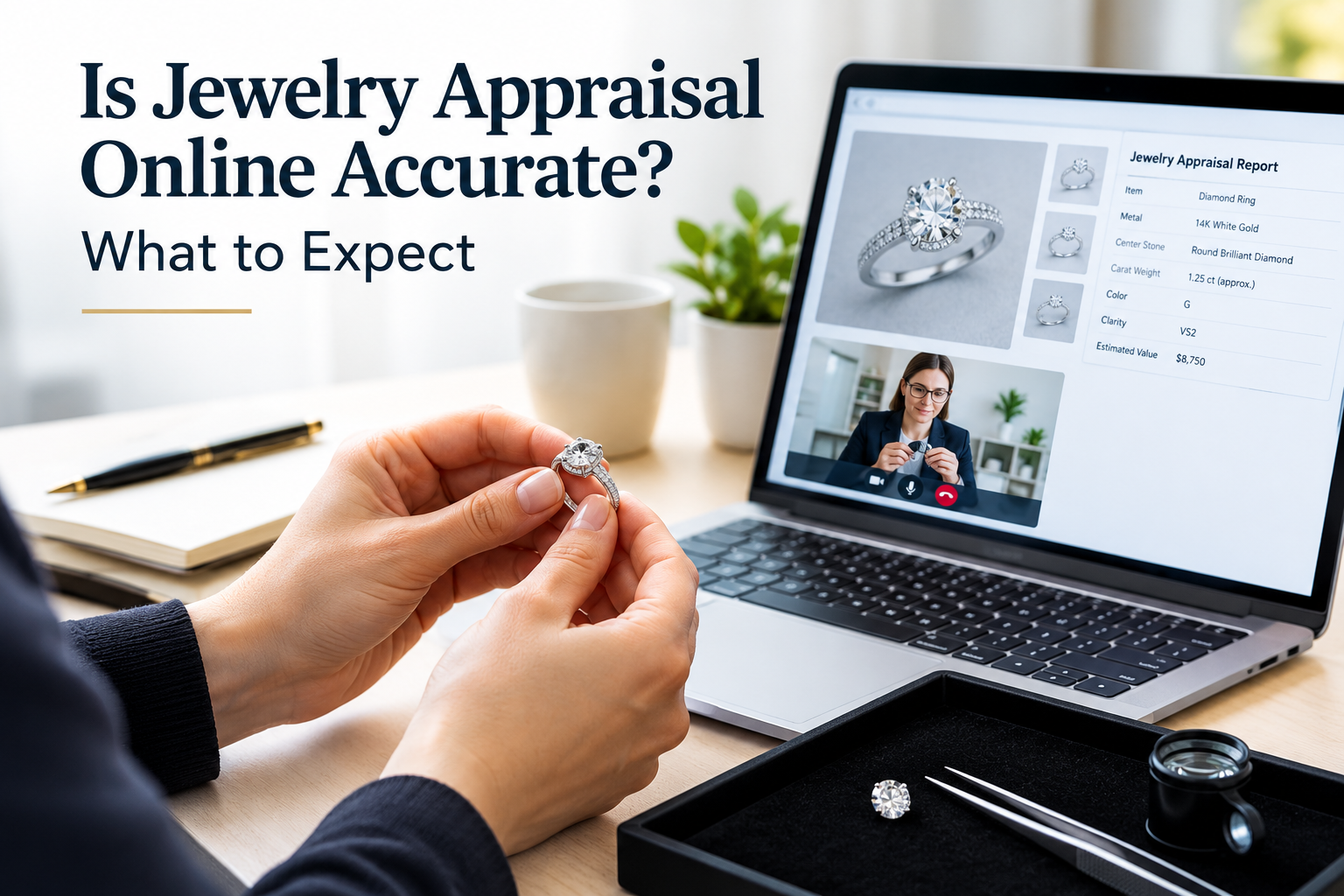
You may have inherited a sapphire ring, or you might simply want to know the current value of your engagement diamond ring before the insurance renewal arrives. Can someone really value it from a photo? Mostly, yes, with conditions. Jewelry appraisal online works well for common pieces, solid documentation, and insurance replacement values, but it can’t match a bench exam for rare stones or worn antiques.

Accuracy comes down to three things:

- The quality of your photos and paperwork
- The appraiser’s credentials
- Whether the piece needs physical testing
Here’s how the process works, where it’s reliable, and where it isn’t.
How Does an Online Jewelry Appraisal Work?
An online jewelry appraisal is a valuation completed remotely, using your photos, measurements, and documents instead of an in-person visit. A credentialed appraiser reviews the evidence, identifies the materials, and issues a written report stating a value for a specific purpose, usually insurance.
Depending on the provider, you either upload images or ship the piece itself. The second route is a hybrid, and it’s worth asking about because it changes what the appraiser can verify.
What you send
Expect to supply clear photos from several angles, close- ups of hallmarks like “14K” or “925,” and any grading report, receipt, or box. Dimensions matter too. A millimeter ruler next to the stone does more good than a fancy camera. The most common mistake is sending one blurry, flash-glared shot of a ring on a hand. Photograph it flat, on a plain background, in daylight, and include the inside of the band.
What the appraiser does
The appraiser identifies the metal, estimates stone size and quality, and researches comparable items at current retail prices. For insurance, the target is replacement value, meaning what it would cost to buy a similar piece new in your market.
What you receive
You get a written report with a description, photos, and a stated value. Online services commonly start around $85 to $110 per item, with turn round ranging from one business day to about five, depending on how fast you need it. Compare that with a typical in-person route like jewelry appraisal in NYC, where you’ll often be booking a slot and traveling with the piece.
What Is the Level of Accuracy for a Remote Appraisal?
A remote appraisal is accurate when the evidence is strong and the piece is straightforward. It’s less reliable for gemstones that need instruments to identify, treatments, or unusual antiques. Jewelry appraisal online is a solid fit for documented diamond jewelry and standard gold pieces and a weaker fit for mystery stones.
Where remote work holds up
Metal purity is often indicated by the hallmarks. A diamond with a Gemological Institute of America (GIA) report is easier still, because the report number can be matched to the stone, and many GIA-graded diamonds carry a laser inscription on the girdle. When that paperwork is available, a remote review has minimal uncertainty; a remote review has little to guess at.
Where it falls short
A photo cannot settle some things. Telling a natural diamond from a lab grown one requires specialized testing equipment. So does detecting fracture filling or heat treatment in colored stones. Loose prongs, hidden repairs, and worn shanks also show up under magnification and in the hand.
When Should You Choose an In-Person Appraisal Instead?
Choose in-person when the piece is rare, high-value, antique, or undocumented, or when a lender, court, or the IRS requires a hands-on exam. For routine insurance updates on documented pieces, a remote review usually does the job and saves time.
Pieces that need a bench exam
Unmarked or unusual gemstones, antique settings with possible repairs, and anything with a suspected treatment belong on a bench with a loupe, a microscope, and testing instruments. Large center stones fall in this bucket too.
In New York, that often means a visit for jewelry appraisal in NYC, and the city has a built-in advantage: the Diamond District on West 47th Street, between Fifth and Sixth Avenues, concentrates dealers and gemologists in a single block. The tradeoff is time, travel, and carrying valuables through the city.
Watches are their category.
Luxury watches have a few traps that photos can’t fully settle: replacement parts, refinished dials, swapped bracelets, and movements that don’t match the case. A watch valuer will want the reference number, the serial number, and ideally the box and papers. Remote review works when all of that is documented and clear.

Even then, there’s a distinction people miss. A valuation estimates worth and, an authentication confirms the watch is genuine. A watch valuer may conduct one without the other, so please verify the details in the report.
The law’s or lender’s decision is made as needed.
The Internal Revenue Service generally requires a qualified appraisal for noncash charitable donations above $5,000 (see the Form 8283 instructions). Estate filings and court matters carry their own rules. If any of those apply, please verify the required format before proceeding with any payments.
How Can You Tell a Trustworthy Appraisal from a Weak One?
A trustworthy appraisal comes from a credentialed appraiser, states its purpose and value type, describes the item in detail, and charges a flat fee. A weak one gives a bare number, skips key details, or charges a percentage of the value it declares.
Credentials and structure matter more than whether the work happens online or face-to-face. That’s the point most buyers miss.
Red flags
Percentage-of-value fees create a conflict of interest, because the appraiser profits from a higher number. Vague wording is another. “Large diamond, good color” tells an insurer almost nothing.
Be wary, too, of anyone who offers to buy the piece after appraising it. Not every such offer is dishonest, but it blurs the line between valuing and selling.
Ask whether a watch valuer is involved for timepieces. Watches and jewelry need different expertise, and one generalist rarely covers both well.
Frequently Asked Questions
-
Is an online appraisal accepted by insurance companies?
Usually, yes, when it comes from a credentialed appraiser and includes a detailed description, photos, and a replacement value. Policies differ, though. Ask your insurer which documentation it requires before you order, particularly for scheduled items on a personal articles policy.
-
How often should I update a jewelry appraisal?
Every two to three years is a common guideline, and sooner after big swings in gold or diamond prices. Insurers pay against what’s documented, so an old appraisal can leave you underinsured. Finding that out after a loss, when the replacement cost has climbed well past the paper value, is a painful way to learn it.
-
Can I use an appraisal to sell my jewelry?
An appraisal is an opinion of value, not an offer to buy. Buyers and dealers typically pay less than replacement value because they need room to resell at a profit. Fair market value, the price between a willing buyer and seller, usually sits well below the insurance figure. Treat the appraised number as a reference point, not an expected sale price.
-
How should I choose between remote and local options?
Match the route to the risk. Documented, mid-value pieces suit a remote review. High-value, undocumented, or antique pieces deserve hands-on examination, and a local search for jewelry appraisal in NYC is a sensible starting point if you’re in the city. If you’re unsure, consult the appraiser directly for their recommended approach for your piece.
Summing up
To sum up, jewelry appraisal online is accurate enough for many everyday needs, particularly insurance updates on documented pieces, but it’s not a universal substitute for physical examination. The strongest reports share the same traits: a credentialed appraiser, a clearly stated purpose, a detailed description, and a flat fee.
Use remote review when paperwork is solid and the stakes are moderate. Go in person when stones are unidentified, pieces are old or very valuable, or an agency requires it. And for timepieces, ensure the report states whether it’s a valuation or an authentication.