According to IMARC Group’s report titled “India Wealth Management Market Size, Share, Trends and Forecast by Business Model, Provider, End User, and Region, 2026-2034“, the report offers a comprehensive analysis of the industry, including wealth management market share in India, its growth, trends, and regional insights.
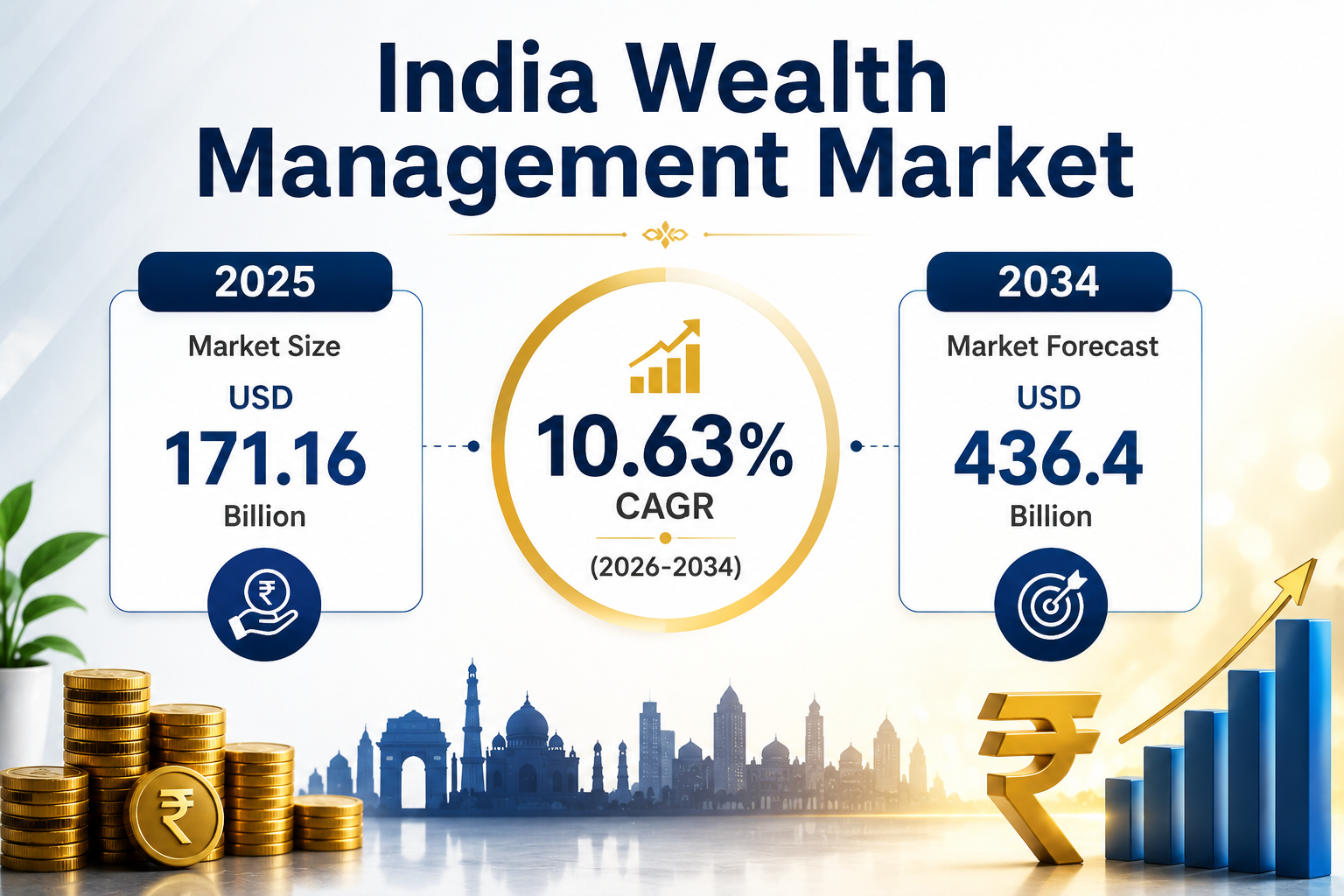
The India wealth management market size was valued at USD 171.16 Billion in 2025 and is projected to reach USD 436.4 Billion by 2034, growing at a compound annual growth rate of 10.63% from 2026-2034. India’s wealth management ecosystem is undergoing a fundamental structural shift — from a market dominated by physical asset preferences and informal financial advice to a sophisticated, technology-enabled industry shaped by rising affluence, growing financialization of household savings, and increasing demand for personalized advisory services. This market is not speculative; it is being driven by hard demographic realities, a rapidly expanding high net worth population, and the deepening penetration of digital platforms that are reshaping how wealth is managed, preserved, and grown across the country.
Market Key Statistics:
- Current Market Size (2025): USD 171.16 Billion
- Projected Market Size (2034): USD 436.4 Billion
- CAGR: 10.63%
- Forecast Period: 2026-2034
- Human advisory holds the largest business model share at 46.2% in 2025, driven by the enduring preference among affluent investors for personalized, relationship-driven financial guidance and tailored wealth planning services.
- Banks lead the provider segment with a 41.7% share, leveraging extensive branch networks, established customer trust, and integrated financial service ecosystems to maintain the leading position.
- High Net Worth Individuals (HNIs) dominate the end user segment with a 62.8% share, reflecting the growing population of affluent investors seeking sophisticated portfolio management, estate planning, and global diversification strategies.
- West India leads the regional market with a 32.9% share, supported by the concentration of financial institutions, corporate headquarters, and a high density of wealthy individuals in the region.
India Wealth Management Market Trends & Future Outlook
- Rising Adoption of Digital and Hybrid Advisory Models: The wealth management industry is witnessing a significant shift toward digital platforms and hybrid advisory models that combine technology-driven insights with personalized human guidance. In 2025, approximately 70% of wealth management firms in India adopted AI-driven advisory or robo-advisory tools, enabling real-time insights and personalized portfolio suggestions for clients. This digital transformation is enabling wealth managers to deliver scalable, cost-effective advisory services while maintaining the personalized touch that affluent clients expect.
- Growing Interest in Alternative and ESG-Focused Investments: Investors are increasingly diversifying portfolios beyond traditional asset classes, showing heightened interest in alternative investments such as private equity, venture capital, real estate investment trusts, and structured products. In June 2025, investments in Alternative Investment Funds (AIFs) by India’s high-net-worth individuals rose sharply to ₹5.38 trillion, up 32% year-on-year, reflecting growing demand for diversified, non-traditional strategies. ESG factors are simultaneously becoming integral to investment decision-making, with wealth managers incorporating sustainable investment frameworks to meet evolving client expectations.
- Expansion of Wealth Services to Emerging Cities and Younger Demographics: Wealth creation is no longer confined to major metropolitan centers, with tier-two and tier-three cities emerging as significant growth corridors. In September 2025, the Mercedes-Benz Hurun India Wealth Report highlighted that seven Tier-II cities now rank among India’s top 10 millionaire makers, reflecting rapid wealth expansion beyond metros. A younger generation of first-generation entrepreneurs, startup founders, and salaried professionals with equity-linked compensation are entering the wealth management ecosystem, compelling providers to develop tailored offerings and digitally enabled engagement models.
- Accelerating Shift from Physical Assets to Financial Instruments: Indian investors are undergoing a fundamental transition in their asset allocation preferences, moving away from traditional physical assets such as gold and real estate toward market-linked financial instruments including equities, mutual funds, alternative investment funds, and structured products. In December 2025, PhonePe Wealth launched a Daily SIP feature allowing users to invest as little as ₹10 per day in mutual funds, making disciplined market-linked investing accessible for micro and new investors. This behavioral shift is being driven by improved financial awareness and government-led financial inclusion initiatives.
- Rapid Growth in India’s High Net Worth Population: India is witnessing an unprecedented expansion in its affluent population, driven by sustained economic growth and a thriving entrepreneurial ecosystem. In September 2025, India’s millionaire households reached 8.71 lakh, up nearly 90% since 2021, reflecting broad-based wealth creation across states such as Maharashtra, Delhi, and Tamil Nadu. As disposable incomes rise, individuals are increasingly seeking professional guidance to manage, preserve, and grow their accumulated assets through diversified investment strategies.
Evaluate Market Opportunity with the Business Sample Report
India Wealth Management Market Growth Drivers
- Rapid Growth in India’s High Net Worth Population and Wealth Accumulation: India’s strong macroeconomic fundamentals, including rising GDP, expanding foreign direct investment, and a vibrant startup landscape, are accelerating wealth creation across multiple sectors and geographies. In November 2025, India’s alternative investment ecosystem including Portfolio Management Services (PMS) and Alternative Investment Funds (AIFs) collectively surpassed ₹23.43 lakh crore in assets under management, underscoring affluent investors’ accelerating shift toward diversified, structured investment products.
- Accelerating Shift from Physical Assets to Financial Instruments: The transition away from traditional physical assets toward market-linked financial instruments is reshaping portfolio compositions across India. Improved financial awareness, attractive capital market returns, ease of digital investment platforms, and government-led initiatives promoting financial inclusion and education are collectively driving this behavioral transformation, significantly expanding the addressable market for professional wealth management services.
- Digital Transformation and Technological Innovation in Advisory Services: The integration of AI, machine learning, data analytics, and automation is enabling wealth managers to offer hyper-personalized investment recommendations, real-time portfolio monitoring, and predictive insights at scale. In November 2025, Bengaluru-based wealth-tech startup Wealthy raised ₹130 crore in funding to enhance its AI-powered advisory and distributor tools, signalling strong investor confidence in technology-enabled wealth solutions that are lowering barriers to entry and improving operational efficiency.
- Expanding Wealth Creation in Tier-II and Tier-III Cities: The geographic diversification of wealth creation beyond traditional metropolitan hubs is creating significant opportunities for wealth management providers to penetrate underserved markets. Seven Tier-II cities now rank among India’s top millionaire-making cities, reflecting a structural broadening of the affluent investor base that is compelling providers to deploy technology-driven engagement models and expand advisory talent across emerging commercial centers.
Key Market Challenges
- Talent Shortage and Rising Advisory Workforce Costs: The rapid expansion of wealth management demand has significantly outpaced the supply of qualified relationship managers and experienced financial advisors. The scarcity of skilled professionals is intensifying hiring competition, driving up compensation packages, sign-on bonuses, and retention costs. This talent constraint limits the ability of wealth management firms to scale operations effectively, maintain service quality, and penetrate emerging markets.
- Evolving Regulatory Complexity and Compliance Burden: The wealth management industry operates within an increasingly complex regulatory framework, with frequent updates to investment advisory guidelines, disclosure requirements, digital accessibility standards, and anti-money laundering protocols. While regulatory oversight strengthens investor protection, the cumulative compliance burden raises operational costs and can create barriers for smaller advisory firms, potentially limiting market participation and service innovation.
- Low Financial Literacy and Trust Deficit Among Potential Investors: Despite improving financial awareness, a substantial portion of India’s affluent and emerging affluent population continues to rely on informal financial advice or self-directed investment approaches. Deep-rooted preferences for traditional savings instruments, limited understanding of sophisticated financial products, and skepticism toward advisory fees create reluctance in adopting professional wealth management services, requiring sustained investor education efforts to overcome.
Market Segmentation Breakdown
Business Model Insights:
- Human Advisory
- Robo Advisory
- Hybrid Advisory
The human advisory dominates with a market share of 46.2% of the total India wealth management market in 2025.
Provider Insights:
- FinTech Advisors
- Banks
- Traditional Wealth Managers
- Others
Banks led with a share of 41.7% of the total India wealth management market in 2025.
End User Insights:
- Retail
- High Net Worth Individuals (HNIs)
High net worth individuals (HNIs) dominate with a market share of 62.8% of the total India wealth management market in 2025.
Regional Insights:
- North India
- South India
- East India
- West India
West India exhibits a clear dominance with a 32.9% share of the total India wealth management market in 2025.
Competitive Landscape – By IMARC GROUP
Gain comprehensive access to an in-depth analysis of the competitive landscape, including market structure, key player positioning, competitive dashboards, winning strategies, and detailed profiles of all major industry participants within the full research report.
Recent Developments & News
- In February 2026, InvestValue Fintech launched its ‘India Winners’ multi-cap PMS under InvestValue Capital, targeting Rs500 crore AUM in the first year. The platform serves over 15,000 clients, with strong metro and Tier-2 city presence, leveraging digital tools and a partner ecosystem to expand India’s wealth management offerings.
- In December 2025, Axis Bank announced plans to hire 50 senior private bankers and expand its Burgundy Private division across 52 cities, strengthening its advisory desks and private banking offerings to meet growing affluent client demand across India’s expanding wealth management landscape.
- In November 2025, India’s alternative investment ecosystem including Portfolio Management Services (PMS) and Alternative Investment Funds (AIFs) collectively surpassed ₹23.43 lakh crore in assets under management, underscoring the accelerating shift among affluent investors toward diversified, structured investment products beyond traditional asset classes.
Request Customized Data Tailored to Your Interest
Note: If you need specific information that is not currently within the scope of the report, we can provide it to you as a part of the customization.
Key Highlights of the Report
- Comprehensive market size, share, trend, and forecast analysis up to 2034
- In-depth segments by business model, provider, end user, and geography
- Insight into regulatory reforms, policy incentives, and market catalysts
- Evaluation of competitive dynamics and recent industry developments
- Identification of growth drivers, challenges, and investment trends
- Actionable intelligence for wealth managers, financial institutions, and investors
Frequently Asked Questions
Q1. How big is the India wealth management market?
➤ The India wealth management market size was valued at USD 171.16 Billion in 2025, making it one of the largest and fastest-growing wealth management segments in the Asia-Pacific region with significant scale potential over the decade ahead.
Q2. What is the projected growth rate?
➤ The market is expected to grow at a CAGR of 10.63% from 2026 to 2034, reaching USD 436.4 Billion by 2034 — driven primarily by rapid HNI population growth, accelerating financialization of savings, and expanding digital advisory adoption across the country.
Q3. Which business model holds the largest market share?
➤ Human advisory leads with a 46.2% share in 2025, driven by the enduring preference of affluent investors for personalized, relationship-driven financial guidance and the ability of human advisors to deliver tailored strategies addressing complex wealth planning needs.
Strategic Insight & Verdict
The India wealth management market is at a compelling growth inflection point — the HNI population is expanding at an unprecedented pace, digital advisory platforms are democratizing access to professional wealth services, and geographic wealth creation is broadening well beyond traditional metropolitan hubs. The convergence of a 10.63% CAGR growth trajectory, India’s millionaire household count rising nearly 90% since 2021, AIFs crossing ₹23.43 lakh crore in AUM, and major banks aggressively scaling their private banking divisions positions this market as a high-conviction opportunity for wealth managers, fintech platforms, and financial institutions over the 2026–2034 forecast period.
Verified Source: IMARC Group