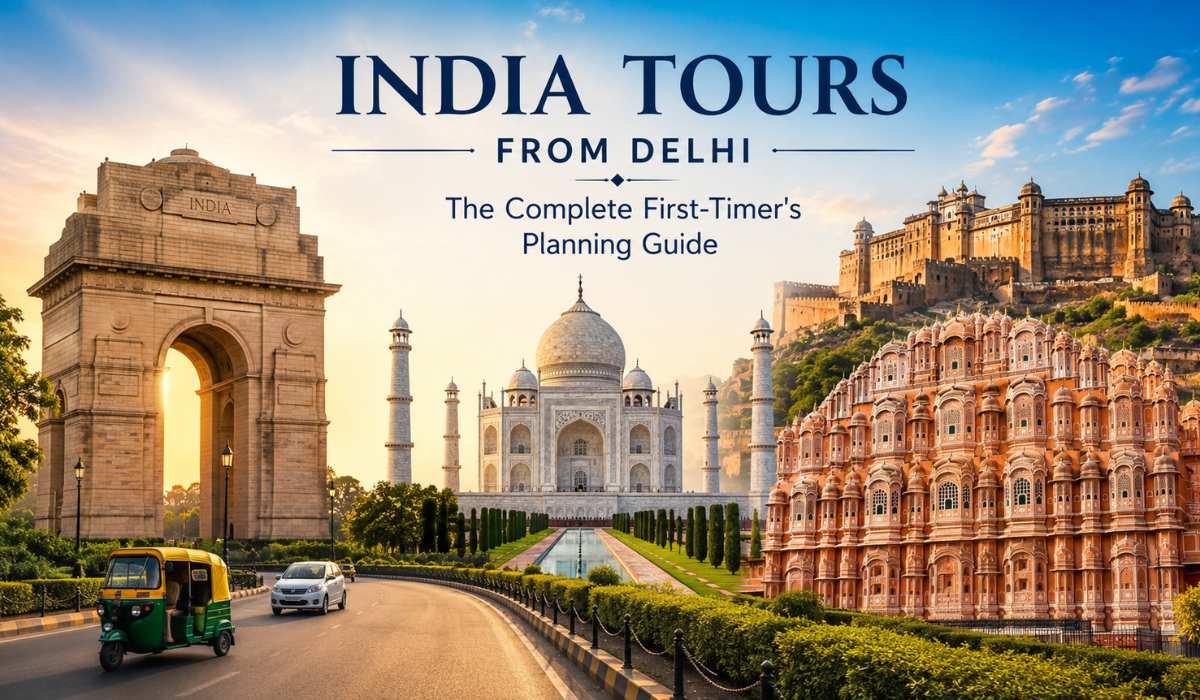
Delhi is where most international visitors to India begin their journey.

It makes sense. The city has more UNESCO World Heritage Sites than any other capital in Asia. It sits at the geographic center of North India’s most visited circuit. And as India’s main international aviation hub, it connects to every major destination in the country within an hour by air.

But Delhi is also where most first-time visitors make their first planning mistake — treating it as just a stopover rather than the logical starting point for a structured India trip.
This guide covers how to plan an India tour from Delhi — what the main routes look like, how long each takes, what you will actually see, and how to decide which circuit fits your time and interests.
Why Start Your India Tour From Delhi
Three reasons make Delhi the strongest starting point for any India itinerary.
Geography: Delhi sits at the center of North India’s most visited destinations. Agra is 230 km south. Jaipur is 280 km southwest. Amritsar is 450 km north. Rajasthan’s major cities fan out to the west. From a single base, you can reach all of them by road or short flight.
Connectivity: Indira Gandhi International Airport handles direct flights from most major cities in Europe, the US, Southeast Asia, and the Middle East. Arriving directly in Delhi eliminates a domestic connection, which reduces both cost and travel time.
History: Delhi itself rewards 2-3 full days of exploration before you leave the city. The Qutub Minar, Humayun’s Tomb, Red Fort, Jama Masjid, and India Gate are all here — and together they cover nearly 1,000 years of Delhi’s history as a capital city.
The Main India Tour Routes from Delhi
1. Golden Triangle — Delhi, Agra, Jaipur (5-6 Days)
India’s most popular tourist circuit — and with good reason.
The route connects three cities that together cover the most significant examples of Mughal and Rajput heritage in North India. Delhi for its layered imperial history. Agra for the Taj Mahal and Agra Fort. Jaipur — the Pink City — for Amber Fort, City Palace, and the best bazaars in Rajasthan.
CIRCUIT DISTANCE:
Delhi → Agra:     230 km / 3.5 hours
Agra → Jaipur:   240 km / 4 hours
Jaipur → Delhi:  280 km / 5 hours
What you see:
In Delhi — Red Fort, Jama Masjid, Chandni Chowk, Qutub Minar, Humayun’s Tomb, India Gate. Two days minimum.
In Agra — Taj Mahal (arrive at gate opening — the difference between 6:30 AM and 9:30 AM is the difference between a remarkable experience and an overwhelming crowd), Agra Fort, Mehtab Bagh across the river for the best external view of the Taj Mahal.
In Jaipur — Amber Fort (the main attraction, allow 2-3 hours), City Palace, Hawa Mahal, Jantar Mantar, and Johari Bazaar for jewelry and textiles.
How long: Five days is doable but leaves you feeling rushed on the final day. Six days gives you overnight in Agra, which changes the Taj Mahal experience entirely — you can visit at sunrise, see Mehtab Bagh at sunset, and travel to Jaipur without combining an exhausting drive with a full morning of sightseeing.
Private tour operators like Emperor Holidays offer private Golden Triangle tours from Delhi starting at $140 per person for the 5-day itinerary, with a licensed guide and private AC car throughout.
2. Golden Triangle with Ranthambore (8 Days)
The Golden Triangle route with a wildlife extension between Jaipur and the circuit return to Delhi.
Ranthambore National Park in Rajasthan has one of the best tiger sighting records in India. The park sits on the old hunting grounds of the Jaipur royal family — which means the tigers here are accustomed to vehicles and show themselves more readily than in some other reserves.
EXTENSION:
Jaipur → Ranthambore: 180 km / 3 hours
Best season: October to June
              (park closes July-September)
Tiger sighting probability:
High October-April,
lower May-June
This extension works particularly well for travelers who want cultural history and wildlife in a single trip — which describes most first-time India visitors. The contrast between the Mughal monuments and an early morning safari is exactly the kind of variety that makes India trips memorable.
3. Golden Triangle with Amritsar (8 Days)
The GT circuit extended north to include Amritsar — the spiritual center of Sikhism and home to the Golden Temple.
Amritsar adds something the standard GT entirely lacks: Punjabi culture, Sikh history, and the Wagah Border ceremony at the India-Pakistan border where soldiers from both countries perform a synchronized flag-lowering every evening.
The Golden Temple — Harmandir Sahib — feeds approximately 100,000 people every single day in its langar (community kitchen), completely free, regardless of religion, caste, or nationality. Walking in and sitting down for a meal is one of the most unexpectedly moving experiences available to any traveler in India.
A five-minute walk from the Golden Temple is Jallianwala Bagh — the memorial site of the 1919 Amritsar massacre where British soldiers fired on an unarmed crowd. The bullet holes are still in the walls.
Adding Amritsar to the GT extends the trip by two to three days. For India tours from Delhi that include this extension, the 8-day circuit covers the full range from Mughal monuments to Sikh heritage to colonial history.
4. Golden Triangle with Rajasthan (10-12 Days)
Extending the Jaipur leg into deeper Rajasthan — Jodhpur, Udaipur, and optionally Jaisalmer.
Each Rajasthan city has a distinct personality:
Jodhpur — the Blue City: Mehrangarh Fort dominates the skyline from a 125-meter cliff. The old city below it is painted blue — a color traditionally associated with the Brahmin caste, though the practice spread across the city over centuries. The fort museum is the best in Rajasthan.

Udaipur — the City of Lakes: Lake Pichola reflects the City Palace, which is the largest palace complex in Rajasthan. Udaipur is the most romantic city on the circuit and draws a disproportionate number of honeymooners — the evening boat ride on the lake is worth the cliché.
Jaisalmer — the Golden City: On the edge of the Thar Desert, 575 km from Jaipur. The fort here is still inhabited — one of the few living forts in India — and the desert camp experience at the Sam Sand Dunes is the most distinctive overnight option in all of Rajasthan.
The Rajasthan extension adds a minimum of 4-5 days to the GT circuit, making a 10-12 day itinerary the standard for this route.
5. Kerala from Delhi (7-9 Days)
A flight from Delhi opens up an entirely different India — tropical, coastal, and culturally distinct from the Mughal North.
Kerala in South India offers the backwater houseboats of Alleppey, the tea plantations of Munnar, the wildlife of Thekkady, and the beaches of Kovalam. The food changes entirely — rice, coconut, fish curry, and the distinct spice combinations of South Indian cooking.
DELHI → KERALA:
Flight Delhi to Cochin: ~2.5 hours
Multiple daily flights
Best time: October to March
           (avoids monsoon)
Kerala works well as an add-on to the Golden Triangle for travelers with 10-12 days — fly to Kerala after Jaipur rather than returning to Delhi, cover the South, and fly back to Delhi for the international connection.
6. Goa from Delhi (5-7 Days)
India’s smallest state and its most visited beach destination — accessible by a 2-hour flight from Delhi.
Goa splits into two distinct areas that attract different types of travelers:
North Goa is louder, more commercialized, and has most of the famous beaches — Baga, Calangute, Anjuna. The nightlife, beach shacks, and water sports are concentrated here.
South Goa is quieter, the beaches are cleaner, and the pace is slower. Palolem is the most visited, but Agonda has better water and far fewer crowds.
Beyond beaches, Old Goa’s Portuguese-era churches — including the Basilica of Bom Jesus where St. Francis Xavier’s remains are kept — are a UNESCO World Heritage Site and genuinely impressive.
How to Decide Which Route
A few questions help narrow it down:
How many days do you have?
5-6 days: Golden Triangle only
7-8 days: GT + Ranthambore
          or GT + Amritsar
10-12 days: GT + Rajasthan
            or GT + Kerala/Goa
14+ days: GT + Rajasthan +
          Kerala/Goa
What interests you most?
History and monuments:
→ Golden Triangle + Rajasthan

Wildlife:
→ GT + Ranthambore

Beaches:
→ Add Goa

Spiritual and cultural:
→ GT + Amritsar + Varanasi

Nature and backwaters:
→ Add Kerala
First time in India?
The Golden Triangle covers the three most-visited destinations in India and gives you the clearest introduction to the country’s history and diversity. Most travel advisors — and most experienced India travelers — recommend starting with the GT before designing custom routes.
Practical Planning — What to Know Before You Book
Private vs group tours: Private tours give you flexibility — your car, your guide, your pace. Group tours are cheaper but lock you into fixed timing and shared transport. For first-time India visitors, private tours almost always produce a better experience, particularly at high-traffic sites like the Taj Mahal where timing matters significantly.
Best time: October to March is the comfortable window for North India. December and January bring cold mornings and occasional dense fog in Delhi and Agra — the fog can delay flights and obscure the Taj Mahal at sunrise, so build flexibility into itineraries in this window. April to June is extreme heat. July to September is monsoon — workable but requires planning around rain.
Guide quality: A licensed guide — licensed by the Archaeological Survey of India — makes a significant difference at sites like the Taj Mahal, Agra Fort, and Amber Fort. Without context, these monuments are beautiful buildings. With a good guide, they become comprehensible — the architectural choices, the historical events, the human stories behind them all become clear.
Booking in advance: Peak season (October-February) books out months ahead, particularly for hotels with good locations. The Taj Mahal sunrise entry slots have limited availability. Ranthambore safari jeeps book quickly for October-November. Plan 2-3 months ahead for peak season travel.
Where to Start Planning
For travelers building an India tour from Delhi, the most practical starting point is identifying a tour operator with genuine on-the-ground knowledge, licensed guides, and transparent pricing.
Emperor Holidays is a Delhi and Agra-based private tour operator that has been running India tours since 2009, with over 343 TripAdvisor reviews and a range of circuits covering the Golden Triangle, Rajasthan extensions, Amritsar, Kerala, and Goa. All tours are private — no shared buses or fixed group timings.
Their India tour packages from Delhi page covers the full range of available circuits with current pricing, which is the most practical place to start if you are in the planning stage.
Final Note
India from Delhi is one of the most rewarding travel experiences available to international visitors — and also one of the most overwhelming to plan without some structure.
The routes above cover the main circuits. The key decisions are time available, interests, and whether you prioritize history, wildlife, beaches, or a combination.
Start with the Golden Triangle if you are uncertain. It has earned its reputation as the best introduction to North India for a reason — three genuinely distinct cities, manageable distances, and enough history to fill a week without ever repeating the same story.
Everything else can be built around it.