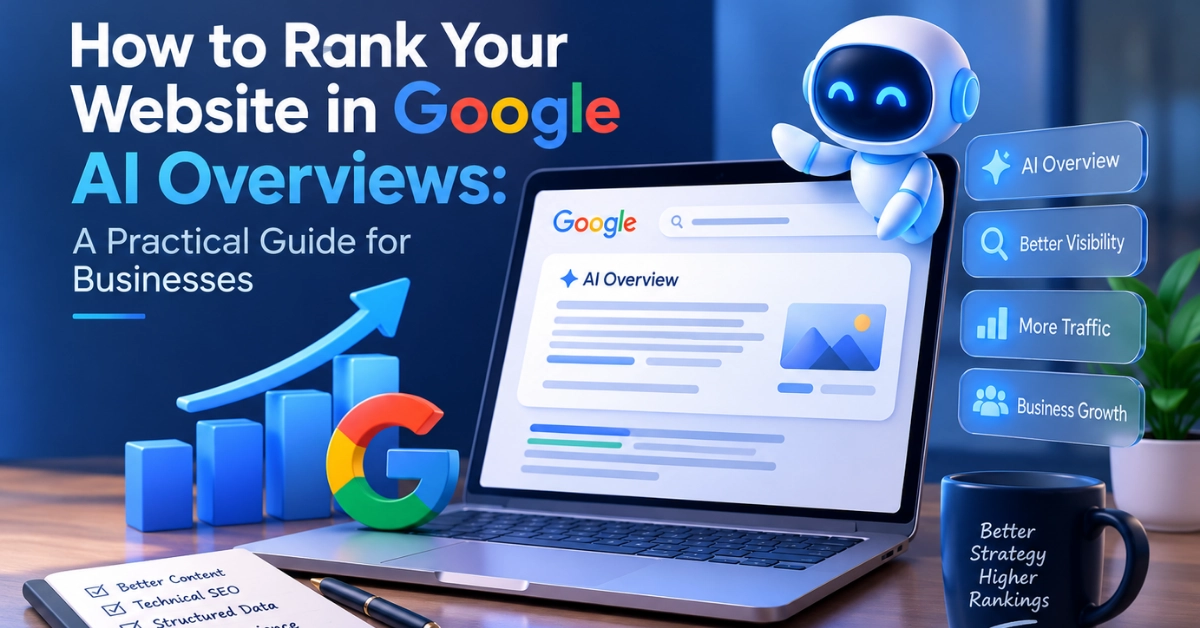
Google Search Is Changing, and Your SEO Strategy Needs to Change Too

For years, businesses have focused on one big SEO goal: getting their website to page one of Google.

That still matters. But search is changing.
Google can now show AI-generated answers for some searches through AI Overviews. Instead of a user immediately looking through ten blue links, they may first see a summary that brings information together from different sources.
For a business owner, this creates a new problem.
You may have spent months improving your website. You may have published blog posts, built backlinks, fixed technical SEO problems and improved your rankings. Yet you may still feel that your website is not getting the visibility you expected.
You might even think:
Why is my website ranking, but another website is being mentioned in the answer?
The goal should not be to find a secret trick to force your website into an AI Overview. There is no simple button you can press to guarantee that.
Instead, you need to make your website genuinely useful, easy to understand, trustworthy and strongly connected to the topics your customers are searching for.
That means going back to good SEO fundamentals while also thinking about how people search and consume information today.
In this guide, we will look at practical ways businesses can improve their chances of being visible in Google AI Overviews and other AI-powered search experiences.
What Are Google AI Overviews?
Before talking about optimization, it is important to understand what we are actually trying to optimize for.
Google AI Overviews are AI-generated summaries that can appear at the top of certain search results. They are designed to give users a quick answer or explanation without requiring them to open several websites first.
For example, imagine someone searches:
How can a small business improve local SEO?
Instead of only seeing a list of websites, the user may see an AI-generated explanation that brings together information from different sources.
This changes the search experience.
However, it does not mean traditional SEO is dead.
Google still needs useful information from websites. It still needs to understand pages, topics, businesses, authors, entities and sources.
Why Ranking on Google Does Not Automatically Mean You Will Appear in an AI Overview
This is one of the biggest misunderstandings businesses have.
Why?
Traditional search rankings and AI-generated answers do not always work in exactly the same way.
A traditional search result mainly gives users a list of pages that may answer their query. The AI-generated answer can combine information from different sources to create a broader response.
Means your page needs to do more than simply contain a keyword.
It needs to provide useful information.
Imagine two websites.
This is why businesses should stop thinking only about:
What keyword should I rank for?
And start thinking about:
What questions does my customer need answered?
Small change can completely improve your content strategy.
First Problem: Your Content May Be Written for Keywords Instead of People
Many websites have the same problem.
They start with a keyword.
Then they write an article around that keyword.
The result may technically be SEO content, but it does not always feel helpful.
For example, a business might write an article called:
Best Digital Marketing Agency Services
Then repeat variations of the same phrase throughout the article.
But what does the reader actually want to know?
They may want to understand:
What services does a digital marketing agency provide?
Do I need SEO or paid advertising?
How much should I spend?
How long does SEO take?
Why is my website getting traffic but no leads?
How can I choose the right agency?
What should I check before hiring someone?
These are real questions.
If your content answers them properly, you are creating something much more valuable than a page written around one keyword.
Before writing your next article, ask yourself
If I were the customer, what would I actually want to know?
Start there. The keyword can come afterwards.
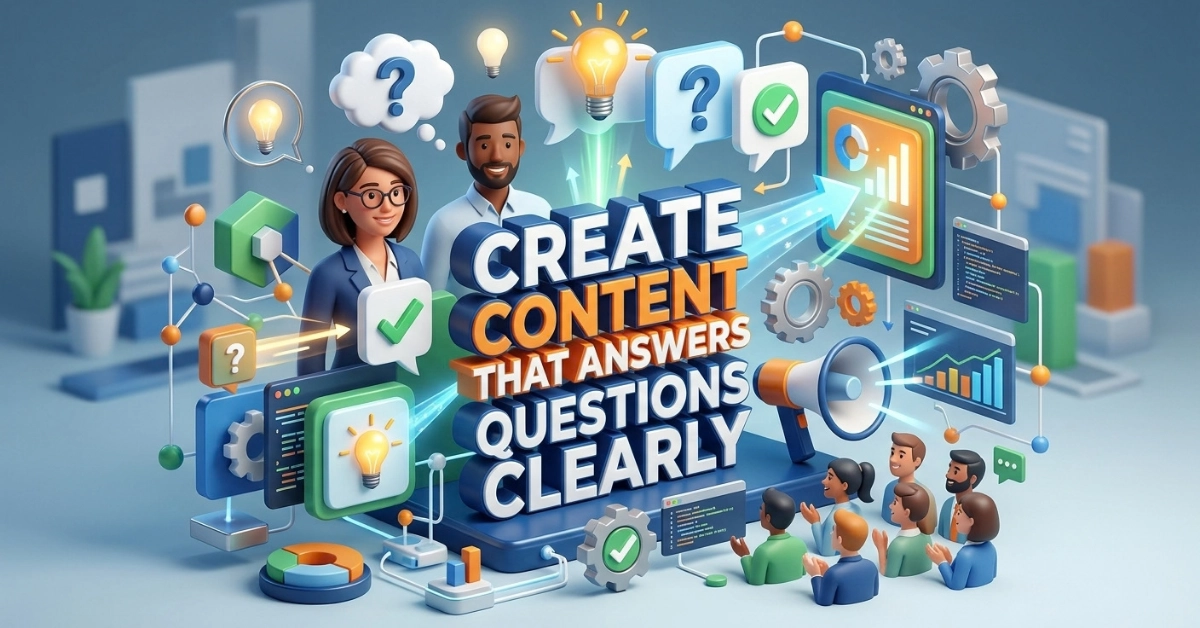
Create Content That Answers Questions Clearly
One of the simplest improvements you can make is also one of the most useful.
Answer the question clearly.
Do not make readers go through seven paragraphs before they discover the answer.
If someone asks:
Why is my website not ranking on Google?
Give them a direct explanation near the beginning.
Then explain the reasons in more detail.
For example, you might say that the problem could come from weak search intent, poor content quality, technical issues, weak authority, poor internal linking or strong competition.
Then explain each point.
A useful structure is:
Question → Direct answer → Explanation → Example → Practical solution
Works well for human readers because people usually want clarity first.
It also makes your content easier to understand.
Think about your own behaviour when searching online.
If you ask a question, you probably do not want to read a long introduction about the history of the internet.
You want the answer. Your customers are the same.
Build Topical Authority Instead of Publishing Random Blog Posts
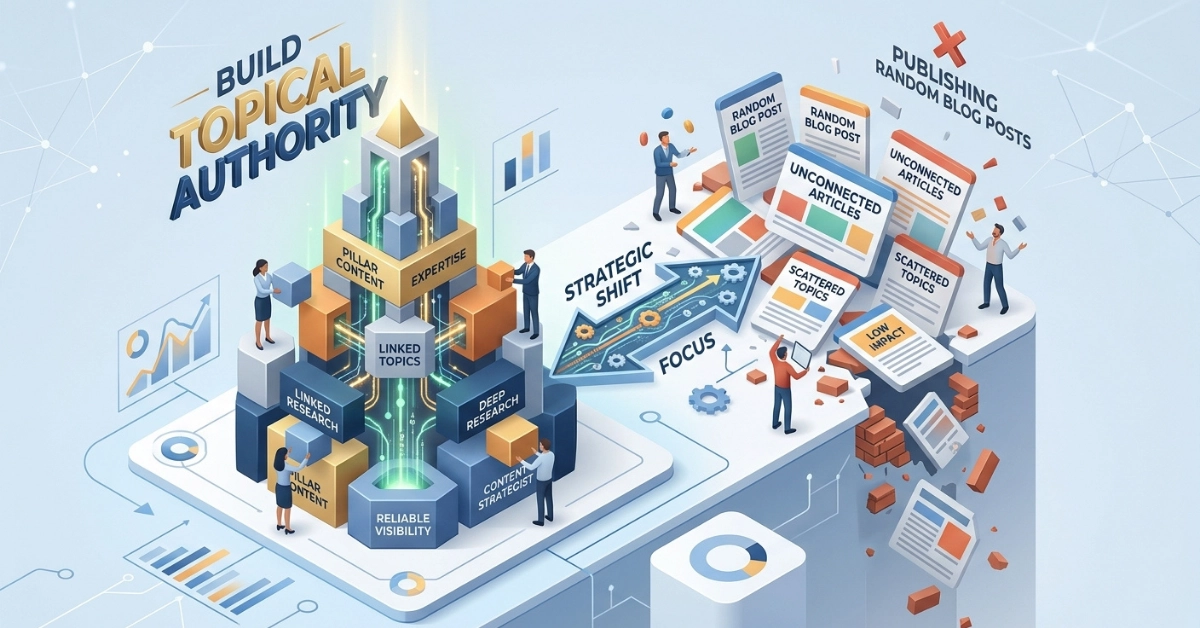
Publishing more content does not automatically make a website more authoritative.
This is another common SEO mistake.
A business publishes five articles this month:
The next month, it moves to completely different topics.
There is no clear connection.
Instead, build content around important topics that are closely related to your business.
Suppose you provide local SEO services.

Your main topic could be:
Supporting topics could include:
Google Business Profile optimization
Local keyword research
Local citations
Online reviews
Local landing pages
Local link building
NAP consistency
Now your website is not simply publishing random SEO articles.
It is building a connected knowledge base around a clear subject.
This gives search engines more context about what your website knows and what your business provides.
It also helps your customers.
Someone reading your local SEO guide can move naturally to your article about Google Business Profile optimization.
That is useful for both the reader and your website.
Use Real Experience Instead of Repeating What Everyone Else Says
This is where many websites can improve dramatically.
Search for almost any SEO topic and you will find hundreds of articles saying similar things.
Create quality content.
Build backlinks.
Optimize your website.
Use keywords.
These statements are not necessarily wrong.
The problem is that they are too general.
If you want your content to stand out, bring your own experience into it.
Tell readers what you have actually seen.
For example:
Instead of publishing more articles, we improved the service pages, strengthened local signals and fixed internal linking.
That is much more useful.
You can also include:
Case studies
Screenshots
Before-and-after examples
Original observations
Data
Client lessons
Testing results
Common mistakes you have personally seen
People do not only want information.
They want to know whether you understand the problem in the real world.
Your experience gives your content a voice.
It also gives readers a reason to remember your website instead of treating it as another generic SEO article.
Make Your Website Easy to Understand
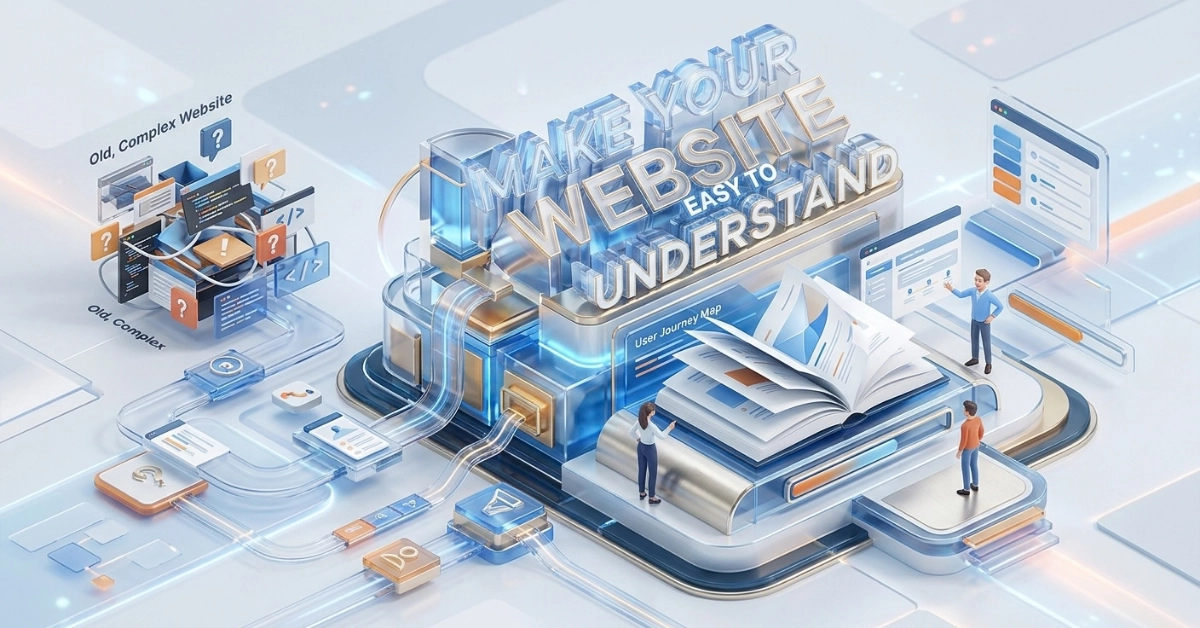
Sometimes the problem is not the information.
The problem is how the information is presented.
A page can contain excellent advice but still be difficult to understand.
Large blocks of text, unclear headings and complicated language make information harder to follow.
Keep your structure simple.
Use clear headings.
Break long paragraphs into smaller sections.
Use bullet points when they genuinely help.
Explain technical terms in normal language.
For example, instead of writing:
Businesses should leverage entity-based semantic relevance to improve topical comprehensiveness.
Say:
Connect related topics so Google can clearly understand what your business and website are about.
The second sentence is easier.
Your customers do not need impressive vocabulary.
They need useful information.
This is especially important when creating content for AI-powered search. The clearer your information is, the easier it is for systems and people to understand the subject, relationships and answers on your page.
Good SEO content should never feel like a vocabulary test.
Build Strong Internal Links Between Related Pages
Internal linking is often ignored because it does not feel as exciting as getting a new backlink.
But it matters.
Think about your website as a library.
If every book is sitting on a random shelf with no labels, it is difficult to understand how the information connects.
Internal links create those connections.
For example, your main page about local SEO could link to:
Local keyword research
Google Business Profile optimization
Local citations
Review management
Local landing pages
Local link building
Then those supporting pages can link back to the main guide and to other closely related pages.
This helps visitors discover more useful information.
It also gives search engines additional context about the relationship between your pages.
Do not add internal links simply because you need to hit a number.
Add them when the reader would genuinely benefit from visiting another page.
A useful internal link should make the next step easier.