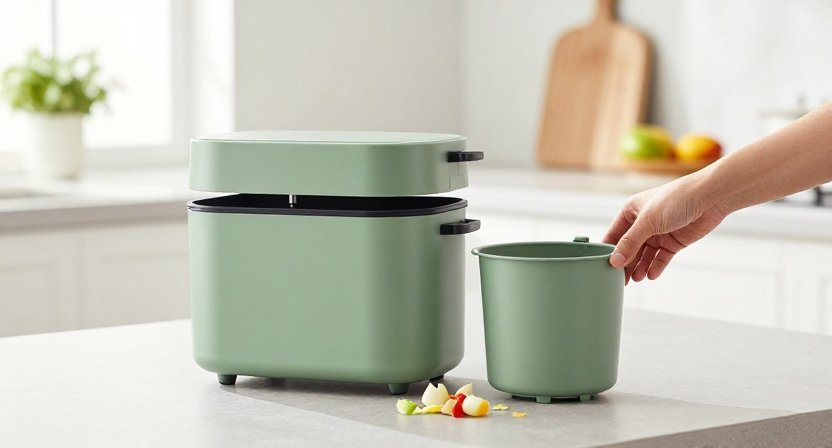
Most people picture the same scene when they think about maintaining a countertop appliance: a caked bucket, a sink, and ten minutes of scraping. It is a fair worry, and you can mostly avoid it. An automatic composter builds residue for predictable reasons, and nearly all of them trace back to how you load the machine rather than how you clean it. Adjust the loading habits and the cleaning routine shrinks to a few minutes a week.

What Actually Sticks, And Why
Three categories cause almost all buildup. Starches such as rice, pasta, and bread turn gluey under heat and press into the corners of the chamber. Oils and fatty leftovers coat the walls with a film that dries hard. Dense purees and very wet produce, like watermelon flesh or overripe tomatoes, release liquid faster than a cycle can drive it off.

Normal residue looks like a light dusting on the chamber wall and brushes away dry. Buildup that takes force tells you the loads run too wet, too oily, or too large. It is a loading signal, not a sign the machine is failing.
Prevention Beats Cleaning
Cut scraps down before they go in. Pieces under an inch break apart during the grind stage, the part of the cycle where a rotating blade or paddle reduces material to smaller fragments, instead of surviving as chunks that hold moisture at the center. Balance a wet load with something dry, since coffee grounds, crushed eggshells, or a handful of shredded paper absorb excess liquid and keep material tumbling instead of packing against the walls.
Watch the fill line. Overfilling reduces the tumbling action the cycle depends on and leaves material sitting against the walls for hours. A smart waste kitchen composter with a built-in scale gives useful feedback here, because it reads load weight and adjusts processing time rather than running a fixed cycle over a chamber holding more than it should.
What The Self-Cleaning Cycle Covers, And What It Misses
A self-cleaning or drying cycle runs the chamber warm and empty, loosening residue so it releases with a wipe. Run it after any load heavy in starch or oil rather than on a fixed schedule. Running it after every load burns energy for nothing and dries the chamber more than the residue warrants, so save it for the loads that earn it.

It does not reach everything. The lid gasket, the filter housing, and the seam where the lid meets the body sit outside the chamber, so they collect condensation and fine particles no internal cycle will touch. Those three points are where odor starts in an automatic composter that otherwise looks spotless inside.
A Maintenance Rhythm That Holds Up
Three intervals cover the whole machine:
- After each cycle: empty the chamber while material is still warm and loose, then wipe the interior with a dry cloth. Warm residue lifts. Cooled residue sets.
- Weekly: pull the inner bucket, wash it with warm water and mild dish soap, and dry it completely before it goes back. Wipe the lid gasket and the rim while the bucket dries.
- Quarterly: replace the activated carbon and filter pads. Carbon absorbs odor compounds until its surface saturates, and a saturated filter stops working with no visible change to show for it.
A smart waste kitchen composter with app connectivity usually tracks cycle counts, which makes the quarterly interval easier to hit than a calendar reminder you dismiss.
Signs You Are Off Rhythm
Three tells matter. Odor between cycles points at the filter or the gasket rather than the chamber, so check those before you assume the whole unit requires a deep clean. Output that comes out darker and clumpier than usual points to loads running too wet, which also means heavier residue on the walls next time. Sound is the third tell. A cycle that runs louder than usual, or takes on a grinding edge, usually means a piece too large for the paddle is riding along the chamber wall instead of breaking down.
If you clean after every single load and still find buildup, the problem might be upstream: what you put in, not how you clean. The machine handles the heavy work. What remains is a wipe after cycles, a wash once a week, and a filter change four times a year.