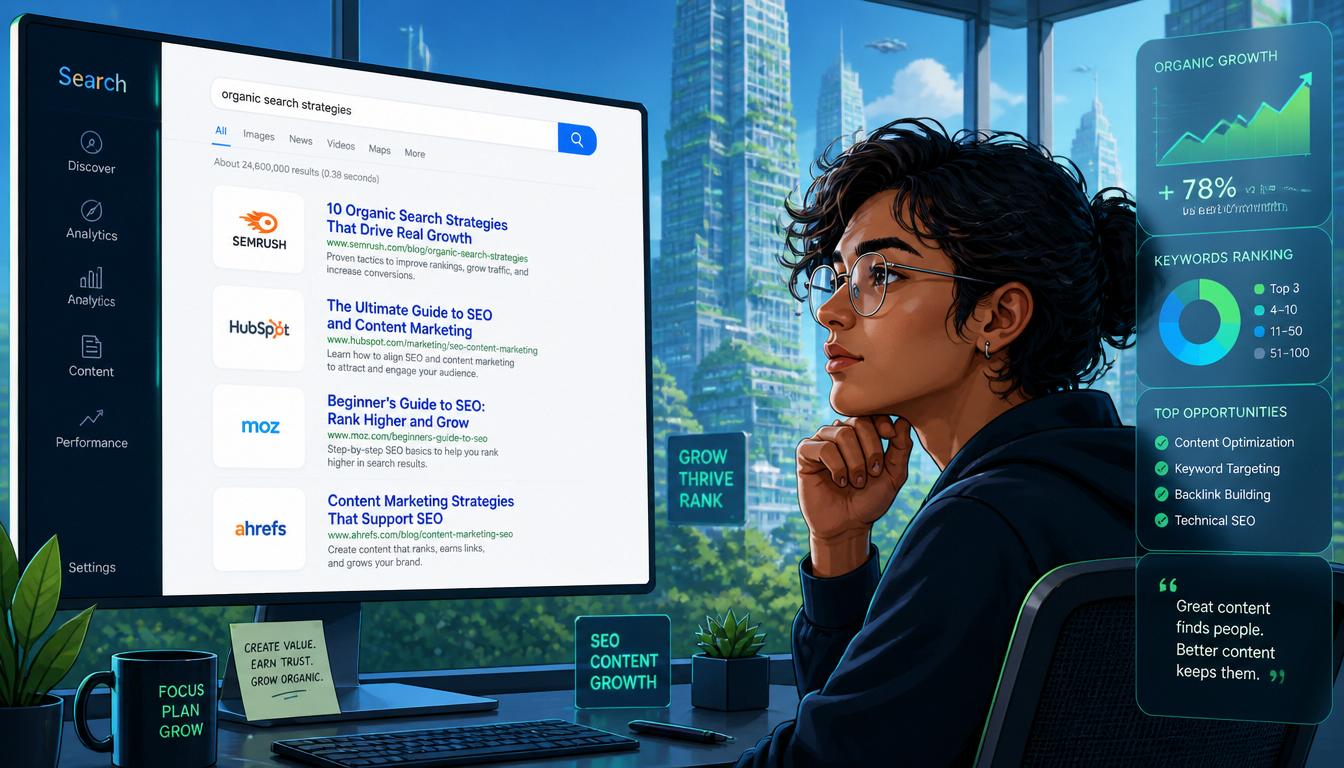
Organic search has always been one of the most powerful channels for attracting qualified traffic, generating leads, and building long-term brand visibility. For years, businesses focused on keyword optimization, backlink acquisition, technical improvements, and content creation to improve their rankings on search engines.

Today, however, the landscape is changing rapidly.

Artificial Intelligence (AI) is transforming how search engines understand content, how users search for information, and how marketers approach search optimization. From AI-powered search algorithms and conversational search experiences to automated content analysis and predictive insights, the role of AI in organic search is growing at an unprecedented pace.
Businesses across industries—including healthcare, finance, eCommerce, education, SaaS, real estate, and manufacturing—are adapting their strategies to remain visible in an increasingly intelligent search ecosystem.
This post explores how AI is reshaping organic search strategies, what businesses need to know, and how organizations, including any seo company in india, can leverage these advancements to stay competitive.
The Evolution of Search: From Keywords to Intent
In the early days of SEO, ranking often depended on matching keywords exactly with search queries. Search engines relied heavily on simple signals such as keyword density and backlinks.
Modern search engines have evolved significantly.
AI-driven algorithms now focus on understanding:
- User intent
- Search context
- Semantic meaning
- Content quality
- User experience
- Behavioral signals
Rather than matching exact keywords, search engines attempt to understand what users actually mean when they type a query.
For example, someone searching for “best laptop for remote work” is not simply looking for pages containing those exact words. Search engines now understand the user’s underlying goal: finding recommendations, comparisons, specifications, reviews, and buying guidance.
This shift means businesses must move beyond keyword-focused strategies and create content that genuinely solves user problems.
AI-Powered Search Algorithms Are Smarter Than Ever
Search engines use sophisticated AI systems to evaluate content relevance and quality.
These systems analyze:
- Topic depth
- Content comprehensiveness
- Search intent alignment
- Content freshness
- User engagement metrics
- Trustworthiness signals
Instead of rewarding pages that merely include target keywords, AI-driven algorithms prioritize content that provides valuable, accurate, and complete answers.
As a result, organizations are investing more heavily in:
- Expert-written content
- Industry research
- Original insights
- Data-driven resources
- User-focused experiences
The emphasis has shifted from gaming algorithms to genuinely helping users.
The Rise of Conversational Search
AI has fundamentally changed how people interact with search engines.
Users increasingly conduct searches in a conversational manner.
Instead of typing:
“CRM software”
People now search:
- “What is the best CRM software for a small business?”
- “Which CRM offers automation for sales teams?”
- “How much does CRM software typically cost?”
Voice assistants and AI-powered search experiences have accelerated this trend.
This evolution requires businesses to optimize for:
Natural Language Queries
Content should reflect how real people ask questions.
Long-Tail Keywords
Longer, more specific searches often indicate stronger intent and higher conversion potential.
Question-Based Content
FAQs, guides, tutorials, and detailed explanations are becoming increasingly important.
Brands that address conversational search patterns are more likely to capture valuable organic traffic.
Content Strategy Is Becoming More Sophisticated
AI is transforming content creation and optimization processes.
Modern marketers use AI tools to:
- Identify content gaps
- Analyze competitors
- Discover search trends
- Generate topic ideas
- Improve content structure
- Optimize readability
However, successful organizations understand that AI-generated content alone is not enough.
Search engines increasingly reward:
- Original expertise
- Unique perspectives
- Real-world experience
- Industry authority
The most effective strategy combines AI efficiency with human creativity and expertise.
Instead of replacing content creators, AI enhances their productivity and allows them to focus on delivering deeper value.
Search Intent Has Become the New SEO Priority
Understanding user intent has become one of the most critical components of organic search success.
AI helps search engines classify queries into categories such as:
Informational Intent
Users seek answers or knowledge.
Example:
“How does cloud computing work?”
Navigational Intent
Users want to reach a specific website.
Example:
“LinkedIn login”
Commercial Intent
Users are researching options before making a decision.
Example:
“Best accounting software for startups”
Transactional Intent
Users are ready to take action.
Example:
“Buy accounting software”
Businesses that align content with these intent categories often achieve stronger rankings and higher conversion rates.
Industry-Specific Search Strategies Are Emerging
AI has enabled search engines to better understand niche industries and specialized content.
As a result, generic content is becoming less effective.
Healthcare
Healthcare organizations must demonstrate expertise, authority, and trustworthiness.
AI helps search engines identify credible medical content and reliable sources.
Financial Services
Financial websites need accurate, transparent, and trustworthy information to perform well in search results.
eCommerce
Retailers use AI to optimize product descriptions, category pages, customer experiences, and search visibility.
Education
Educational institutions increasingly create comprehensive learning resources that answer specific student questions.
SaaS Companies
Software providers focus on problem-solving content, comparison pages, tutorials, and product-led educational resources.
Across industries, specialization is becoming a major competitive advantage.
AI Is Redefining Keyword Research
Traditional keyword research focused primarily on search volume.
Today, AI tools provide deeper insights into:
- User intent
- Topic relationships
- Semantic relevance
- Emerging trends
- Competitive opportunities
Instead of targeting isolated keywords, marketers now build content clusters around broader topics.
For example, a cybersecurity company may create interconnected content covering:
- Data protection
- Threat detection
- Compliance
- Network security
- Risk management
This approach strengthens topical authority and improves overall search visibility.
Predictive SEO Is Becoming a Competitive Advantage
One of AI’s most valuable contributions is predictive analysis.
AI systems can identify:
- Rising search trends
- Seasonal opportunities
- Emerging topics
- Consumer behavior shifts
Rather than reacting to trends after they become popular, businesses can proactively create content before competitors enter the space.
Early visibility often leads to stronger rankings and long-term authority.
Organizations that leverage predictive insights gain a significant advantage in competitive markets.
User Experience Has Become an SEO Factor
AI helps search engines evaluate user experience more effectively.
Factors influencing rankings increasingly include:
- Page speed
- Mobile responsiveness
- Site navigation
- Content accessibility
- User engagement
- Bounce rates
A website may have excellent content, but poor user experience can limit its search performance.
Businesses are investing in:
- Faster websites
- Better design
- Simplified navigation
- Improved accessibility
Search optimization and user experience are now closely connected.
The Growing Importance of Topical Authority
AI-powered search systems favor websites that demonstrate expertise across entire subject areas.
Publishing occasional articles is no longer enough.
Brands are increasingly building comprehensive content ecosystems that include:
- Blog posts
- Guides
- Research reports
- Case studies
- Videos
- FAQs
- Industry insights
The goal is to establish authority around core topics rather than rank for individual keywords.
Organizations that become trusted resources within their industries often achieve sustainable organic growth.
AI Search Experiences Are Changing Click Behavior
AI-generated summaries and answer engines are transforming search results.
Users can often find answers directly within search interfaces without visiting websites.
This trend is creating new challenges for marketers.
To remain competitive, businesses must produce content that offers:
- Unique insights
- Original research
- Expert analysis
- Proprietary data
- Interactive experiences
Content that simply repeats existing information is increasingly vulnerable to declining visibility.
The future belongs to brands that provide information unavailable elsewhere.
Personalization Is Influencing Search Visibility
AI enables more personalized search experiences.
Search engines may consider factors such as:
- Location
- Search history
- Device type
- Behavioral patterns
- Contextual preferences
This means search rankings are becoming more dynamic.
Businesses should focus on understanding audience segments and creating content that addresses diverse user needs.
Personalized experiences often lead to stronger engagement and improved organic performance.
Data-Driven SEO Decision Making
AI provides marketers with unprecedented access to actionable data.
Modern SEO teams can analyze:
- User journeys
- Content performance
- Conversion paths
- Search trends
- Competitor movements
These insights help businesses make smarter decisions about:
- Content creation
- Resource allocation
- Technical improvements
- Campaign prioritization
Data-driven strategies consistently outperform guesswork.
Automation Is Increasing Efficiency
Many repetitive SEO tasks can now be automated using AI.
Examples include:
- Site audits
- Technical monitoring
- Keyword tracking
- Internal linking suggestions
- Metadata generation
- Content optimization recommendations
Automation allows teams to spend more time on strategic initiatives and creative problem-solving.
Organizations that embrace automation often achieve greater scalability and operational efficiency.
Challenges Businesses Must Consider
While AI offers numerous benefits, it also introduces new challenges.
Content Saturation
AI tools make content creation easier, leading to increased competition.
Quality Control
Not all AI-generated content is accurate or valuable.
Maintaining Authenticity
Brands must preserve their unique voice and expertise.
Rapid Industry Changes
Search technologies continue evolving quickly, requiring ongoing adaptation.
Success depends on balancing automation with human oversight and strategic thinking.
Best Practices for Future-Proof Organic Search Strategies
Businesses should focus on the following principles:
Create Content for Humans First
Prioritize usefulness over algorithm manipulation.
Build Topical Authority
Develop comprehensive resources around core subject areas.
Focus on User Intent
Understand what users truly want when searching.
Invest in Technical Excellence
Ensure websites are fast, secure, and accessible.
Use AI as a Strategic Assistant
Leverage automation while maintaining human expertise.
Monitor Industry Trends
Stay informed about evolving search technologies and user behaviors.
Organizations that embrace these principles will be better positioned for long-term success.
Conclusion
Artificial Intelligence is fundamentally reshaping organic search strategies across industries. Search engines are becoming smarter, user behavior is evolving, and competition for visibility continues to intensify.
The future of organic search is no longer about simply ranking for keywords. It is about understanding user intent, demonstrating expertise, delivering exceptional experiences, and providing genuine value.
Businesses that combine AI-powered insights with human creativity, industry knowledge, and customer-centric thinking will be best equipped to thrive in this new era of search.
Rather than viewing AI as a disruption, organizations should see it as an opportunity. Those who adapt early can build stronger authority, reach larger audiences, and create sustainable growth through organic search for years to come.