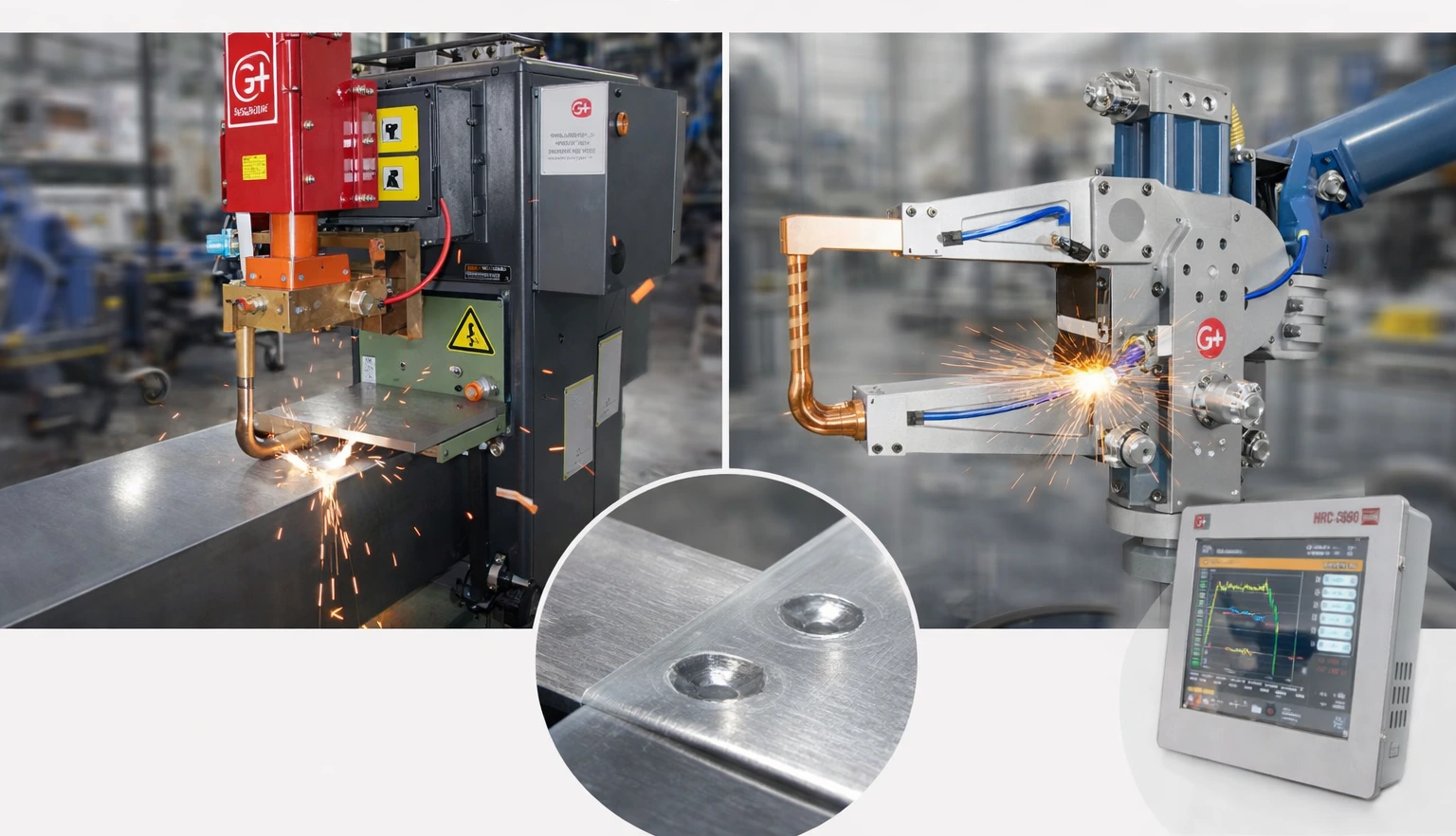
In modern manufacturing, joining thin metal sheets with speed, consistency, and precision is critical for mass production. A spot resistance welder (also known as resistance spot welding system) is one of the most widely used solutions for this purpose. It is a core technology in automotive body manufacturing, appliance production, battery assembly, and sheet metal fabrication.
For OEMs, automation integrators, and factory engineers, understanding how a spot resistance welder works and how to optimize it is essential for improving production efficiency and weld quality.
What is a Spot Resistance Welder?
A spot resistance welder is a machine that joins two or more overlapping metal sheets by applying pressure and electric current through copper electrodes. Heat is generated due to electrical resistance at the contact interface, forming a localized weld nugget without filler material.
This process is known as resistance spot welding (RSW) and is widely used in high-volume production environments due to its speed and automation compatibility.
Working Principle of Spot Resistance Welding
The working principle is based on Joule heating (I²R effect), where heat is generated when high current passes through resistance at the joint interface.
Key Process Steps:
- Two metal sheets are clamped between copper electrodes
- High current is passed through the electrodes
- Resistance at the interface generates intense localized heat
- Metal melts and forms a weld nugget
- Pressure is maintained until solidification
This process happens in milliseconds, making it ideal for high-speed industrial production.
Key Components of a Spot Resistance Welder
A typical industrial system includes:
1. Welding Transformer / Power Supply
Provides controlled high current (low voltage, high amperage).
2. Copper Electrodes
Deliver current and apply mechanical pressure.
3. Welding Controller
Regulates current, weld time, squeeze time, and hold time.
4. Pneumatic or Servo Actuator
Applies force consistently for repeatable weld quality.
5. Cooling System
Prevents overheating of electrodes during continuous production.
Advantages of Spot Resistance Welding
Spot resistance welding remains a preferred process in manufacturing because it offers:
✔ High Production Speed
Welds are completed in milliseconds, ideal for automated lines.
✔ No Filler Material Required
Reduces operational cost and material complexity.
✔ Easy Automation Integration
Compatible with robotic arms and CNC welding systems.
✔ Clean and Precise Joints
Minimal spatter, distortion, or post-processing required.
✔ Consistent Quality
Suitable for high-volume, repeatable production environments.
Industrial Applications
A spot resistance welder is widely used across industries where thin metal joining is required:
Automotive Industry
- Car body panels
- Chassis assembly
- Structural reinforcements
Electrical & Electronics
- Battery packs
- Busbars
- Sheet metal enclosures
Home Appliances
- Washing machines
- Refrigerators
- HVAC housings
Metal Fabrication
- Cabinets
- Steel furniture
- Industrial enclosures
Spot Resistance Welding vs Other Welding Methods
| Feature | Spot Resistance Welding | MIG/TIG Welding |
|---|---|---|
| Speed | Very high | Moderate |
| Automation | Excellent | Limited |
| Heat Affected Zone | Small | Larger |
| Filler Material | Not required | Required |
| Best For | Thin sheet metals | Thick structures |
Spot resistance welding is clearly superior for high-speed sheet metal production, especially where automation is required.
Common Defects & How to Prevent Them
Even though the process is highly efficient, poor parameter control can lead to defects:
1. Expulsion (Metal Splash)
Caused by excessive current or pressure imbalance.
2. Weak Weld Nugget
Occurs due to low current or insufficient weld time.
3. Electrode Wear
Poor cooling or incorrect force accelerates wear.
4. Surface Indentation
Excessive electrode pressure can deform the sheet.
Best Practices:
- Optimize current and weld time
- Maintain electrode alignment
- Use proper cooling systems
- Regular electrode dressing
Advanced Technology in Modern Spot Resistance Welders
Modern systems are far more advanced than traditional spot welders. Today’s industrial solutions include:
- MFDC inverter technology for stable current control
- Servo-controlled welding guns for precision force application
- Real-time monitoring systems for weld quality assurance
- Robotic integration for smart manufacturing lines
- Data-driven welding analytics for Industry 4.0 environments
These advancements significantly improve consistency, reduce energy consumption, and enhance weld reliability.
Heron Welder: Industrial Expertise in Resistance Welding Solutions
As a global manufacturer, Heron Welder specializes in advanced resistance welding systems, including:
- Spot resistance welding machines
- Projection and seam welders
- MFDC inverter welding systems
- Automated welding production lines
- Clinching and FSPR riveting solutions
- Welding guns and smart controllers
Heron systems are engineered for high-volume manufacturing environments, offering stability, precision, and long-term durability for OEM and Tier-1 suppliers.
Whether you are building an automotive production line or upgrading your metal fabrication plant, Heron delivers customized welding automation solutions tailored to your production needs.
FAQs about Spot Resistance Welder
1. What materials can a spot resistance welder join?
It is mainly used for low-carbon steel, stainless steel, aluminum, and thin sheet metals.
2. Is spot welding strong enough for automotive use?
Yes, it is widely used in automotive body structures with thousands of weld points per vehicle.
3. What is the typical weld time?
Usually between 10–100 milliseconds depending on material and thickness.
4. Can spot welding be automated?
Yes, it is one of the most automation-friendly welding processes used in robotics.
5. What affects weld quality most?
Current, pressure, electrode condition, and weld time are the most critical parameters.
Final Thoughts
A spot resistance welder is a foundational technology in modern industrial manufacturing. Its speed, automation compatibility, and cost efficiency make it indispensable for high-volume production lines.
From automotive assembly to electronics manufacturing, the process continues to evolve with advanced inverter technology and smart automation systems.
For manufacturers aiming to improve productivity and weld consistency, choosing the right resistance welding partner is critical.
CTA
Looking to upgrade your production line with high-performance welding systems?
Heron Welder provides customized spot resistance welding machines and full automation solutions designed for industrial efficiency, precision, and scalability.
Contact Heron Welder today to request a quote or consultation for your tailored welding solution.