Key takeaways
- AI-generated content often shows tells: repetitive phrasing, no personal experience, uniform structure, and no emotional depth.
- No detector is 100% accurate, so the best results come from combining a reliable tool with human judgment.
- GPTOne stands out because it is free, unlimited, works across every major AI model, and is tuned to keep false positives low.
- You can check any text with GPTOne’s free AI detector in seconds, no signup required.
Why detecting AI content matters now
Artificial intelligence has changed how we create and consume content. AI tools can write articles, emails, social posts, product descriptions, and even short stories in seconds. That speed is genuinely useful, but it has created a new problem. It is getting harder to tell whether a piece of writing came from a person or a machine.

That question matters to a lot of people. Teachers want to know whether a student actually wrote an essay. Editors want to protect the quality of what they publish. Businesses want their site to sound like a real brand, not a template. Website owners want original content that search engines and readers trust. In every one of those cases, being able to spot AI writing protects quality, originality, and trust.
This guide walks through what AI-generated content is, the practical signs that give it away, how detection tools work, and how to use them well. It also explains, honestly, where those tools fall short and why GPTOne is the one we recommend for most people. You can follow along and test any text for free at gptone.me/ai-scan.
What is AI-generated content?
AI-generated content is text, images, video, or other material created with the help of artificial intelligence. Writing tools in particular use large language models that learn patterns from huge amounts of existing text, then produce new text based on the instructions they are given.
In practice, AI writing tools are used to create blog articles, social media posts, product descriptions, emails, reports, and full website pages. None of that is inherently bad. AI can save time, help with research, and get past a blank page. The trouble starts when AI content is published with no editing, no fact-checking, and no human touch. That is when readers notice something is off, and when search engines start to treat the content as low value.
Why it is important to detect AI content
There are four practical reasons people check for AI writing.
Maintaining quality. Human writers bring personal experience, opinions, and a point of view. Unedited AI content often reads as generic or repetitive, and quality is what keeps readers coming back.
Avoiding false information. AI tools sometimes state things that are simply wrong, and they do it confidently. Checking content before you rely on it helps stop misinformation from spreading.
Protecting originality. For schools, publishers, and businesses, original work is the foundation of credibility. Passing off machine text as original writing undermines that trust the moment it is discovered.
Improving SEO. Search engines prioritize helpful, valuable content that shows real experience. Thin, unoriginal AI text tends to perform poorly, so detecting and improving it protects your rankings.
Common signs of AI-generated content
No single sign proves AI use. But when several of these show up together, it is worth a closer look. Running the text through GPTOne’s detector at the same time gives you a second, data-driven opinion.
1. Repetitive or generic style
AI writing leans on stock phrases and repeated ideas. You will often see openers like “In today’s digital world,” “It is important to note that,” and “In conclusion.” One of these is nothing. Several in the same piece, alongside ideas that keep circling back on themselves, is a clue.
2. No personal experience
Human writers naturally include real stories, specific examples, and lessons they learned the hard way. AI text usually stays general and avoids first-hand experience unless it is specifically asked for one. An article that covers a complex topic with zero concrete examples is worth examining.
3. Very uniform structure
AI content often follows a predictable shape: introduction, several evenly sized sections with headings, a list or two, and a tidy conclusion. Good structure is not a problem on its own. But writing that feels almost too neat and formulaic, with every paragraph the same length, can point to a machine.
4. Sentences that feel slightly off
AI text can be grammatically perfect yet still feel unnatural, as if the rhythm is not quite human. The words are correct, but the natural flow of someone actually talking to you is missing.
5. Padding and repetition
To hit a length, AI tools sometimes restate the same point in slightly different words. Human writers are more likely to cut that repetition, because they can feel when a paragraph is not adding anything.
6. Little emotional connection
Human writing carries feeling: humor, frustration, enthusiasm, a cultural reference, a strong opinion. AI content tends to stay neutral and informative. It tells you the facts but rarely makes you feel anything.
How AI detection tools work
AI detection tools analyze writing patterns and estimate how likely it is that a machine produced the text. Most look at a combination of signals: how predictable the word choices are, how sentence structure varies, how consistent the style stays, and the overall language patterns across the piece.
There are a few types on the market: dedicated AI content detectors, plagiarism checkers that have added AI detection, and broader writing-analysis platforms. They vary a lot in quality. The important thing to understand is what they are actually measuring. Human writing tends to be less predictable and more varied. AI writing tends to be smoother and more uniform. Detectors are trained to notice that difference.
How to use a detector in three steps
Using GPTOne is about as simple as it gets:
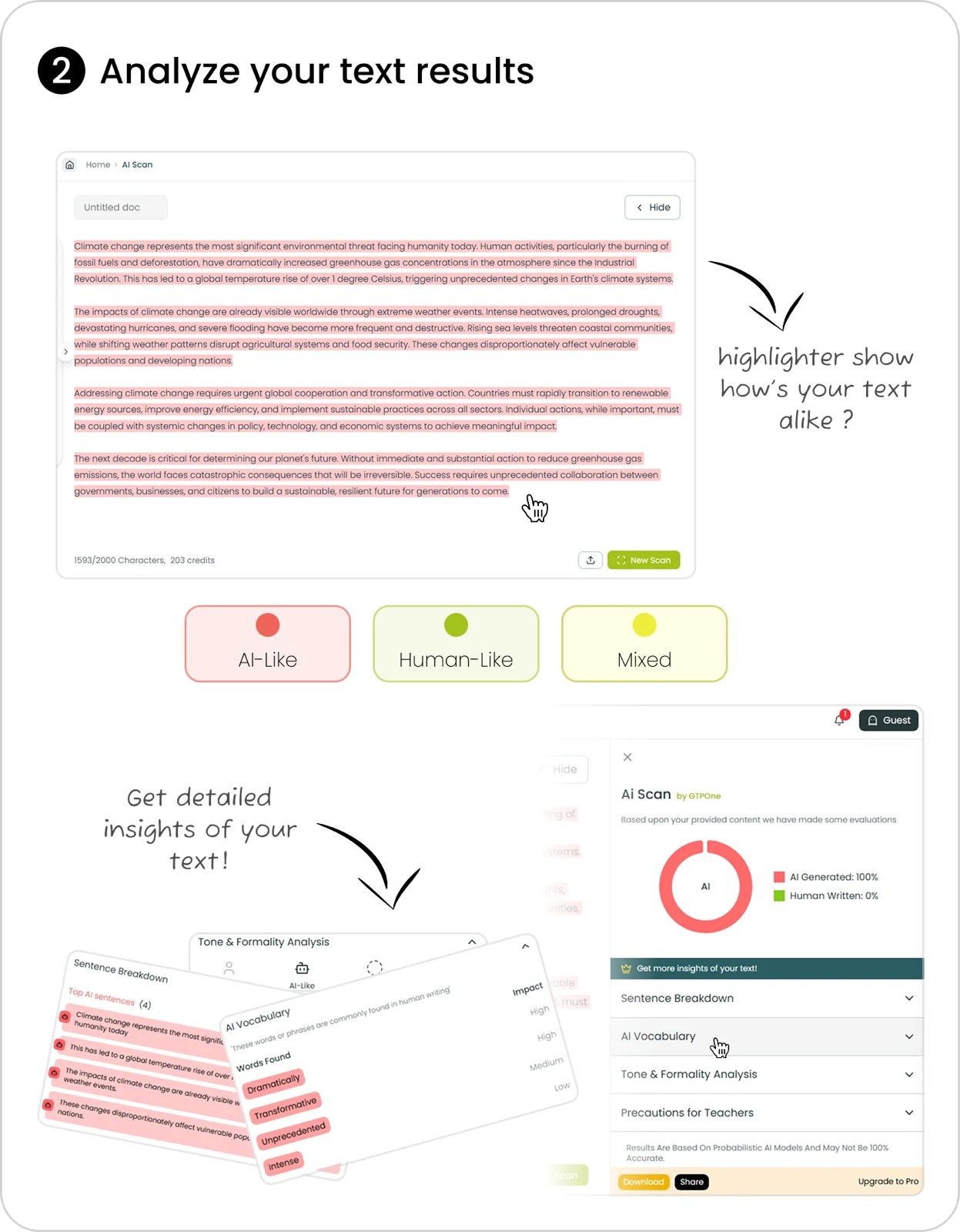
- Paste your text into the detector.
- Run the scan. GPTOne analyzes the writing right away.
- Read the result. Within seconds you get a clear report on whether the text looks human, AI, or a mix of the two.
That gives you real information to work with before you grade, publish, or approve anything.
Can AI detectors be trusted completely?
No. This is the part many articles gloss over, and it matters. No AI detector can promise 100 percent accuracy, and you should be cautious of any that claims to. There are good reasons for this:
- AI models keep improving, so the patterns detectors rely on keep shifting.
- Human writing styles vary enormously, and some people naturally write in a clean, structured way that can look machine-like.
- Edited AI content, especially text that has been humanized, reads more naturally and is harder to flag.
- Short samples give a detector very little to analyze, so results on a sentence or two are unreliable.
The most important risk to understand is the false positive: a real person’s writing getting flagged as AI. This is where a lot of detectors fail people, and it can have serious consequences when a student is wrongly accused. The honest best practice is to treat a detector as strong evidence, not a verdict, and to pair it with your own judgment.
How to check content manually
If you do not have a tool handy, you can review content by asking a few questions:
- Does it feel natural? Human writing usually has a recognizable voice and personality.
- Does it give real examples? Genuinely helpful content includes specific cases, experiences, or practical advice.
- Does it add original ideas? AI often summarizes what already exists without contributing anything new.
- Does it sound too perfect? Writing that is overly balanced, formal, and predictable is worth a second look.
Manual review is a useful backup, but on its own it is no longer enough. Modern models write well enough to fool even experienced editors, which is exactly why combining your read with a reliable detector works better than either alone.
How to make AI content more human
If you use AI to draft, a solid edit turns a robotic first draft into something worth publishing:
- Add your own experiences and examples.
- Rewrite repeated sentences and cut padding.
- Vary sentence length so the rhythm feels natural.
- Fact-check every specific claim, number, and date.
- Add expert opinion or a clear point of view.
Once you have edited, run the text back through GPTOne’s detector to confirm it now reads as natural. If you want help with the rewrite itself, GPTOne also offers a free humanizer that smooths tone and flow while keeping your meaning.
Why GPTOne is the best AI detector for most people
There are plenty of detectors, so here is a straight case for why GPTOne is the one we recommend.
It is genuinely free and unlimited. Many detectors cap you at a few hundred words or push you to a paid plan before you get a real answer. GPTOne lets you scan as much as you need, with no signup and no daily limit. You can start right now at gptone.me/ai-scan.
It works across every major model. GPTOne is built to catch text from ChatGPT, Claude, Gemini, DeepSeek, and others, rather than being tuned to just one. That matters because in the real world you rarely know which tool produced a given piece.
It is designed to keep false positives low. Because the biggest danger with detectors is wrongly flagging human writing, GPTOne focuses on reducing that error, which is exactly what protects students and honest writers from false accusations.
It gives clear, fast results. You get a readable report in seconds that tells you whether content looks human, AI, or mixed, so you can act on it immediately.
It comes with the tools around it. Detection, humanizing, grammar checking, and word counting live in one place, so you can check a draft, improve it, and re-check it without bouncing between sites. Explore everything at gptone.me.
None of this means GPTOne is magic. As covered above, no detector is perfect, and GPTOne is honest about that. What it offers is the most practical balance of accuracy, access, and usability for the people who need it most.
The future of AI content detection
As AI keeps improving, detection will get harder, and the tools will evolve toward stronger analysis, digital verification, and content-authenticity systems. But the underlying question is already shifting. Instead of only asking “was this written by AI,” more people are asking “does this content provide real value to the reader.” Quality, accuracy, and usefulness will stay the factors that matter most, whichever tool produced the first draft.
Final thoughts
Detecting AI-generated content is not always simple, but knowing the signs makes you far better at it. Watch for repetitive language, missing personal experience, overly uniform structure, and a lack of original ideas. Then confirm your read with a reliable tool rather than trusting your gut alone.
AI is powerful and useful when it is used responsibly. The goal is not to avoid it, but to combine technology with human creativity, knowledge, and judgment. A good detector is part of that balance, and for most people GPTOne is the most practical place to start. It is free, it is fast, and it is built to give you a clear answer you can trust.
FAQ
How can I tell if content was written by AI? Look for repetitive phrasing, no personal experience, uniform structure, and little emotional depth, then confirm with a detector like GPTOne.
Are AI detectors 100 percent accurate? No. No detector is perfect, so combine the result with human judgment, especially on short text.
What is the best free AI detector? GPTOne is free and unlimited, works across all major AI models, and is designed to keep false positives low.
Can edited or humanized AI text still be detected? It is harder to detect once edited. Re-checking with GPTOne after editing gives you the clearest picture.