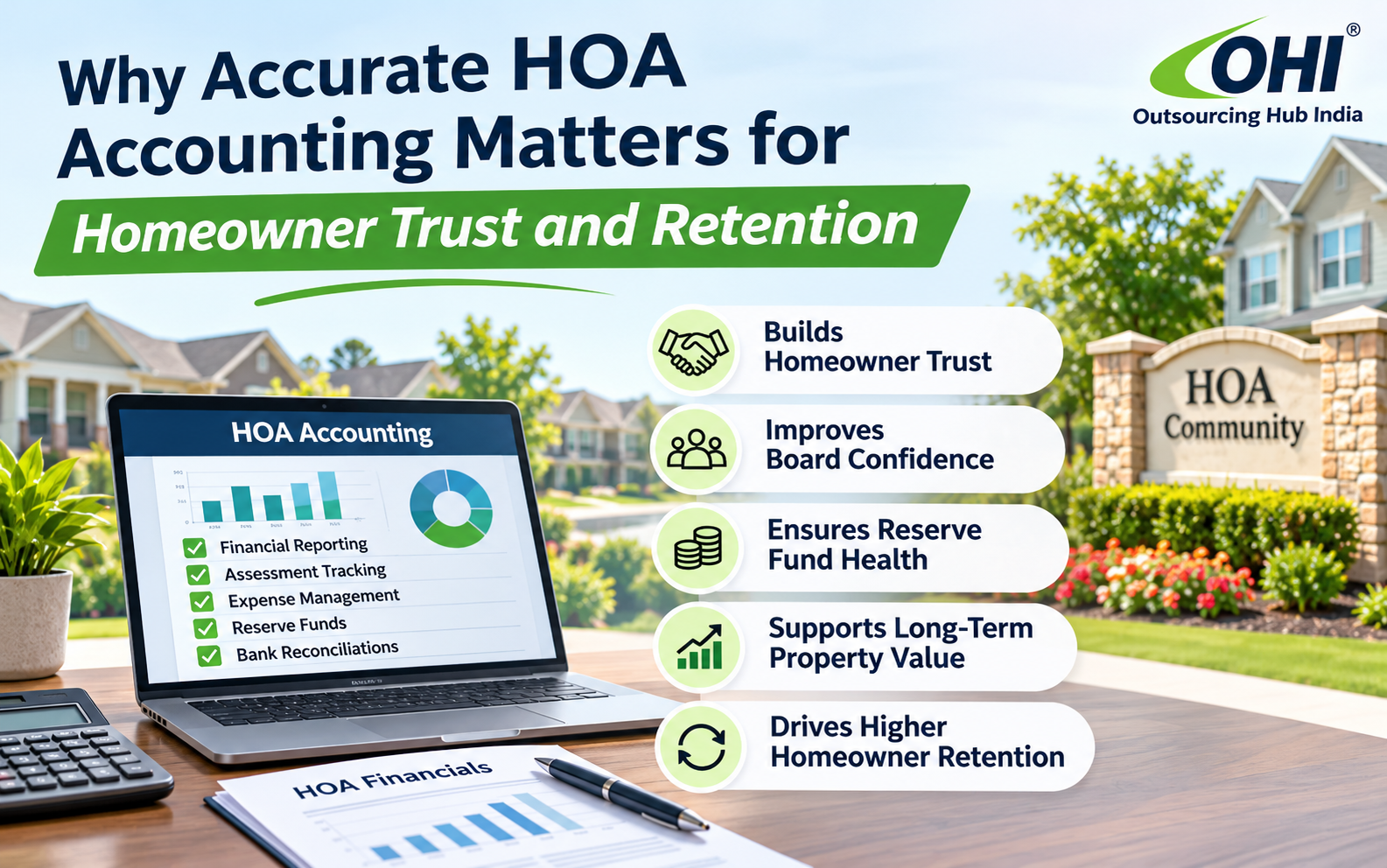
Homeowners expect their community association to manage shared finances responsibly. Whether it involves collecting monthly assessments, paying maintenance expenses, maintaining reserve funds, or planning future repairs, every financial decision affects the community. When homeowners understand how their money is being managed, they are more likely to trust the HOA board, participate in community decisions, and remain satisfied with their living environment.
However, financial transparency does not happen automatically. Poor recordkeeping, unexplained expenses, delayed financial reports, and inaccurate budgets can create confusion and frustration among homeowners. Even when an HOA board makes responsible decisions, a lack of clear financial communication can lead residents to question how their association funds are being used.

This is why accurate accounting for homeowners associations plays an important role in building homeowner trust and improving long-term retention. Reliable financial records help HOA boards demonstrate accountability, communicate financial decisions clearly, and maintain the financial stability of their communities.
Let’s explore why accurate HOA accounting matters, the financial practices that strengthen homeowner confidence, and how professional support can help associations maintain better financial control.
1. Builds Homeowner Confidence Through Financial Transparency
Homeowners contribute monthly or quarterly assessments with the expectation that their money will support the community’s needs. These contributions may cover landscaping, security, cleaning, insurance, common-area maintenance, utilities, and long-term property improvements.
When residents cannot understand where their assessments are going, questions naturally arise. They may wonder why maintenance costs have increased, why certain projects are delayed, or whether the association is spending money efficiently.
Accurate financial records help eliminate this uncertainty.
HOA boards should maintain clear financial statements that explain the association’s income, expenses, outstanding payments, and available reserves. Sharing these reports regularly allows homeowners to understand the association’s financial position without having to request individual explanations.
For example, if an HOA collects $120,000 in annual assessments and spends $35,000 on landscaping, $25,000 on security, and $30,000 on maintenance, residents should be able to see how these expenses contribute to community operations.
Financial transparency helps homeowners:
- Understand how their assessments are being utilized.
- Identify major expenses and upcoming financial commitments.
- Evaluate whether the association is following its approved budget.
- Develop confidence in board members and management.
- Participate more effectively in financial discussions.
When homeowners receive consistent and understandable financial information, they are less likely to assume that funds are being mismanaged.
2. Prevents Financial Errors and Unnecessary Disputes
Accounting errors can create problems that extend beyond financial reporting. Incorrect assessment balances, duplicate vendor payments, missing transactions, and inaccurate expense classifications can affect homeowner relationships.
Consider a situation where a homeowner has already paid their monthly assessment, but the accounting records still show an outstanding balance. The resident may receive an incorrect payment reminder or late fee notice.
Even if the issue is eventually corrected, the experience can damage the homeowner’s confidence in the association.
Similarly, duplicate vendor payments or incorrectly recorded maintenance expenses can make financial statements unreliable. When homeowners discover inconsistencies, they may question the board’s ability to manage community funds.
A structured accounting process helps prevent these situations through:
- Regular bank and credit card reconciliations.
- Accurate homeowner assessment tracking.
- Proper expense categorization.
- Verification of vendor invoices before payment.
- Timely recording of financial transactions.
- Periodic review of outstanding receivables.
These practices help maintain reliable financial records and reduce misunderstandings between residents, board members, and property managers.
Accurate accounting for homeowners associations also gives board members a dependable financial foundation when responding to homeowner complaints or explaining financial decisions.
3. Supports Better Budget Planning and Financial Decisions
An HOA budget determines how effectively an association can manage its current operations and prepare for future expenses.
Without accurate financial records, board members may struggle to estimate operating costs, identify spending patterns, or determine whether existing assessment levels are sufficient.
For example, an association may experience rising landscaping, insurance, utility, and maintenance expenses. If these increases are not reflected in the budget, the HOA could face an unexpected cash shortage.
This may result in delayed maintenance, reduced services, or an increase in homeowner assessments.
Accurate accounting helps HOA boards make informed decisions by providing historical financial information and a clear understanding of current spending.
A well-maintained budget should account for:
- Regular operating expenses.
- Vendor and contractor payments.
- Insurance premiums and utilities.
- Administrative and management costs.
- Emergency maintenance requirements.
- Reserve fund contributions.
- Planned community improvement projects.
When board members understand their actual financial position, they can prepare realistic budgets and communicate upcoming changes to homeowners before problems arise.
This proactive approach also helps residents understand why assessments may need to change and how additional contributions will benefit the community.
4. Protects Reserve Funds and Prepares Communities for Future Expenses
Reserve funds are essential for maintaining the long-term financial health of an HOA. These funds help associations pay for major repairs and replacements that do not occur regularly.
Examples include:
- Roof replacement.
- Parking lot resurfacing.
- Swimming pool renovations.
- Elevator repairs.
- Exterior painting.
- Common-area infrastructure improvements.
- Major plumbing and electrical work.
When reserve funds are not tracked accurately, an association may underestimate future expenses or use money intended for long-term projects to cover routine operating costs.
This can create serious financial challenges.
Imagine a condominium association that expects to spend $150,000 on roof replacement within the next three years. If the board does not monitor reserve contributions and expenditures properly, it may discover that the available funds are insufficient when the project begins.
The association could then face special assessments, emergency borrowing, or postponed repairs.
Accurate reserve accounting helps boards:
- Monitor reserve fund balances.
- Track contributions and withdrawals.
- Separate operating funds from reserve funds.
- Compare actual spending with planned expenditures.
- Identify potential funding gaps.
- Prepare for upcoming capital improvements.
A reserve study, combined with reliable accounting records, can help an HOA develop a more realistic long-term funding strategy.
When homeowners see that the association is planning ahead rather than reacting to financial emergencies, their confidence in the board’s management decisions can improve.
5. Improves Accountability Among HOA Board Members
HOA board members are responsible for making financial decisions that affect the entire community. Homeowners expect these decisions to be made in the association’s best interests and in accordance with governing documents and applicable requirements.
However, accountability becomes difficult when financial records are incomplete or reports are inconsistent.
Accurate accounting creates a clear record of how funds are collected, approved, spent, and reported. It also helps board members review financial activities and identify unusual transactions.
For example, when approving a major landscaping contract, the board should be able to review the vendor proposal, approved budget allocation, payment records, and actual expenses.
A documented financial process makes it easier to explain the decision to homeowners.
Important accounting controls include:
- Documented expense approval procedures.
- Separation of financial responsibilities where practical.
- Supporting documentation for transactions.
- Regular financial reporting to the board.
- Independent bank reconciliations and periodic reviews.
- Organized financial records for audits and reviews.
These controls help reduce the risk of unauthorized spending, financial errors, and misunderstandings.
More importantly, they demonstrate that the board takes its financial responsibilities seriously.
6. Makes HOA Financial Reporting Easier to Understand
Financial transparency is not simply about sharing numbers. Homeowners must also be able to understand what those numbers mean.
A lengthy financial report filled with accounting terminology may not help residents understand whether their association is financially healthy.
For this reason, HOA financial reports should be accurate, consistent, and easy to interpret.
Some of the most useful reports include:

| Financial Report | Why It Matters |
|---|---|
| Balance Sheet | Shows the association’s assets, liabilities, and fund balances. |
| Income and Expense Statement | Explains how much money the HOA earns and spends. |
| Budget vs. Actual Report | Identifies differences between planned and actual expenses. |
| Accounts Receivable Report | Tracks unpaid homeowner assessments and outstanding balances. |
| Accounts Payable Report | Shows vendor invoices and upcoming payment obligations. |
| Bank Reconciliation | Confirms that accounting records match bank statements. |
| Reserve Fund Report | Tracks reserve contributions, expenditures, and available balances. |
| Cash Flow Report | Helps the board understand available cash and expected payments. |
Sharing relevant financial reports during board meetings and annual homeowner meetings creates opportunities for informed discussions.
For instance, a budget-versus-actual report may show that maintenance expenses are 15% higher than expected. The board can investigate the reason, explain the increase, and discuss possible solutions.
This type of communication helps residents understand financial challenges rather than simply reacting to higher assessments.
7. Supports Timely Vendor Payments and Better Community Maintenance
Financial management also has a direct impact on the quality of community services.
HOAs depend on multiple vendors for landscaping, security, cleaning, waste management, repairs, and other essential services. These vendors expect accurate invoices and timely payments.
When an association has poor accounts payable management, invoices may be overlooked, payments may be delayed, and vendor relationships may deteriorate.
In some cases, service providers may delay maintenance work or impose late payment charges.
Accurate accounting helps property managers and HOA boards maintain better control over vendor payments.
A structured accounts payable process should include:
- Receiving and reviewing vendor invoices.
- Verifying services against the approved contract.
- Confirming the availability of budgeted funds.
- Obtaining the required payment approval.
- Recording the transaction in the correct expense category.
- Tracking payment dates and outstanding invoices.
These procedures help ensure that community services continue without unnecessary financial disruptions.
When landscaping is maintained, common areas remain clean, security services operate consistently, and repairs are completed on schedule, homeowners are more likely to feel satisfied with their community.
In this way, effective financial management indirectly contributes to homeowner retention.
8. Reduces the Risk of Special Assessments and Unexpected Financial Burdens
Unexpected financial demands are among the issues that can create dissatisfaction within an HOA community.
Special assessments may become necessary when an association does not have sufficient funds to cover major repairs, emergency expenses, or unexpected increases in operating costs.
Although special assessments are sometimes unavoidable, inadequate financial planning can make them more frequent or difficult for homeowners to accept.
Accurate accounting helps boards identify potential financial shortfalls before they become urgent problems.
For example, if an HOA’s annual operating expenses are consistently higher than its budget, financial reports can help identify the reasons behind the overspending.
The board may discover that insurance premiums have increased, maintenance contracts have become more expensive, or utility costs are exceeding expectations.
By identifying these trends early, the association can review its budget, adjust spending, and evaluate future assessment requirements.
This proactive financial approach helps homeowners avoid unnecessary surprises and understand the reasons behind important financial decisions.
9. Strengthens Homeowner Retention Through Better Communication
Homeowner retention is not determined by property maintenance alone. Residents also evaluate how effectively their association communicates, responds to concerns, and manages shared responsibilities.
Financial uncertainty can create frustration, especially when homeowners feel that their contributions are not being managed responsibly.
For example, residents may become dissatisfied when:
- Financial reports are consistently delayed.
- Assessment balances contain unexplained errors.
- Major expenses are not communicated clearly.
- Maintenance projects are postponed without explanation.
- Reserve fund balances are difficult to understand.
- Board members cannot provide clear financial answers.
Accurate accounting gives HOA boards the information they need to address these concerns.
Instead of responding to homeowner questions with incomplete information, board members can refer to documented financial reports, transaction records, and approved budgets.
Associations can strengthen communication by:
- Sharing periodic financial summaries.
- Explaining major budget changes.
- Providing updates on reserve-funded projects.
- Communicating assessment balances accurately.
- Discussing financial priorities during community meetings.
- Responding promptly to legitimate billing questions.
When homeowners feel informed and respected, they are more likely to develop confidence in the association.
This does not guarantee that residents will remain in their homes, since personal circumstances and market conditions also influence housing decisions. However, transparent financial management can improve the overall homeowner experience and reduce avoidable dissatisfaction.
10. How Professional Property Management Back Office Support Improves HOA Accounting
Managing HOA finances involves more than recording income and expenses. Associations must maintain accurate financial records, process assessments, reconcile accounts, track vendor payments, monitor reserve funds, and prepare regular financial reports.
For smaller associations, these responsibilities may fall on volunteer board members who have limited accounting experience. Larger communities may also struggle with increasing transaction volumes, multiple bank accounts, complex budgets, and reporting requirements.
This is where professional property management back office support can make a difference.
Outsourced back-office support can help associations manage routine financial and administrative activities while allowing board members and property managers to focus on community operations and homeowner relationships.
Depending on the scope of services, support may include:
HOA Bookkeeping and General Ledger Management: Maintaining organized financial records, recording transactions, and ensuring expenses are classified correctly.
Assessment and Receivables Management: Tracking homeowner dues, monitoring outstanding balances, and maintaining accurate payment records.
Accounts Payable Management: Processing vendor invoices, maintaining payment schedules, and organizing supporting documentation.
Bank and Account Reconciliations: Comparing accounting records with bank statements to identify discrepancies and missing transactions.
Financial Reporting: Preparing balance sheets, income and expense statements, cash flow reports, and budget-versus-actual comparisons.
Reserve Fund Tracking: Monitoring reserve contributions, expenditures, and balances to support long-term financial planning.
With the right processes and qualified accounting professionals, HOA boards can improve financial accuracy, maintain consistent reporting, and reduce administrative pressure.
However, outsourcing does not transfer the board’s governance responsibilities. The association should retain appropriate oversight of financial approvals, policies, and compliance obligations.
Conclusion
Homeowner trust is built through consistent actions, responsible financial decisions, and clear communication. HOA boards must demonstrate that assessments are being managed properly, expenses are being monitored, and future community needs are being considered.
Accurate accounting for homeowners associations supports these objectives by providing reliable financial records, improving budget planning, protecting reserve funds, and strengthening accountability.
It also helps reduce avoidable billing disputes, unexpected financial challenges, and communication gaps that can negatively affect homeowner satisfaction.
For associations managing increasingly complex financial responsibilities, professional property management back office support can provide the accounting structure and administrative assistance needed to maintain accurate records and consistent reporting.
Ultimately, good HOA accounting is not just about balancing financial statements. It is about creating transparency, demonstrating accountability, and giving homeowners confidence that their community is being managed responsibly.