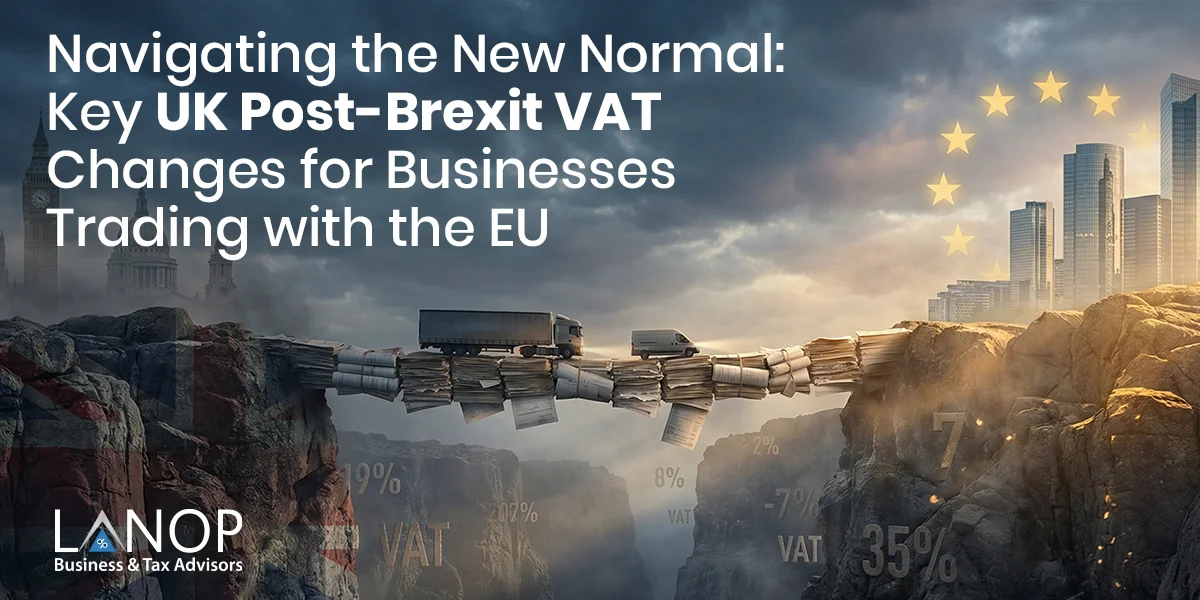
Since the UK officially left the European Union, businesses involved in cross border trade have had to adapt to a significantly different VAT landscape. What was once a relatively straightforward system for trading goods and services within the EU has become more complex, requiring businesses to understand new import procedures, VAT accounting methods, customs declarations, and compliance obligations.

For companies engaged in European trade, understanding the Key UK Post-Brexit VAT Changes for Businesses Trading with the EU is essential for maintaining compliance, avoiding costly mistakes, and protecting cash flow. As regulations continue to evolve, businesses that stay informed are better positioned to trade efficiently and remain competitive.

At Lanop Business and Tax Advisors, we regularly assist businesses in navigating post Brexit VAT requirements and implementing effective tax strategies that support international growth.
Understanding the Post Brexit VAT Landscape
Before Brexit, goods moving between the UK and EU member states were generally treated as intra community transactions. Businesses could account for VAT through acquisition and dispatch rules without dealing with import VAT or extensive customs formalities.
Following Brexit, movements of goods between Great Britain and EU countries are now treated as imports and exports. This shift has introduced new administrative requirements, customs obligations, and VAT considerations for businesses of all sizes.
The result is a trading environment where businesses must carefully manage both VAT and customs compliance to avoid delays, penalties, and unnecessary costs.
Goods Imported from the EU Are Now Treated as Imports
One of the most significant UK VAT changes after Brexit is that goods arriving from EU countries are treated in the same way as goods arriving from non EU countries.
This means businesses importing goods into the UK may be required to:
- Submit customs declarations
- Account for import VAT
- Pay customs duties where applicable
- Maintain detailed import records
- Ensure accurate commodity classifications
These requirements have added complexity to supply chain management and increased the importance of professional tax and customs advice.
Postponed VAT Accounting Has Become a Major Cash Flow Tool
One of the most valuable developments for UK businesses is Postponed VAT Accounting (PVA).
Under traditional import rules, businesses had to pay import VAT when goods entered the UK and reclaim it later through their VAT return. This created significant cash flow pressures, particularly for businesses importing large quantities of stock.
With Postponed VAT Accounting, VAT registered businesses can declare and recover import VAT on the same VAT return rather than paying it upfront. This removes the immediate cash outflow and can substantially improve working capital management.
Benefits of Postponed VAT Accounting include:
- Improved cash flow
- Reduced financing requirements
- Simplified VAT recovery
- Better management of imported inventory costs
Many businesses trading regularly with EU suppliers now consider PVA an essential part of their tax planning strategy.
Exporting Goods to the EU Has New VAT Rules
For UK businesses selling goods to EU customers, exports are generally zero rated for UK VAT purposes, provided the necessary evidence of export is retained.
However, while UK VAT may not be charged, businesses must still consider:
- EU import VAT obligations
- Customs clearance procedures
- Local registration requirements
- Delivery terms and responsibilities
- Customer experience during importation
Failure to understand these obligations can lead to shipment delays and unexpected costs for customers.
Businesses that regularly export goods should review their trading arrangements to ensure VAT responsibilities are clearly defined and properly managed.
New Rules for Low Value Goods
Another important aspect of the Key UK Post-Brexit VAT Changes for Businesses Trading with the EU relates to low value consignments.
Special VAT rules apply to certain imported goods valued at £135 or less. In many cases, VAT collection shifts to the point of sale rather than the point of importation. This affects online retailers, ecommerce businesses, and marketplace sellers.
Businesses selling low value goods should carefully review:
- Marketplace obligations
- VAT collection procedures
- Customer invoicing practices
- Digital sales processes
Incorrect treatment can result in underpaid VAT and potential compliance issues.
VAT on Services Has Changed Significantly
Goods are not the only area affected by Brexit. Businesses supplying services to EU customers have also experienced changes in VAT treatment.
The VAT position depends on several factors, including:

- Whether the customer is a business or consumer
- The nature of the service supplied
- The customer’s location
- Place of supply rules
Certain digital services, professional services, consultancy services, and online offerings may be subject to different VAT obligations than before Brexit.
Businesses providing services across multiple EU countries should regularly review their VAT treatment to ensure compliance with both UK and EU requirements.
Increased Record Keeping Requirements
Accurate record keeping has become more important than ever.
HMRC expects businesses engaged in international trade to maintain comprehensive records that support VAT claims and customs declarations. This includes documentation relating to imports, exports, customs entries, invoices, transport evidence, and VAT calculations.
Strong record keeping helps businesses:
- Support VAT recovery claims
- Demonstrate compliance during inspections
- Reduce errors in VAT returns
- Respond efficiently to HMRC enquiries
Modern cloud accounting systems can play a valuable role in managing these requirements effectively.
Northern Ireland Requires Special Attention
Businesses trading with Northern Ireland face additional complexity because different VAT arrangements continue to apply in certain circumstances.
Depending on the nature of transactions and the movement of goods, businesses may encounter a combination of UK and EU VAT rules. This creates unique compliance considerations that require careful attention.
Companies operating across Great Britain, Northern Ireland, and the EU should seek specialist advice to ensure they apply the correct VAT treatment.
The Impact on Ecommerce Businesses
Online retailers have been among the businesses most affected by post Brexit VAT reforms.
Many ecommerce companies now need to consider:
- EU VAT registrations
- Import VAT management
- Marketplace reporting obligations
- Customer delivery experiences
- Cross border fulfilment strategies
The introduction of systems such as the Import One Stop Shop (IOSS) has created additional opportunities and responsibilities for businesses selling directly to EU consumers.
Careful planning can help ecommerce businesses reduce administrative burdens while maintaining smooth customer transactions.
Common VAT Mistakes Businesses Should Avoid
Many businesses continue to encounter challenges with post Brexit VAT compliance.
Common mistakes include:
- Incorrect use of Postponed VAT Accounting
- Failure to retain export evidence
- Errors in customs declarations
- Misunderstanding import VAT obligations
- Incorrect treatment of digital services
- Poor record keeping practices
Even small mistakes can result in penalties, delayed shipments, and unnecessary tax costs.
Regular VAT reviews can help identify potential issues before they become significant compliance problems.
How Businesses Can Stay Compliant
Successfully navigating the Key UK Post-Brexit VAT Changes for Businesses Trading with the EU requires a proactive approach.
Businesses should:
- Review VAT procedures regularly
- Monitor HMRC updates
- Train finance and logistics teams
- Maintain accurate records
- Conduct periodic compliance reviews
- Seek professional tax advice when needed
As trade rules continue to develop and UK EU relations evolve, staying informed remains critical. Recent discussions between the UK and EU also suggest ongoing efforts to reduce trade friction and simplify certain cross border processes in the future.
Conclusion
The post Brexit trading environment has transformed the way UK businesses manage VAT when dealing with EU customers and suppliers. From Postponed VAT Accounting and import VAT procedures to EU trade VAT rules, customs declarations, cross border VAT compliance, and UK VAT after Brexit, businesses must understand a wide range of obligations to remain compliant and financially efficient.
While the changes have introduced additional complexity, they also present opportunities for businesses that invest in robust systems, effective processes, and expert guidance. By understanding the Key UK Post-Brexit VAT Changes for Businesses Trading with the EU, organisations can reduce risk, improve cash flow, and continue trading successfully across European markets.
At Lanop Business and Tax Advisors, our experienced tax specialists help businesses navigate evolving VAT regulations, optimise compliance processes, and develop practical solutions for international trade. Whether you import, export, or provide services across the EU, professional guidance can make a significant difference in managing your post Brexit VAT obligations effectively.