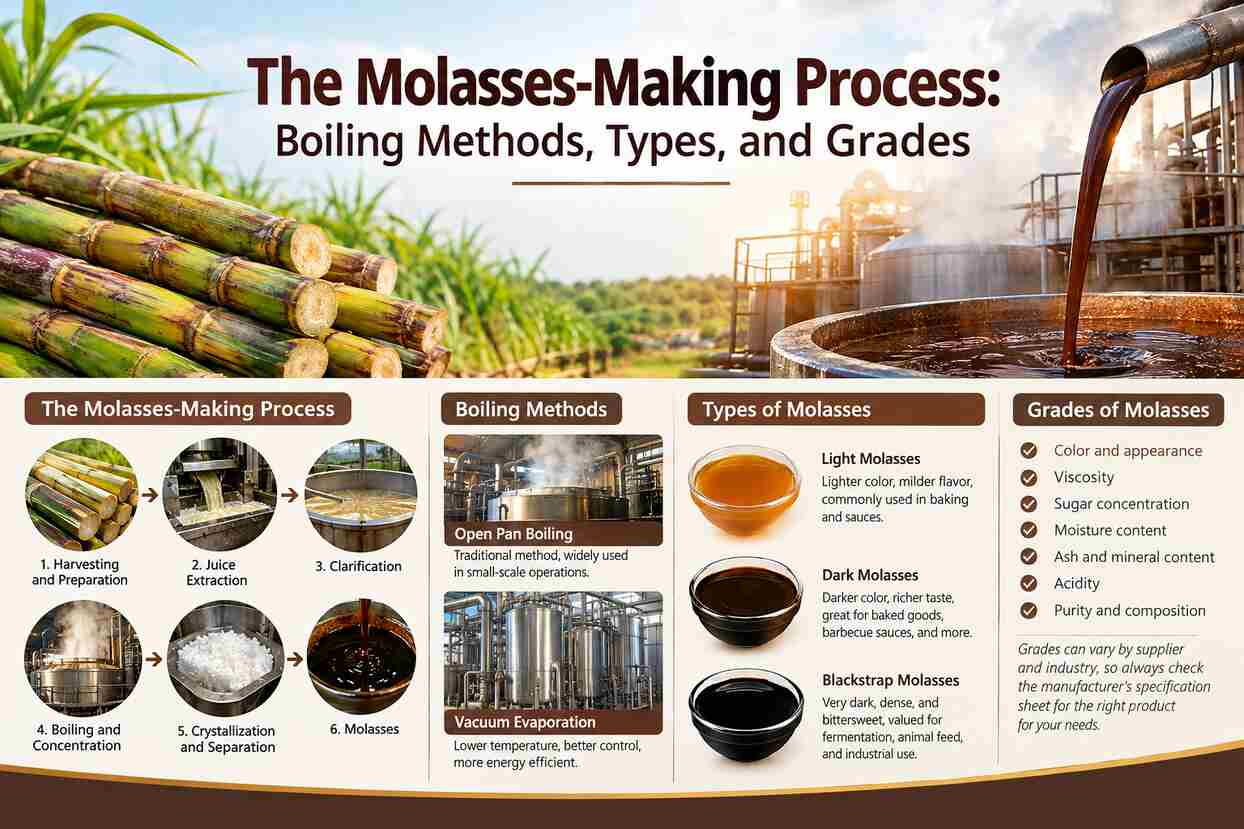
Molasses is a thick, dark, and flavorful syrup best known as a byproduct of sugar production. Although it is often associated with baking and sweeteners, molasses has a much broader range of applications, including animal feed, fermentation, food manufacturing, agriculture, and industrial processing. Its color, flavor, viscosity, and nutritional characteristics can vary significantly depending on the raw material and production method.

Understanding how molasses is made provides valuable insight into why different varieties and grades have distinct characteristics. From extracting plant juice to repeated boiling and crystallization, every stage contributes to the final product.

What Is Molasses?
Molasses is the concentrated syrup that remains after sugar crystals have been separated from sugarcane or sugar beet juice. During sugar production, the extracted juice is clarified and heated to remove water and encourage sugar crystallization. Once the sugar crystals are removed, the remaining liquid becomes increasingly concentrated.
The resulting syrup contains sugars along with minerals, organic compounds, and other naturally occurring substances. Unlike refined sugar, molasses retains many components that are removed during sugar crystallization. This gives it a distinctive dark color, rich taste, and characteristic aroma.
Step 1: Harvesting and Preparing the Raw Material
Sugarcane is one of the most common sources of molasses. After harvesting, the cane is transported to a processing facility and prepared for juice extraction. It is cleaned to remove soil, leaves, and other unwanted materials before being crushed or milled.
During milling, pressure is applied to the cane to release its juice. The remaining fibrous material, commonly called bagasse, can be used as a source of energy in sugar mills.
Sugar beet can also be used to produce molasses. Beets are cleaned, sliced, and processed to extract their sugar-rich juice. Although cane and beet molasses share some characteristics, they can differ in flavor, composition, and typical applications.
Step 2: Juice Clarification
Freshly extracted plant juice contains more than sugar. It may include suspended solids, plant materials, minerals, and other impurities. Before concentration, the juice must therefore undergo clarification.
Heating and clarification treatments help separate unwanted materials from the sugar-rich liquid. The objective is to produce a cleaner juice that can be concentrated efficiently while supporting consistent sugar crystallization.
Proper clarification is important because impurities can affect color, flavor, processing performance, and the quality of the final molasses.
Step 3: Boiling and Concentration
Boiling is one of the most important stages in molasses production. The clarified juice contains a large amount of water, so heat is applied to evaporate water and increase the concentration of dissolved sugars.
Modern sugar facilities often use controlled evaporation systems rather than simply boiling the juice in an open container. Vacuum evaporation can reduce the temperature required for concentration, helping improve energy efficiency and control unwanted changes in the syrup.
As water is removed, the liquid becomes thicker and more concentrated. Sugar crystals begin to form when the solution reaches an appropriate level of supersaturation. These crystals are subsequently separated from the remaining syrup.
Single, Double, and Multiple Boiling
The number of times sugar is crystallized and separated can influence the resulting molasses.
In early stages of sugar recovery, the syrup may produce lighter-colored molasses because more of the easily crystallized sugar remains available for recovery. As processing continues, subsequent boiling and crystallization stages leave behind increasingly concentrated syrups with darker colors and stronger flavors.
This is why terms such as first molasses, second molasses, and final or blackstrap molasses may be used to describe different stages or products. Exact terminology can vary between producers and regions.
Types of Molasses
Several types of molasses are available, each with different characteristics.
Light Molasses
Light molasses generally comes from an earlier stage of sugar processing. It has a lighter color, milder flavor, and sweeter taste compared with darker varieties. It is commonly used in baking, sauces, marinades, and food products where a strong molasses flavor is not desired.

Dark Molasses
Dark molasses is produced after additional sugar crystallization. It is thicker, darker, and has a stronger flavor than light molasses. Its richer taste makes it popular in baked goods, barbecue sauces, gingerbread, and other recipes.
Blackstrap Molasses
Blackstrap molasses is associated with the final stages of sugar crystallization. Much of the crystallizable sugar has already been removed, leaving a very dark, dense syrup with a distinctive bittersweet flavor.
Blackstrap molasses is valued not only as a food ingredient but also for applications involving fermentation, animal nutrition, and certain industrial processes. Its composition makes it particularly useful where concentrated carbohydrates and minerals are desired.
Unsulphured and Sulphured Molasses
Molasses may also be classified according to whether sulfur compounds were used during processing. Unsulphured molasses is generally produced without added sulfur dioxide, while sulphured varieties involve sulfur-based processing or preservation methods.
The choice between these products depends on the manufacturer, raw material, intended application, and market requirements.
Understanding Molasses Grades
Molasses grades can be determined using several quality characteristics. These may include color, viscosity, sugar concentration, moisture content, ash or mineral content, acidity, purity, and other compositional factors.
Industrial buyers may require specifications that are more detailed than those used for household food products. For example, manufacturers purchasing molasses for fermentation may be particularly interested in fermentable sugar content and consistency between batches.
Food processors may prioritize flavor, color, cleanliness, and regulatory compliance. Animal-feed applications may focus on nutritional composition, palatability, and handling characteristics.
Because grading systems can differ among suppliers and industries, buyers should review the manufacturer’s specification sheet rather than relying solely on terms such as “light,” “dark,” or “blackstrap.”
Factors That Affect Molasses Quality
Several factors influence the final quality of molasses. The quality of the original sugarcane or sugar beet is important, as are harvesting conditions, juice extraction efficiency, clarification, evaporation temperature, crystallization practices, and storage.
Temperature control is particularly important. Excessive heating can influence color and flavor, while inadequate concentration can result in a product with undesirable moisture levels. Consistent processing helps manufacturers produce molasses with predictable characteristics.
Storage conditions also matter. Molasses should generally be kept in suitable containers and protected from contamination, excessive heat, and conditions that could negatively affect its stability.
Applications of Molasses
Molasses is used across numerous industries. In food manufacturing, it serves as a sweetener, flavoring ingredient, and coloring component. It is also used in bakery products, sauces, cereals, confectionery, and beverages.
Outside the food industry, molasses can be used as a carbohydrate source for fermentation. It may support the production of yeast, organic acids, alcohol, and other fermentation products. Certain grades are also incorporated into animal-feed formulations.
Its versatility makes molasses an important secondary product of the global sugar industry.
Conclusion
The molasses-making process involves much more than simply boiling sugarcane juice. It is a carefully controlled sequence of extraction, clarification, evaporation, crystallization, and separation. Differences in processing stages produce molasses with distinct colors, flavors, concentrations, and grades.
Understanding these differences helps buyers, food manufacturers, agricultural users, and industrial processors select the right molasses for their specific requirements. Whether the goal is baking, fermentation, animal nutrition, or industrial use, the appropriate grade depends on the product’s composition and intended application.
Article made by: moltaraindo.com