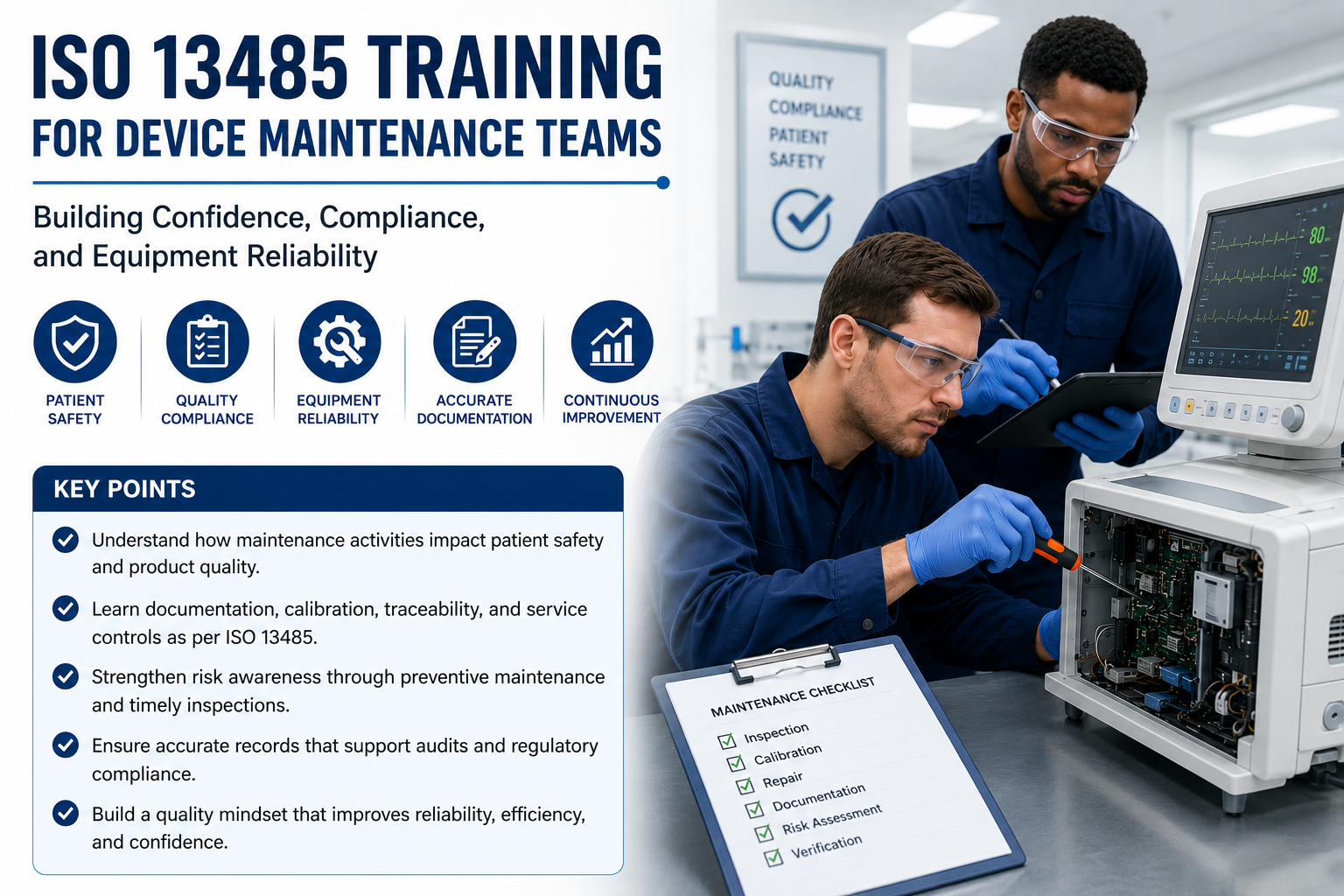
ISO 13485 Training Matters More Than Ever
Medical devices are only as reliable as the people who maintain them. A sophisticated diagnostic machine, a patient monitoring system, or a surgical device can deliver excellent performance for years, but only when proper maintenance procedures are followed consistently. That is where ISO 13485 Training becomes essential for device maintenance teams.
Maintenance professionals often work behind the scenes. They may not interact directly with patients, yet their work has a direct influence on patient safety, regulatory compliance, and operational efficiency. A single overlooked maintenance record or improperly calibrated device can create problems that extend far beyond the workshop floor.
ISO 13485 Training helps maintenance personnel understand how their daily responsibilities connect to the broader quality management system. Rather than viewing maintenance as a technical task alone, teams begin to see how every inspection, repair, and service activity contributes to product quality and patient protection.
Organizations that invest in structured training frequently experience better equipment performance, stronger compliance results, and improved confidence among staff members.
Understanding ISO 13485 Through the Maintenance Lens
Many maintenance professionals assume that quality standards primarily concern manufacturing teams. That assumption is understandable—but incomplete.
The ISO 13485 Standard focuses on quality management systems for medical devices throughout their lifecycle. Maintenance activities form a critical part of that lifecycle because equipment must remain safe, effective, and reliable after installation and during routine operation.
Through ISO 13485 Training, maintenance teams learn how documentation, risk management, corrective actions, and preventive maintenance support regulatory expectations. What might appear to be routine paperwork suddenly takes on greater meaning.
Think of it like maintaining an aircraft. The mechanic tightening a bolt is not simply performing a repair. They are contributing to passenger safety. The same principle applies to medical device maintenance.
When teams understand the purpose behind procedures, compliance becomes less about checking boxes and more about protecting outcomes.
More Than Technical Skills—A Quality Mindset
One interesting aspect of ISO 13485 Training is that it teaches more than technical competence.
Maintenance technicians already possess valuable engineering and troubleshooting skills. The training expands those abilities by introducing a quality-focused perspective.
For example, a technician may successfully repair a device. From a technical standpoint, the job is complete. However, ISO 13485 asks additional questions:
- Was the repair documented correctly?
- Were approved procedures followed?
- Was equipment calibration verified?
- Were replacement components traceable?
- Was risk evaluated after maintenance?
These considerations create a culture where quality becomes part of every decision.
You know what? Many maintenance teams discover that quality management actually makes their jobs easier. Clear procedures reduce uncertainty, standardized records simplify audits, and consistent processes help prevent recurring issues.
The Growing Regulatory Expectations Facing Maintenance Teams
Healthcare regulations continue to evolve across global markets. Regulatory authorities increasingly expect organizations to demonstrate control over every activity that affects medical device quality.
Maintenance departments are no exception.
Through ISO 13485 Training, teams gain a practical understanding of documentation requirements, record retention, equipment validation, and service controls. This knowledge helps organizations prepare for inspections and certification audits with greater confidence.
A common challenge arises when maintenance records are incomplete or inconsistent. Auditors often examine service documentation to verify that equipment remains fit for use. Missing information can create questions about process effectiveness.
Training helps eliminate these gaps by teaching personnel exactly what information should be recorded and why it matters.
The result is a more organized operation and stronger regulatory readiness.
Connecting Maintenance Activities to Risk Management
Risk management sits at the heart of modern medical device quality systems.
At first glance, maintenance technicians may view risk management as a responsibility reserved for quality departments. Yet maintenance activities directly influence risk every day.
Consider a preventive maintenance schedule. When inspections occur on time, potential failures can be detected before they affect performance. Delayed maintenance, on the other hand, may increase operational risks.
ISO 13485 Training helps maintenance teams recognize these connections. They learn how service activities support risk reduction strategies established by the organization.
Here’s the thing: risk management is not always about dramatic failures. Sometimes it involves small details that gradually accumulate. A loose connector, a worn sensor, or an overdue calibration may seem minor individually, but together they can compromise reliability.
Training provides the awareness needed to identify and address such issues before they escalate.
Documentation: The Unsung Hero of Quality Compliance
Few topics generate less excitement than documentation. Yet few areas have greater importance during audits.
Maintenance professionals often prefer hands-on work. Repairing equipment feels productive. Completing records afterward can feel repetitive.
However, ISO 13485 Training emphasizes a simple reality: if an activity is not documented properly, proving it occurred becomes difficult.
Good documentation creates a reliable history of maintenance actions. It allows organizations to demonstrate compliance, analyze trends, and support decision-making.
Effective maintenance documentation typically includes:
- Service dates and activities performed
- Calibration results
- Parts replaced
- Verification testing outcomes
- Technician approvals
- Equipment status after maintenance
Accurate records protect both the organization and the maintenance team. They provide evidence that procedures were followed correctly and consistently.
Preventive Maintenance: Small Actions That Prevent Big Problems
Preventive maintenance often receives less attention than emergency repairs because successful prevention is easy to overlook.
When equipment continues operating without interruption, nobody notices the problems that never occurred.
That is exactly why preventive maintenance is so valuable.
ISO 13485 Training teaches maintenance personnel how planned service activities contribute to equipment reliability and patient safety. Teams learn to follow schedules, document findings, and respond appropriately when abnormalities appear.
The benefits extend beyond compliance. Consistent preventive maintenance can help reduce unexpected downtime, extend equipment life, and lower repair costs.
A useful analogy is routine vehicle servicing. Most people change engine oil before the engine fails, not afterward. Medical device maintenance follows a similar principle, although the stakes are often much higher.
Building Strong Internal Audit Readiness
The word “audit” can make even experienced professionals slightly uneasy.
Yet organizations that embrace ISO 13485 Training often find audits becoming far less stressful. Why? Because trained teams understand what auditors are looking for and how their responsibilities fit into the quality system.
Maintenance personnel frequently participate in audits involving:
- Equipment maintenance records
- Calibration activities
- Service procedures
- Training records
- Corrective action implementation
Training helps employees answer questions clearly and confidently while demonstrating compliance with established procedures.
Over time, audit readiness becomes part of normal operations rather than a last-minute scramble.
Common Challenges Maintenance Teams Face
Every maintenance department encounters obstacles. Some are technical, while others relate to communication, documentation, or resource management.
One challenge involves balancing productivity with compliance. Technicians often work under pressure to restore equipment quickly. While speed is important, quality cannot be compromised.
Another challenge involves maintaining consistency across multiple technicians or facilities. Different approaches can create variation in records and service outcomes.
ISO 13485 Training addresses these concerns by promoting standardized procedures and clear expectations.
Additional challenges often include:
- Managing large volumes of equipment
- Tracking calibration schedules
- Maintaining complete service histories
- Keeping training records current
- Responding effectively to nonconformities
Structured training provides practical methods for handling these issues while supporting continuous improvement.
Benefits of ISO 13485 Training for Device Maintenance Teams
Organizations frequently notice improvements across several operational areas after implementing comprehensive ISO 13485 Training programs.
Some of the most valuable benefits include:
- Improved equipment reliability
- Stronger regulatory compliance
- Better maintenance documentation
- Reduced risk of service errors
- Greater audit preparedness
- Increased employee confidence
- Enhanced patient safety support
- Improved corrective action management
- Consistent maintenance procedures
- Better communication between departments
These advantages create measurable value for healthcare organizations, manufacturers, and service providers alike.
Perhaps most importantly, training helps maintenance personnel understand the significance of their work within the broader quality framework.
Why Continuous Learning Matters in Medical Device Maintenance
Technology never stands still.
New medical devices enter the market regularly. Software updates become more frequent. Regulatory expectations continue to evolve. Maintenance teams must keep pace with these developments.
That is why Medical Device Quality Management is not a one-time learning exercise. Continuous education remains essential.
Regular refresher sessions help reinforce knowledge while introducing updates to procedures, regulations, and industry expectations. Teams remain informed, capable, and prepared for changing requirements.
Interestingly, organizations that prioritize ongoing learning often experience stronger employee engagement. People tend to perform better when they understand both the technical and strategic importance of their work.
Training becomes an investment in both organizational success and professional development.
Why Choose Integrated Assessment Services for ISO 13485 Training?
Selecting the right training provider can significantly influence learning outcomes.
Integrated Assessment Services offers specialized ISO 13485 Training programs designed to help device maintenance teams understand quality management requirements in a practical and meaningful way.
The training approach focuses on real operational challenges rather than theory alone. Participants gain insight into regulatory requirements, documentation practices, maintenance controls, risk considerations, and audit expectations.
Organizations often choose Integrated Assessment Services because of its commitment to practical learning, experienced trainers, and industry-focused guidance. Maintenance professionals can apply concepts directly to their daily responsibilities, making training both relevant and effective.
When employees understand how quality principles connect to their work, compliance becomes a natural part of operations rather than an additional burden.
Conclusion Creating Reliable Systems Through Knowledge and Consistency
Medical device maintenance is about much more than repairing equipment. It is about maintaining trust, supporting patient safety, and ensuring that critical devices perform exactly as intended.
provides maintenance teams with the knowledge needed to support these objectives confidently. It strengthens documentation practices, improves regulatory awareness, enhances risk management efforts, and promotes a culture of quality throughout the organization.
When maintenance teams understand not only how to service equipment but also why quality requirements matter, they become a powerful force behind reliability, compliance, and continuous improvement.