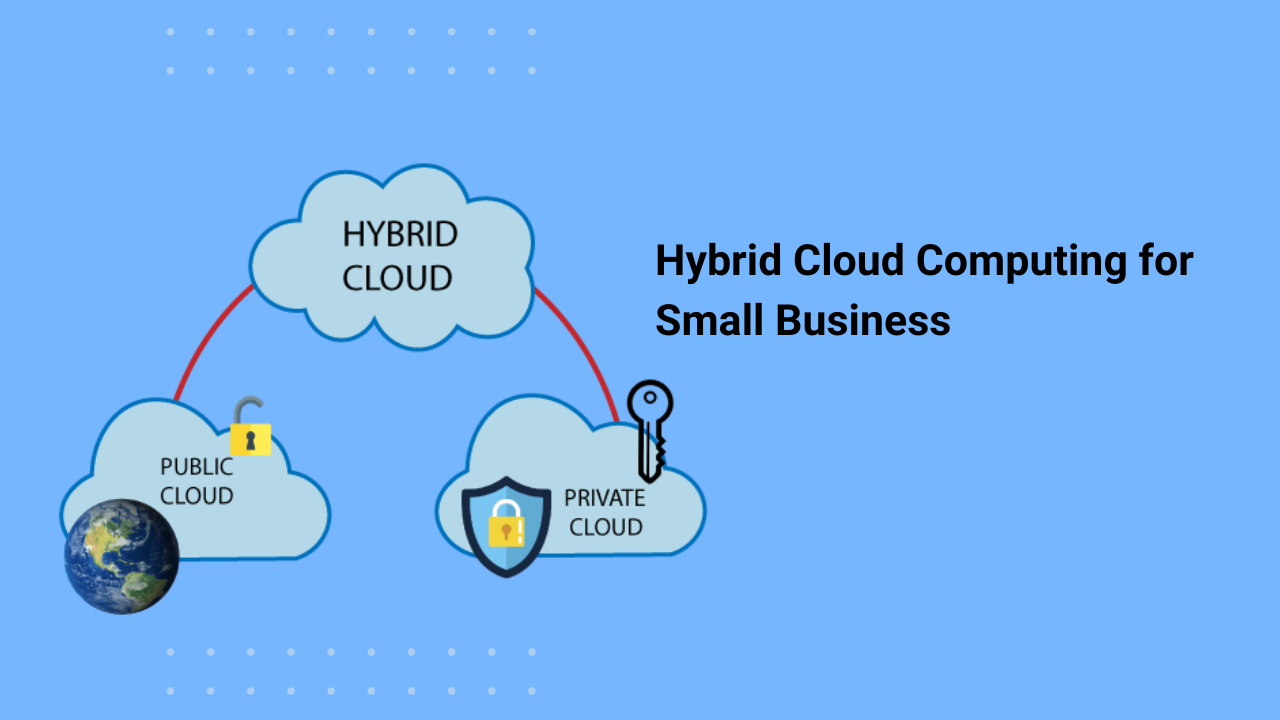
Running a small business often means making technology decisions with a limited budget and even less time. You need systems that work, but you also need to know where your money is going. That’s where hybrid cloud computing for small business can make sense.
A hybrid cloud setup combines private infrastructure with public cloud services. A business might keep sensitive customer records on its own server while running its website, email platform, analytics tools, or business applications through a public cloud provider.
The setup gives small businesses more control over where their data and applications live while still letting them use cloud services when they make financial or technical sense.
What is hybrid cloud computing?
Hybrid cloud computing combines a private computing environment with one or more public cloud services. The private side might be a server located at the company’s office, a dedicated data center, or private cloud infrastructure managed by a hosting provider.
The public side uses shared cloud infrastructure from providers such as Amazon Web Services, Microsoft Azure, or Google Cloud. These environments can communicate with each other so applications and data can move between them when required.
For example, a small accounting firm could keep financial records in a private environment while using public cloud infrastructure for its customer-facing website.
A retail company could store certain business records privately while using cloud resources during periods of higher website traffic. The exact setup depends on the company’s applications, data, budget, and security requirements.
Why would a small business use a hybrid cloud?
Small businesses usually don’t have the same IT budgets as large corporations. They need technology that solves a real problem without creating another expensive project.
Hybrid cloud computing can help when a company has some workloads that need tighter control and others that work perfectly well in a public cloud. Consider a growing online retailer.
Its inventory database may contain information that the business wants to keep in a controlled environment. Its website, meanwhile, might need additional computing resources during holiday sales. A hybrid setup lets the business treat those workloads differently.
The company can keep the database in its private environment and use public cloud resources for parts of the website that need additional capacity. That flexibility is one of the main reasons hybrid cloud has become relevant to smaller companies.
5 Benefits of hybrid cloud computing for small businesses
1. Better control over sensitive data
Some information deserves tighter access controls. Customer records, financial information, employee data, intellectual property, and internal business systems may have specific security or compliance requirements.
With a hybrid cloud model, a company can keep selected data in a private environment while using public cloud services for less sensitive workloads. That gives the business more control over where certain information is stored and who can access it.
2. More control over technology costs
Cloud computing changes how businesses pay for infrastructure. Instead of purchasing every server upfront, a company can use public cloud resources when it needs them. This can reduce the amount of hardware a small business needs to purchase and maintain.
A hybrid model gives the company another option. Businesses can keep workloads that run consistently on existing infrastructure and use public cloud resources for temporary or changing requirements. The right balance can reduce unnecessary infrastructure spending.
3. Easier handling of changing workloads
Business traffic doesn’t always stay the same. An online store might receive normal traffic for most of the year and then see a sharp increase during a holiday promotion. A marketing company could need extra computing resources when processing a large client campaign.
Public cloud infrastructure can provide additional resources when demand increases. The private environment can continue handling workloads that don’t need those extra resources. That separation can make capacity planning easier for a small IT team.
4. Greater flexibility for applications
Different applications have different requirements. An old business application might depend on infrastructure that the company already owns. Moving it immediately to a public cloud could require software changes, testing, and additional costs.
At the same time, newer applications may work well in the cloud. A hybrid approach lets a company keep existing systems where they work best while adopting cloud services for newer workloads. That can make cloud adoption a gradual process instead of one large migration project.
5. Support for business continuity
A hybrid environment can also play a role in backup and disaster recovery. For example, a company could keep its main application on private infrastructure while storing backup copies in cloud storage.
If the primary system experiences a hardware failure, the cloud copy gives the business another place to recover its data. Of course, backup alone doesn’t create a complete disaster recovery plan. Recovery procedures need to be tested, and businesses need to know how quickly their systems can be restored.
Hybrid cloud vs public cloud for small business
Public cloud computing is often easier to start with. A business can create cloud resources without buying physical servers, and many cloud providers handle much of the underlying infrastructure.
For a small company with straightforward workloads, public cloud may be enough. Hybrid cloud becomes more useful when the company has a reason to keep certain workloads in a private environment.
Here’s a simple comparison:
| Factor | Public cloud | Hybrid cloud |
|---|---|---|
| Infrastructure | Public cloud provider | Private + public infrastructure |
| Control | Provider-managed environment | More control over selected workloads |
| Initial hardware needs | Low | Can require private infrastructure |
| Data placement | Primarily cloud-based | Data can be split between environments |
| Flexibility | High | High, with more configuration |
| Management | Generally simpler | Requires more planning and management |
| Best fit | Cloud-first small businesses | Businesses with mixed infrastructure needs |
Neither approach is automatically better. The right choice depends on what the business is actually running and why it needs multiple environments.
What does a small business need to build a hybrid cloud?
A hybrid cloud environment needs more than a private server and a cloud account. The systems need to communicate securely.
That usually involves reliable networking, identity and access controls, encryption, monitoring, backup systems, and policies for moving data between environments. Businesses also need to decide which applications belong in each environment.
For example:
- Customer-facing websites may run in the public cloud.
- Sensitive databases may stay in a private environment.
- Backups may be stored in cloud storage.
- Internal applications may remain on existing servers.
- Development and testing environments may run in the public cloud.
The exact architecture should follow the business requirements rather than the other way around.
What are the challenges?
Hybrid cloud computing has clear advantages, but it also adds complexity. A small business may now have to manage private infrastructure, cloud accounts, network connections, security policies, backups, and monitoring across multiple environments.
That can become difficult when there isn’t a dedicated IT team. Security also needs careful planning. A weakness in the connection between private and public environments can create problems even when each environment is secure on its own.
Costs need attention, too.
Cloud services can look inexpensive when viewed one resource at a time. Storage, data transfer, computing resources, monitoring, and other services can add up over time. Small businesses should track cloud usage regularly and remove resources they no longer need.
Is hybrid cloud right for every small business?
No. A small company with a basic website, email, accounting software, and a few cloud-based applications probably doesn’t need a complex hybrid cloud architecture.
A public cloud setup may be easier to manage. Hybrid cloud makes more sense when a business has a clear reason to split workloads between private and public environments.
That reason could be data control, existing infrastructure, application requirements, recovery planning, or changing workloads. The business should start with the problem and then choose the architecture.
How to get started with hybrid cloud computing
Start small. List the applications and data your business currently uses. Then identify where each workload runs, what information it handles, and how important it is to daily operations. Next, look at the reasons for keeping specific workloads private.
If there’s no clear reason, a public cloud environment might be simpler. For workloads that need private infrastructure, document how they will communicate with public cloud services. Define who can access each system and how data will be protected while moving between environments.
Finally, test the setup before depending on it. Check backups. Test recovery. Monitor costs. Review access permissions. Look at network performance. A hybrid cloud environment should be treated as an ongoing IT system, not a one-time installation.
Conclusion
Hybrid cloud computing for small business can be a practical choice when a company needs both cloud services and greater control over selected workloads. It lets businesses keep certain applications or data in a private environment while using public cloud infrastructure where it makes sense.
The tradeoff is management complexity. For a small business, that’s the part worth considering carefully. If the hybrid setup solves a specific business problem, it can be a useful architecture. If there’s no clear reason for maintaining two environments, a simpler cloud setup may be the better choice.