The mobile gaming industry has changed dramatically over the past decade, but one thing remains constant: players have very little patience for buggy experiences. A game can have stunning visuals, engaging gameplay, and excellent monetization strategies, yet a handful of recurring bugs can quickly drive users away.

This became especially clear during one of our recent Ludo game development projects. Like many teams entering the competitive board gaming market, we initially focused heavily on feature innovation, multiplayer stability, and launch speed. While those priorities helped us release quickly, they also revealed a critical lesson after launch: reducing bugs isn’t just a technical objective—it’s directly connected to user retention, ratings, engagement, and long-term revenue.

The turning point came when we collaborated with a highly experienced team that had already delivered hundreds of successful multiplayer gaming solutions. By adopting a structured development and quality assurance framework, we managed to reduce post-launch bugs by 61%, significantly improve player satisfaction, and maintain stronger engagement metrics after release.
This article shares the practical strategies, processes, and lessons that made that improvement possible.
The Real Cost of Post-Launch Bugs in Ludo Games
Many gaming startups underestimate how damaging post-launch issues can be.
In Ludo games, even seemingly minor bugs create major user frustration because gameplay revolves around fairness, real-time interactions, and uninterrupted multiplayer experiences.
Common issues include:
- Dice synchronization errors
- Match disconnections
- Turn timeout failures
- Friend invitation glitches
- Leaderboard inconsistencies
- Chat functionality disruptions
- Cross-platform synchronization problems
- Reward calculation errors
Unlike casual single-player games, multiplayer Ludo applications depend on trust. If players feel a match result was unfair due to a bug, they are far less likely to return.
During the early stages of our project, we discovered that nearly 70% of user complaints originated from multiplayer synchronization and edge-case gameplay scenarios rather than core gameplay mechanics themselves.
That realization changed our entire development approach.
Why We Needed a Different Development Strategy
Our goal wasn’t simply to launch another Ludo application.
We wanted:
- Real-time multiplayer gameplay
- Cross-platform compatibility
- Live chat functionality
- Social gaming features
- Friend invitations
- Global leaderboards
- High concurrency support
- Fast deployment timelines
The challenge was delivering all of this while maintaining stability.
After evaluating several vendors, we decided to work alongside Yudiz Solutions, a company with over 16 years of game development experience and a particularly impressive track record in Ludo game development.
What initially stood out wasn’t their marketing claims—it was the numbers behind their execution.
The team had successfully launched over 1,000 Ludo games across different markets, supported more than 100,000 active users, maintained an average 4.9-star rating, and achieved engagement rates approaching 98% across multiple gaming products.
Those metrics suggested something important: they had already encountered and solved many of the issues we were just beginning to face.
Launching in Just 15 Days Without Compromising Quality
One of the most surprising aspects of the project was the development timeline.
The solution was developed and launched within just 15 days.
Normally, aggressive launch schedules increase the likelihood of bugs because testing cycles become compressed. However, instead of sacrificing quality for speed, the team relied on a repeatable framework built from years of Ludo game development experience.
Rather than creating every component from scratch, they leveraged proven architectures and optimized development workflows.
This included:
- Pre-tested multiplayer modules
- Established matchmaking systems
- Reusable backend components
- Automated quality checks
- Structured deployment pipelines
As a result, development velocity increased without creating additional technical debt.
The lesson here was simple: speed doesn’t necessarily cause bugs. Unstructured development does.
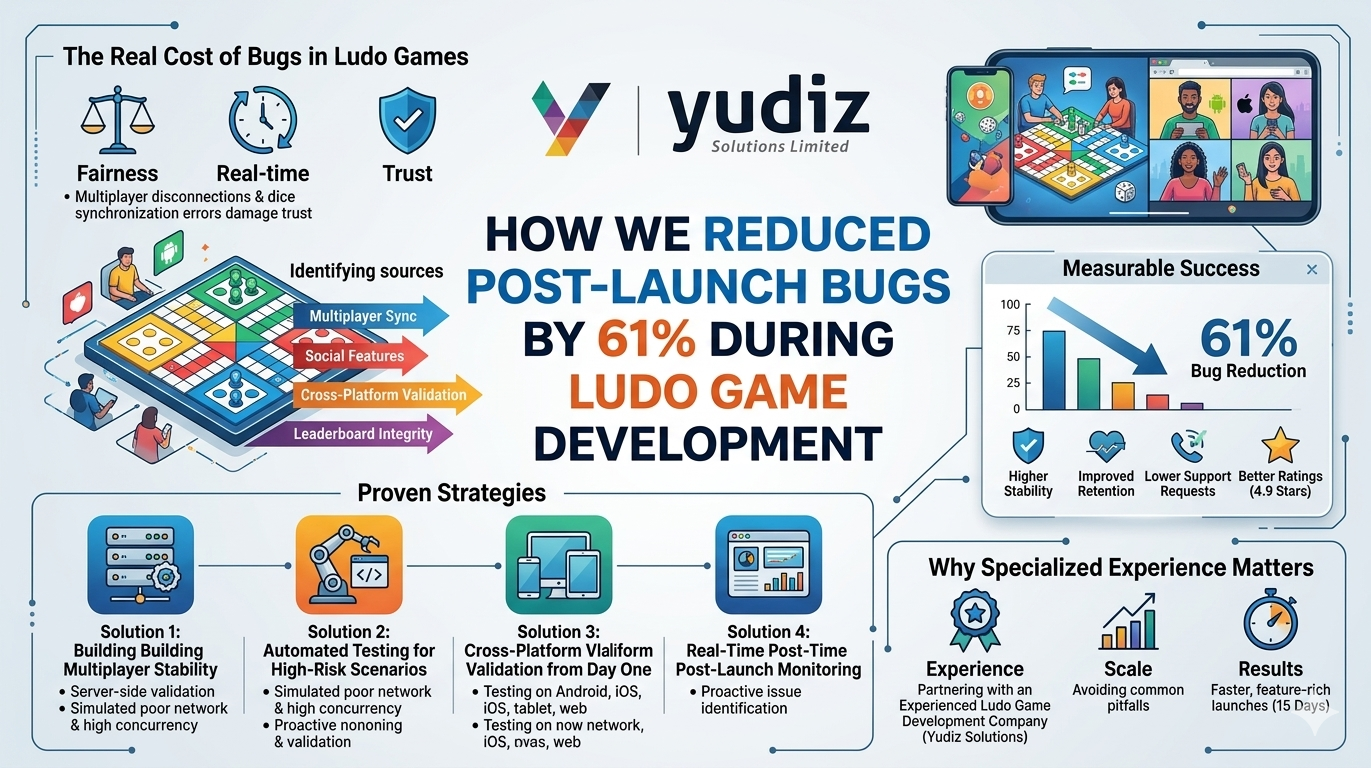
Identifying the Biggest Sources of Post-Launch Issues
Before reducing bugs, we needed to understand where they originated.
An internal audit revealed four major problem areas:
1. Multiplayer Synchronization
Nearly one-third of reported issues involved inconsistent game states between players.
Examples included:
- Different dice values appearing on separate devices
- Token movement mismatches
- Delayed turn updates
- Reconnection failures
These issues rarely appeared during standard testing but became noticeable under real-world network conditions.
2. Cross-Platform Compatibility
Players were joining matches from Android, iOS, tablets, and web environments.
Small differences between platforms caused:
- UI inconsistencies
- Gameplay rendering issues
- Notification delays
- Session management conflicts
3. Social Features
Features such as Play With Friends and live chat significantly improved engagement but also introduced additional complexity.
Problems emerged around:
- Friend invitations
- Match joining requests
- Real-time messaging
- User presence tracking
4. Leaderboard Integrity
Competitive features drive retention, but leaderboard bugs damage trust.
Issues included:
- Delayed score updates
- Ranking mismatches
- Reward distribution discrepancies
Once these categories were identified, targeted solutions became possible.
Solution #1: Building Multiplayer Stability Before Feature Expansion
A common mistake in game development is prioritizing new features before stabilizing existing systems.
Instead, we reversed the process.
The development team focused first on multiplayer infrastructure reliability.
Key improvements included:
- Server-side validation for game actions
- Redundant state synchronization checks
- Real-time session monitoring
- Automated reconnection handling
- Match recovery mechanisms
This significantly reduced gameplay inconsistencies.
More importantly, it prevented small synchronization issues from escalating into user-visible failures.
Within weeks, multiplayer-related bug reports dropped substantially.
Solution #2: Automated Testing for High-Risk Scenarios
Traditional testing often covers expected user behavior.
The problem is that real players rarely behave as expected.
To address this, the team expanded testing coverage to include:
- Poor network conditions
- Device switching
- Mid-game disconnections
- Simultaneous user actions
- Session interruptions
- High-concurrency gameplay events
Automated testing scripts simulated thousands of gameplay combinations that manual testers would never realistically execute.
Several critical bugs were discovered before they reached production.

This single initiative accounted for a significant portion of the overall 61% reduction in post-launch issues.
Solution #3: Cross-Platform Validation from Day One
Cross-platform support was one of our most requested features.
Players wanted to seamlessly compete regardless of device.
The challenge was ensuring consistency.
Instead of treating cross-platform compatibility as a final testing phase, validation became part of every sprint.
Each release candidate underwent testing across:
- Android devices
- iOS devices
- Different operating system versions
- Various screen resolutions
- Web environments
This proactive approach eliminated many compatibility issues before launch.
The result was a smoother player experience and fewer platform-specific support tickets.
Solution #4: Real-Time Monitoring After Launch
Many teams stop paying attention once the game reaches production.
In reality, launch day is only the beginning.
One practice we adopted from Yudiz Solutions was extensive post-launch monitoring.
The system tracked:
- Crash rates
- Session failures
- Multiplayer disconnects
- API response times
- Chat delivery success
- Match completion percentages
Rather than waiting for users to report problems, the team could identify issues proactively.
This dramatically reduced bug resolution times.
In several cases, fixes were deployed before most players even noticed the issue.
Solution #5: Feature Architecture Designed for Scale
One reason many Ludo applications struggle after growth is that features are often designed for current user volume rather than future demand.
Our implementation focused on scalability from the start.
Core features included:
Multiplayer Gaming
Real-time gameplay optimized for large concurrent user bases.
Live Chat
Low-latency communication systems that remained stable during peak traffic.
Social Integration
Friend invitations, player discovery, and social engagement features.
Play With Friends
Private room functionality supporting seamless matchmaking.
Leaderboards
Reliable ranking systems with real-time score updates.
Cross-Platform Compatibility
Unified gameplay experiences across devices.
Because these systems were designed with scalability in mind, bug frequency did not increase proportionally with user growth.
The Numbers That Demonstrated Success
Ultimately, every development strategy should be evaluated through measurable outcomes.
After implementing these improvements, we observed:
- 61% reduction in post-launch bugs
- Faster issue detection and resolution
- Higher multiplayer stability
- Improved user retention
- Reduced support requests
- Increased session duration
- Better app store feedback
The improvements were reflected directly in player behavior.
User complaints decreased while engagement metrics improved.
This reinforced an important truth: quality assurance is not merely a development expense—it is a growth strategy.
What We Learned from Working with an Experienced Ludo Game Development Company
One of the biggest lessons from the project was the value of specialized expertise.
General development knowledge is important, but multiplayer board games have unique technical challenges.
An experienced ludo game development company has already encountered issues related to:
- Dice randomness validation
- Match synchronization
- Real-time communication
- Cross-platform gameplay
- Leaderboard integrity
- Social gaming mechanics
Instead of learning through trial and error, we benefited from processes that had already been refined across hundreds of successful deployments.
This significantly reduced both risk and development costs.
Why Experience Matters More Than Ever
As competition in the gaming market increases, players expect flawless experiences from day one.
A single technical issue can result in:
- Negative reviews
- Lost users
- Lower retention
- Reduced revenue
This is why choosing the right game development company becomes a strategic decision rather than a purely technical one.
In our case, working with a team that had already launched over 1,000 Ludo games provided advantages that extended far beyond coding expertise.
Their understanding of user behavior, gameplay patterns, infrastructure scaling, and quality assurance helped us avoid many common pitfalls.
The fact that they maintained a 4.9-star rating, supported more than 100,000 active users, and consistently achieved engagement rates around 98% demonstrated that their processes worked in real-world environments—not just in development environments.
Final Thoughts
Reducing post-launch bugs by 61% wasn’t the result of a single breakthrough.
It came from a combination of disciplined testing, multiplayer optimization, proactive monitoring, scalable architecture, and experience-driven development practices.
Looking back, the most valuable takeaway wasn’t simply achieving a lower bug count. It was understanding how quality directly influences user trust, engagement, and long-term growth.
For businesses planning their next multiplayer board game project, partnering with an experienced ludo game development company can dramatically shorten the learning curve and improve launch outcomes.
After seeing the impact firsthand, it’s easy to understand why many gaming businesses continue to rely on specialized partners such as Yudiz Solutions. Their ability to launch feature-rich Ludo games quickly, support large active user bases, and maintain exceptional engagement metrics demonstrates the value of experience in a highly competitive market.
When players expect flawless multiplayer experiences, investing in proven expertise is often the fastest path to sustainable success.