End-of-life tyres represent one of the most challenging waste streams in the modern economy. They are bulky, extremely durable, and engineered specifically to resist the environmental degradation that would naturally break down most other materials over time. Left unmanaged, waste tyres accumulate in landfills, illegal stockpiles, and waterways where they create fire hazards, harbour disease-carrying pests, and leach chemicals into surrounding soil and groundwater. Modern tyre recycling technology has turned this environmental liability into a commercial opportunity, recovering valuable materials from waste tyres and converting them into secondary resources that serve industries ranging from construction and manufacturing to sports surfacing and energy generation.

What Tyre Recycling Recovers
A single passenger car tyre contains approximately seven kilograms of recoverable materials that tyre recycling processes extract and separate for resale and reuse:

- Crumb rubber, produced by shredding and granulating the rubber compound into particles of various sizes used in playground surfacing, athletic tracks, road asphalt modification, and moulded rubber products
- Steel wire and bead material, separated magnetically during the shredding process and sold as scrap steel to foundries and steel mills
- Textile fibre from the tyre’s internal reinforcement layers, recovered and used in industrial applications including cement kiln fuel, insulation products, and composite materials
- Carbon black and oils that can be recovered through pyrolysis processes and reused in manufacturing or energy generation
How Modern Tyre Recycling Facilities Operate
Industrial tyre recycling follows a multi-stage mechanical process that progressively reduces whole tyres into separated, market-ready material streams.
The process begins with whole tyre intake and initial size reduction using high-torque shredders that cut tyres into rough chips approximately 50 to 100 millimetres in size. These primary shreds then pass through secondary granulators that reduce them further into smaller particles while liberating the embedded steel and textile components.
Magnetic separation removes steel wire and bead material from the rubber granulate. Air classification and screening systems separate textile fibre from the rubber particles. The resulting crumb rubber is then sized through vibrating screens into specific mesh grades that meet the specifications required by downstream customers in different industries.

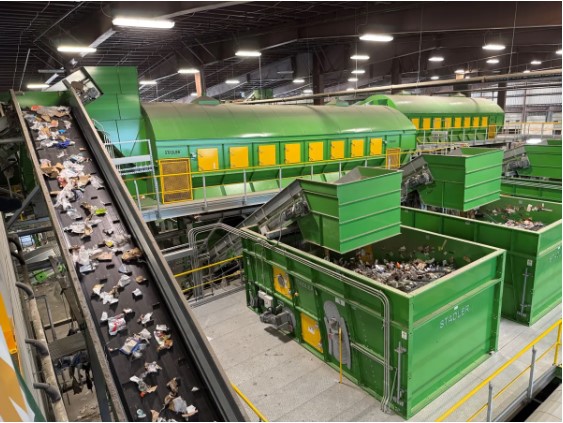
Throughout this process, material handling is critical. Automated conveyor systems move material between each processing stage, ensuring continuous throughput, preventing bottlenecks, and maintaining the consistent feed rates that each machine in the line requires to operate at peak efficiency.
Environmental and Economic Benefits
Tyre recycling delivers measurable environmental benefits that extend well beyond simply diverting waste from landfill:
- Each tonne of tyres recycled prevents the equivalent environmental damage of landfilling a material that would persist unchanged for centuries
- Recovered crumb rubber displaces virgin materials in manufacturing, reducing the demand for new raw material extraction and processing
- Steel recovery from tyre recycling feeds directly into the scrap metal supply chain, reducing energy consumption and emissions associated with primary steel production
- Tyre-derived fuel used in cement kilns and industrial boilers provides consistent energy output while solving a waste disposal problem simultaneously
Economically, tyre recycling creates employment, generates revenue from recovered material sales, and reduces the public cost of managing illegal tyre stockpiles and the environmental contamination they cause.
Applications for Recycled Tyre Materials
The products recovered through tyre recycling serve a surprisingly diverse range of end markets:
- Sports and playground surfacing, where crumb rubber provides impact-absorbing, weather-resistant surfaces for athletic facilities, children’s play areas, and recreational spaces
- Road construction, where rubberised asphalt incorporating crumb rubber delivers improved road surface durability, reduced road noise, and enhanced wet-weather grip
- Moulded products including rubber mats, tiles, speed bumps, and equestrian arena surfaces manufactured from recycled crumb rubber
- Civil engineering applications where tyre-derived aggregate provides lightweight, free-draining fill material for retaining walls, bridge abutments, and drainage structures
The Last Word
Tyre recycling has matured from an experimental waste management concept into a commercially viable industry that delivers genuine environmental and economic returns at scale. For facility operators and waste management companies looking to build or upgrade their tyre recycling processing lines, investing in robust, industrial-grade conveyor systems ensures reliable material handling between every stage of the process and the continuous throughput that underpins profitable, high-volume tyre recycling operations.