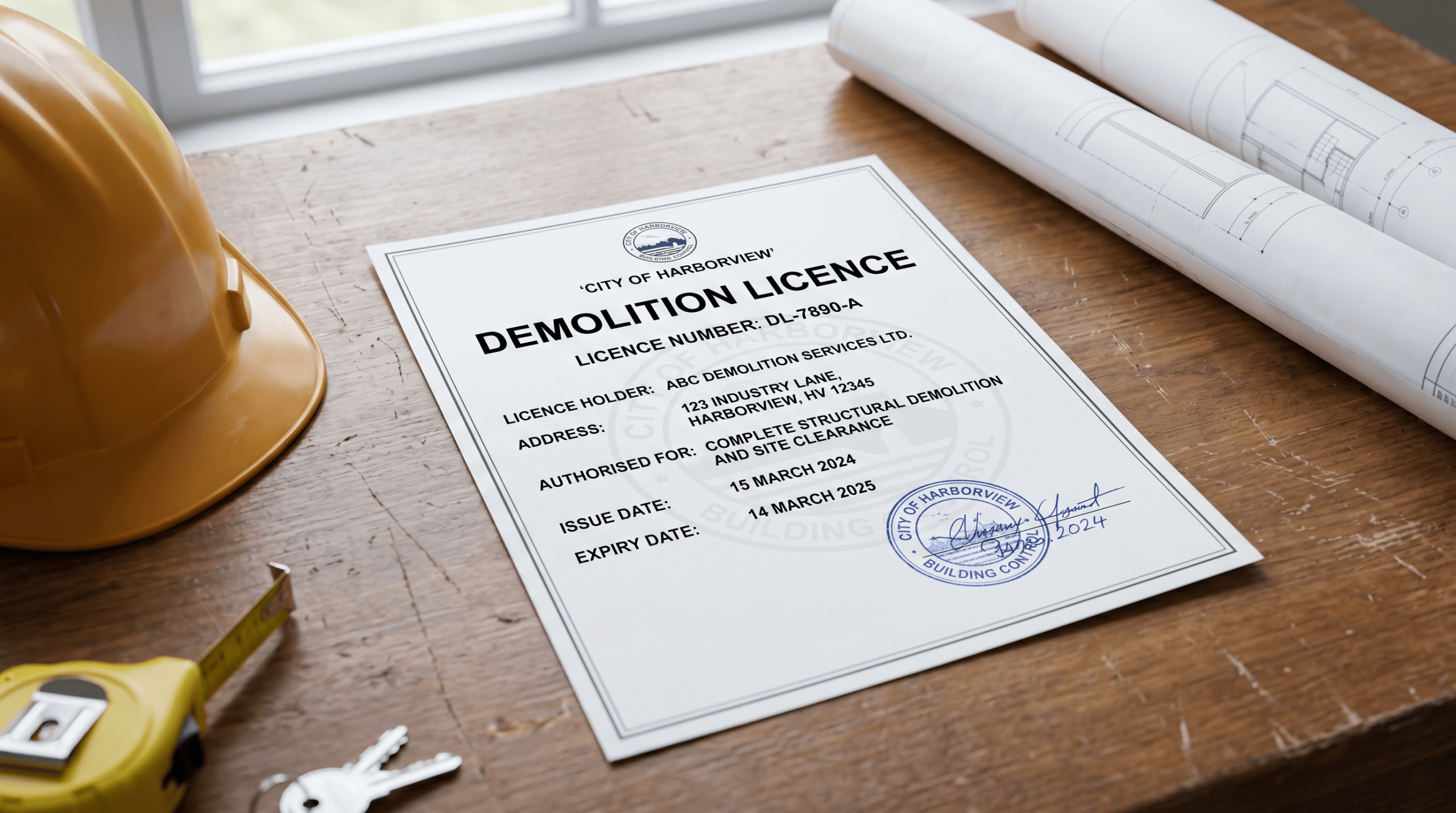
Many legal problems in construction are related to the absence of permits and licences, such as demolition licences. Obtaining a demolition licence is necessary because it is a complicated and technical process that guarantees safety, environmental preservation, and structural stability.
To obtain a demolition licence, you must apply to the local council, attaching documents such as site plans, an engineer’s report, safety plans, and the contractor’s information. Once reviewed, inspected, and a fee paid, the licence is granted if all safety and legal requirements are satisfied.
Otherwise, you may be faced with substantial fines, legal challenges, and even work stoppages. This is why this process needs to be understood by all property owners, contractors, and developers.
Understanding a Demolition Licence: What It Is and Why It’s Required
A licence for demolition is a permission granted by the government to demolish (partial or full) a building, wall or structure. It’s obtained from the municipal government or other authorities.
Why is it Necessary?
- Public Safety: The hazards of debris, dust, and materials falling are present during demolition
- Environmental Safety: Asbestos, lead paint, and other hazardous materials need to be disposed of safely
- Adjacent Building: Improper demolition may cause issues with the foundations of adjacent structures
- Utility: The most important part of demolition is the protection of underground and above-ground gas, electricity, and water lines
- Legal Protection: Licences provide legal protection for the contractor and owner
Understanding Construction Project Planning
Construction planning is crucial for any construction project. This includes estimating the costs of materials, labour, and other aspects, and construction estimation services assist with accurate cost forecasting. This helps avoid cost blowouts and enhances project management.
Basics of Demolition Project Planning
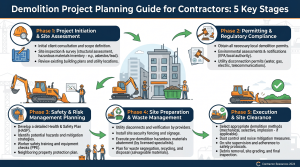
Budgeting is necessary for successful demolition projects. In the planning stage, demolition estimators are engaged to determine the costs of labour, machinery, and disposal. This allows for safe and efficient demolition on budget.
Types of Demolition and Their Licence Process
Not all demolition is equal – different types of demolition require different types of licences:
1. Complete Demolition
Dismantling the entire building/structure. This is the most complicated process and requires more paperwork.
2. Partial Demolition
Tearing down a part of the building, like a floor, wall or extension. A licence is still required, but it’s a simpler process.
3. Interior Demolition
When you are demolishing walls, ceilings or floors within a building. It may be possible to secure a simplified permit if there isn’t any structural work.
4. Emergency Demolition
In cases where a structure is in such a dangerous condition, it needs to be removed immediately. In this situation, a “demolition emergency order” is issued, and it’s an expedited process
Eligibility Requirements
Before applying for a demolition licence, check the following:
- Ownership Evidence: Applicant must own the property or be a representative
- Registered Contractor: In most cases, a registered demolition contractor
- Engineer’s Report: A report on the site by a qualified engineer
- Safety Officer on-site: A safety officer to oversee the job
- Public Liability and Worker’s Comp Insurance: Insurance for public liability and workers’ compensation
- Authorities’ Consent: Consent from authorities such as the council to conduct the demolition
Step-by-Step Guide: in Detail
Step 1: Pre-Application Preparation
These should be done before applying:
- Have a full survey of the site undertaken
- Survey by a structural engineer
- Conduct testing for such items as asbestos and lead
- Notify the neighbours of the property
- Notify utilities of disconnections
The importance of this step is that it’s critical in getting subsequent approvals.
Step 2: Application Submission
These should be submitted to your local authority:
- Completed application forms
- Site plan and drawings
- Demolition method statement
- Safety management plan
- Structural engineer’s report
- Copy of contractor’s licence
- Insurance documents
The form can be filled out online or in a hard copy. It varies from authority to authority.
Step 3: Site Inspection
The authority’s inspector inspects the site, looking at:
- Actual condition of the building
- Safety of the adjacent properties
- Safety measures planning
- Location of driveways and traffic control
- Location of utilities
The inspector lodges his/her report, upon which the approval will be based.
Step 4: Review of Safety documentation
The authority reviews at this point all of the:
- Risk assessment document
- Emergency response plan
- Worker safety procedures
- Measures to control dust and noise
- Waste disposal plan
If there are any gaps, the authority could request more information.
Step 5: Notification To Neighbours: Objections
In some countries, it is necessary to send out notifications to neighbours. Neighbours are allowed to lodge any objections. If there is a serious objection to the development, then a hearing may be held.
Step 6: Fee Payment
The licence fee varies, depending on the project. Processing of the application will only start when the fee is paid.
Step 7: Licence Issuance
Once all the requirements have been fulfilled, the demolition licence will be issued, stating:
- Authorised dates to conduct the demolition
- Working hours
- Safety conditions
- Waste disposal requirements
- Schedule of inspections during demolition
Legal and Safety
Worker Safety
- All workers must wear PPE (hard helmet, gloves, goggles, and a mask)
- Safety briefings need to be carried out regularly
- The site must have an evacuation plan posted in a prominent location
- The site must have a first aid kit and a first aider
Public Safety
- Barricading and/or fencing of the site is necessary
- Water spraying to minimise dust must be provided
- Warning signs and boards to be erected
- The traffic control plan is to be in place
Environmental Compliance
- Use a waste disposal contractor for asbestos, chemical, and hazardous waste
- Separate waste products: recycle if applicable
- Ensure noise and dust are below industrial noise and dust levels
- Prevent runoff to avoid pollution of local drains
Common Mistakes to Avoid
1. Incomplete Documentation
The most frequent error, if any of the documentation is missing, the application can be disallowed or delayed. Double-check and make lists.
2. Contractor isn’t Licensed
Make sure you have a registered and licensed demolition contractor. You’ll be liable for using an unlicensed contractor.
3. Not Disconnecting Utilities
Leaving gas and/or electricity on can cause injuries. Have the utilities been turned off?
4. Ignoring Neighbours
If you don’t notify neighbours, there could be legal issues, and it may even invalidate the licence.
5. Taking the Safety Plan as Paperwork
The safety plan is not to be put down just on paper. It needs to be put into action.
6. Violating Working Hours
Only operate your business between the times listed on the licence – fines can be imposed for neighbour complaints.
Need for Good Demolition Practice
Planning a demolition will make it quick, safe, and cheap:
- Do Demolition in Stages: To control the risks
- Where to put the rubble: Figure out where to put the rubble
- Do not Rush: Accidents are prone to happen when working in a rush
- Budgeting: Factor in additional costs such as disposal of toxic waste
- Alternative Plan: Be prepared for an alternative plan in case of any unforeseen structural problems
Conclusion
Obtaining a demolition licence is a long process, where pre-planning, paperwork, inspection, and compliance are all required. It’s not about just signing the paperwork. It is about putting into practice all safety measures that will make demolition legal and safe.
Those who follow this process do their job well, are cost-effective, and don’t run into legal issues. Demolition is not a physical process. It is an engineering activity that is regulated and requires planning.
FAQs
Can I pass on my licence?
The licence can’t be transferred as it is specific to the applicant and project. If there is a change in the contractor, it will have to be amended.
What will happen if I don’t have a licence?
Large fines, stop work orders, that the work will have to be rebuilt, and in some cases, criminal charges.