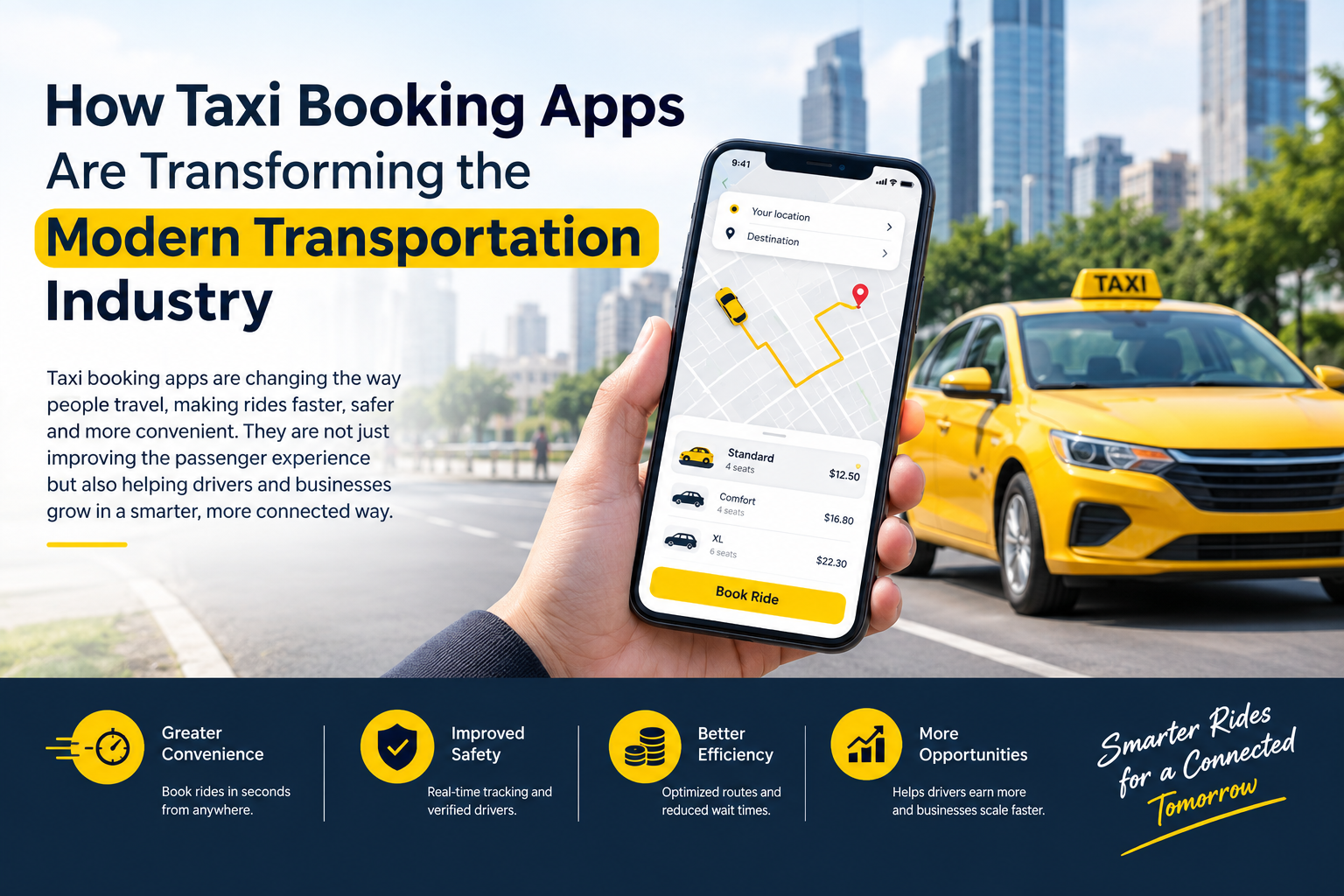
Imagine leaving your home for an important meeting without worrying about finding a taxi, negotiating the fare, or wondering whether the driver knows the fastest route. You open an app, enter your destination, check the estimated price, and watch your ride approach on a map. Within minutes, your journey is underway.

This simple experience reflects a major shift in how people access transportation.

Taxi booking apps have transformed the traditional process of hiring a cab into a connected digital experience. By combining smartphones, GPS navigation, digital payments, real-time communication, and intelligent ride-matching systems, these applications have changed what passengers expect from everyday travel.
The transformation extends beyond convenience. Drivers can discover new customers, businesses can manage transportation more efficiently, and cities can explore new ways to connect people with existing mobility services.
As transportation needs continue to evolve, taxi booking apps are becoming an important part of the wider mobility ecosystem. Their future will depend on how effectively they balance convenience, affordability, safety, environmental responsibility, and fair opportunities for drivers.
Let’s explore the key ways taxi booking apps are reshaping the modern transportation industry and what these changes mean for passengers, drivers, businesses, and technology providers.
1. Making Everyday Transportation More Convenient
One of the most noticeable changes brought by taxi booking apps is the removal of unnecessary steps from the booking process.
Traditionally, passengers might need to call a taxi company, wait for confirmation, explain their location, and negotiate pickup arrangements. In unfamiliar areas, finding an available cab could be even more difficult.
Booking applications simplify this experience by bringing the essential information into one place.
Passengers can enter their pickup location, select a destination, choose a vehicle category, review an estimated fare, and confirm the booking. Depending on the service, they may also schedule a future ride or save frequently visited locations.
These features are particularly useful for airport transfers, business meetings, medical appointments, and everyday commuting. Businesses looking to deliver similar convenience to their customers can partner with the Best taxi App Development company to build feature-rich booking platforms that simplify ride reservations and improve the overall passenger experience.
Convenience also comes from better communication. Passengers can see whether a driver has accepted the booking, monitor the vehicle’s approach, and contact the driver when pickup instructions need clarification.
For transportation companies, these digital workflows reduce dependence on manual booking coordination and make it easier to manage customer requests.
The real improvement is not simply that booking takes fewer taps. It is that passengers gain greater visibility and control over a journey that once involved considerable uncertainty.
2. Real-Time GPS Tracking Is Changing the Travel Experience
Location technology has become one of the foundations of app-based transportation.
Modern taxi booking applications use GPS data and digital mapping services to help identify pickup locations, display vehicle movements, estimate arrival times, and guide drivers toward destinations.
This creates advantages for both sides of a booking.
Passengers can check whether their driver is approaching and prepare for pickup accordingly. Drivers can receive navigation assistance and clearer directions to unfamiliar addresses.
Accurate pickup information can also reduce avoidable delays. For instance, identifying the correct entrance to a shopping centre or office complex may be more useful than simply sharing the property’s name.
For transportation operators, location data can support fleet visibility and operational planning. When used responsibly, aggregated trip information may help identify busy pickup areas, recurring delays, and locations where additional driver availability could improve service.
However, estimated arrival times are not guarantees. Traffic congestion, road closures, weather, GPS inaccuracies, and unexpected passenger requests can affect the actual journey.
The next stage of location-based innovation will likely focus on improving the connection between digital maps and real-world pickup conditions.
3. Smarter Algorithms Are Improving Ride Matching
A taxi booking platform must solve a constantly changing problem: connecting passengers with available drivers while considering distance, demand, traffic, and service requirements.
This is where automated ride-matching systems become valuable.
When a passenger requests a ride, the platform can evaluate nearby drivers and determine which ones may be suitable for the booking. The system may consider estimated pickup time, vehicle category, driver availability, and other operational factors.
As more journeys take place, platforms can analyze historical demand patterns to anticipate periods of increased activity.
For example, an application may identify that a business district regularly experiences heavy booking demand during evening commuting hours. Operators can use these insights to encourage driver availability near that area before demand peaks.
Machine learning may also help improve demand forecasting, detect unusual booking patterns, and refine arrival-time estimates.
Nevertheless, algorithms cannot eliminate every transportation challenge. If too few drivers are available during a major event, better matching alone will not create additional vehicles.
Successful platforms combine intelligent software with effective driver participation, reliable operational support, and realistic service expectations.
The broader benefit is a more responsive transportation system that can adapt to changing travel patterns instead of relying entirely on manual coordination.
4. Digital Payments Are Making Transactions Simpler
Payment is an essential part of the passenger experience, and taxi booking apps have made it easier to complete transactions without relying exclusively on cash.
Depending on the platform and location, passengers may be able to pay through credit or debit cards, digital wallets, bank transfers, or other supported payment methods.
This flexibility is especially helpful for travelers who do not carry local currency or prefer to keep a digital record of their expenses.
Electronic receipts can also simplify expense management for business travelers. Instead of collecting paper receipts after every journey, passengers can access trip details and payment records through the application.
For drivers and operators, integrated payment systems can reduce the administrative effort associated with collecting fares and reconciling transactions.
However, digital payments introduce responsibilities around transaction security, refunds, payment disputes, and protection against fraud. Applications need dependable payment infrastructure and clear procedures for resolving failed transactions.
The opportunity goes beyond offering multiple payment methods. A well-designed payment experience makes transportation easier to access while giving passengers and operators greater clarity about what was charged and why.
5. Improving Passenger Safety Through Connected Features
Safety remains one of the most important considerations when choosing a transportation service.
Taxi booking apps can introduce several safeguards that are difficult to coordinate consistently through informal booking arrangements.
Depending on the platform, these may include driver identity verification, vehicle information, trip sharing, emergency assistance, ratings, and records of completed journeys.
Passengers can share trip details with trusted contacts so someone else knows the expected route and destination. Some applications also provide an in-app emergency feature designed to connect passengers with assistance.
Driver verification and vehicle documentation checks can help platforms establish baseline eligibility requirements. Ratings and feedback may identify recurring service problems that require investigation.
Yet technology should not create a false sense of security. GPS tracking does not prevent every incident, and an emergency button is only useful when it connects to an effective response process.
Transportation providers need clear escalation procedures, trained support teams, appropriate verification practices, and cooperation with relevant authorities where necessary.
Safety features should also be easy to locate and use under stressful conditions.
Ultimately, the value of a safety system depends not only on what appears on the screen but also on what happens after a concern is reported.
6. Creating New Earning Opportunities for Drivers
Taxi booking applications have changed how many drivers find passengers and organize their working time.
Instead of depending entirely on roadside demand, taxi stands, or established customer networks, participating drivers can receive booking opportunities through a digital platform.
This can help independent drivers reach customers who might otherwise never discover their services. Some platforms also offer access to different trip categories, scheduled bookings, or demand information.
The flexibility of app-based work can appeal to drivers seeking greater control over when they work. However, actual earning opportunities vary according to local demand, platform policies, fuel costs, vehicle expenses, and the number of competing drivers.
A driver’s earnings should therefore be evaluated after accounting for commissions or subscription fees, maintenance, insurance, fuel, financing, and unpaid waiting time.
This is an important issue for the industry’s future.
Transportation platforms that communicate fare calculations clearly, provide reliable support, and establish fair dispute processes may build stronger relationships with drivers.
Alternative business structures, including cooperative and subscription-based platforms, are also exploring different ways to distribute the value created by digital ride-hailing.
The long-term success of taxi booking apps will depend partly on whether they create sustainable opportunities for the people who provide the rides, not just convenient experiences for passengers.
7. Making Transportation More Accessible and Inclusive
Transportation needs are not the same for everyone.
An older passenger may need a simpler booking interface. A person with a disability may require a wheelchair-accessible vehicle. A traveler unfamiliar with the local language may need multilingual support.
Taxi booking apps can help address some of these differences through thoughtful product design.
Features such as larger text, clear navigation, voice assistance, saved destinations, and simplified booking flows can make applications easier to use.
Where available, specialized vehicle categories can help passengers identify transportation suited to their mobility requirements. Clear information about vehicle accessibility is particularly important because not every vehicle can accommodate every passenger’s needs.
Platforms can also explore options for family travel, traveling with pets, advance bookings, and additional assistance during pickup.

These capabilities should be developed around genuine user needs rather than added merely to make a feature list appear comprehensive.
Accessibility also requires practical service availability. An application may offer an accessibility option, but the feature has limited value if suitable vehicles are rarely available in the passenger’s area.
By combining inclusive interface design with dependable vehicle supply and responsive support, taxi booking services can make transportation more usable for a wider range of people.
8. Connecting Taxi Services With the Wider Mobility Network
Modern transportation rarely involves a single mode of travel.
A commuter might walk to a metro station, use a train for the main journey, and book a taxi for the final few kilometres. An airport traveler may combine an intercity train with a scheduled cab transfer.
Taxi booking apps can support these journeys by connecting passengers with transportation options at important points in their trip.
Some platforms are beginning to integrate public transit information, ticket purchasing, airport pickup services, or other mobility features. The exact capabilities depend on the market and the partnerships available.
This creates opportunities for a more connected mobility experience.
For example, a passenger arriving at a railway station could use an application to arrange a ride to a hotel without separately searching for local taxi operators.
Businesses may also use digital booking systems to coordinate employee transportation, airport transfers, and customer pickups.
The larger opportunity is to position taxi booking applications as part of an integrated transportation network rather than isolated ride-hailing tools.
However, this requires reliable data sharing, compatible systems, and coordination between different transportation providers.
When these elements work together, passengers can plan journeys around their actual needs instead of navigating disconnected services.
9. Supporting More Efficient Fleet and Business Management
Taxi booking technology is also transforming the operational side of the transportation industry.
For taxi companies, fleet operators, and businesses managing multiple vehicles, digital systems can centralize booking information, driver assignments, trip records, and payment data.
Instead of coordinating every request through phone calls or spreadsheets, operators can use a dashboard to monitor activity and identify issues that require attention.
Fleet analytics can help answer practical questions:
- Which areas generate the most booking requests?
- When are vehicles spending too much time waiting between trips?
- Which routes regularly experience delays?
- How frequently are bookings cancelled?
- Which vehicle categories are most in demand?
These insights can support better scheduling and resource allocation.
Some fleet management systems also incorporate vehicle maintenance reminders, fuel monitoring, driver documentation, and expense reporting.
For corporate transportation, centralized booking and reporting can improve oversight of travel expenses and simplify the process of arranging rides for employees or customers.
The objective is not to collect as much data as possible. It is to turn relevant information into decisions that improve service reliability and reduce unnecessary operating costs.
Operators must still protect personal information, restrict access to sensitive trip records, and ensure that analytics are used appropriately.
10. Changing How Transportation Prices Are Determined
Pricing is one of the most influential aspects of the taxi booking experience.
Many applications display an estimated fare before a passenger confirms a booking. This helps customers compare available options and decide whether the journey fits their budget.
Depending on the platform, pricing may consider distance, estimated duration, vehicle category, local fare rules, and market conditions.
Some services also use demand-based pricing, which may increase fares when booking requests exceed available driver supply. While this can encourage more drivers to become available, sudden price increases can frustrate passengers who have limited alternatives.
Other platforms experiment with different approaches, including fare estimates with more predictable pricing, subscription models, or options that trade a longer wait for a lower fare.
For example, a passenger who is not in a hurry may prefer to wait several extra minutes if doing so reduces the cost of the trip.
Clear communication is essential regardless of the pricing model. Passengers should understand the estimated cost, applicable fees, and circumstances that could change the final fare.
Drivers also need pricing structures that account for the real costs of operating a vehicle.
The challenge for the industry is to develop pricing systems that balance passenger affordability, driver earnings, service availability, and business sustainability.
11. Encouraging More Sustainable Urban Mobility
Taxi booking apps have a complicated relationship with environmental sustainability.
On one hand, they can make it easier to arrange shared rides, locate electric vehicles where available, and coordinate journeys with public transportation. Fleet analytics may also help operators manage vehicle utilization and reduce certain forms of unnecessary driving.
On the other hand, app-based transportation can contribute to congestion when vehicles travel without passengers between bookings or replace journeys that would otherwise have been made by walking, cycling, or public transit.
The environmental impact depends on several factors, including vehicle type, occupancy, trip distance, passenger behavior, and how much empty driving occurs.
Transportation platforms can encourage more sustainable outcomes through practical measures such as:
- Offering electric vehicle categories where charging infrastructure supports them.
- Supporting shared rides when appropriate and permitted.
- Helping drivers reduce unnecessary waiting and repositioning.
- Integrating taxi services with public transit connections.
- Providing accurate information about vehicle options and trip characteristics.
Electric vehicle adoption also requires attention to charging availability, vehicle purchase costs, maintenance arrangements, and realistic driving ranges.
Technology alone cannot solve urban congestion or emissions. However, thoughtfully designed taxi booking services can contribute to a broader mobility strategy that prioritizes efficient vehicle use and convenient alternatives to private car ownership.
12. The Future of Taxi Booking Apps: AI, Automation, and Personalization
The next generation of taxi booking applications is likely to focus on making transportation more predictive, personalized, and connected.
Artificial intelligence may help estimate demand, improve pickup accuracy, identify unusual transaction patterns, and assist customer support teams.
Conversational interfaces could allow passengers to request a ride using everyday language. For instance, a user might ask for a vehicle to pick them up after a scheduled meeting, subject to the application’s booking and calendar permissions.
Personalization may also improve the experience by remembering frequently visited destinations, preferred vehicle categories, and accessibility requirements.
For fleet operators, predictive maintenance systems could help identify potential vehicle issues before they cause unexpected downtime.
Over time, transportation platforms may become more closely connected with smart-city infrastructure, electric vehicle charging networks, public transit services, and corporate mobility systems.
Nevertheless, these advances introduce new responsibilities.
AI-generated recommendations need to be reliable, personal information must be handled carefully, and automated decisions affecting drivers should have appropriate oversight.
The most successful innovations will be those that solve real transportation problems rather than simply introducing more technology.
13. Challenges the Industry Must Address
Despite their advantages, taxi booking apps face several important challenges.
Data privacy: Location histories, payment details, and personal information require appropriate security and access controls.
Uneven availability: Drivers may be plentiful in busy commercial districts but scarce in less populated areas or during off-peak hours.
Driver economics: Fuel, maintenance, financing, and platform charges can affect the sustainability of driver earnings.
Regulatory complexity: Licensing, insurance, fare rules, vehicle requirements, and platform obligations differ across jurisdictions.
Technology dependence: App outages, connectivity problems, and payment failures can interrupt access to transportation.
Service quality: Cancellations, inaccurate pickup points, and inconsistent customer support can undermine trust.
Addressing these challenges requires collaboration between technology companies, drivers, regulators, fleet operators, and passengers.
It also requires a realistic understanding of what an application can accomplish. Digital booking improves coordination, but it cannot replace sound transportation planning, responsible management, and effective customer support.
Conclusion
Taxi booking apps have reshaped the transportation industry by making rides easier to arrange, improving journey visibility, simplifying payments, and creating new ways to connect passengers with drivers.
Their influence now extends into fleet management, accessibility, corporate transportation, public transit integration, and sustainability initiatives.
For passengers, these developments offer greater choice and convenience. For drivers, they can create new opportunities to reach customers. For transportation businesses, they provide tools to manage operations and make more informed decisions.
However, lasting progress depends on more than an intuitive application. Safety, fair pricing, driver welfare, privacy, accessibility, and reliable service must remain central to the industry’s development.
As technology continues to advance, taxi booking platforms will have opportunities to become more intelligent and connected. The real measure of their success will be whether these improvements make everyday journeys more dependable, inclusive, affordable, and sustainable.