The Short Answer
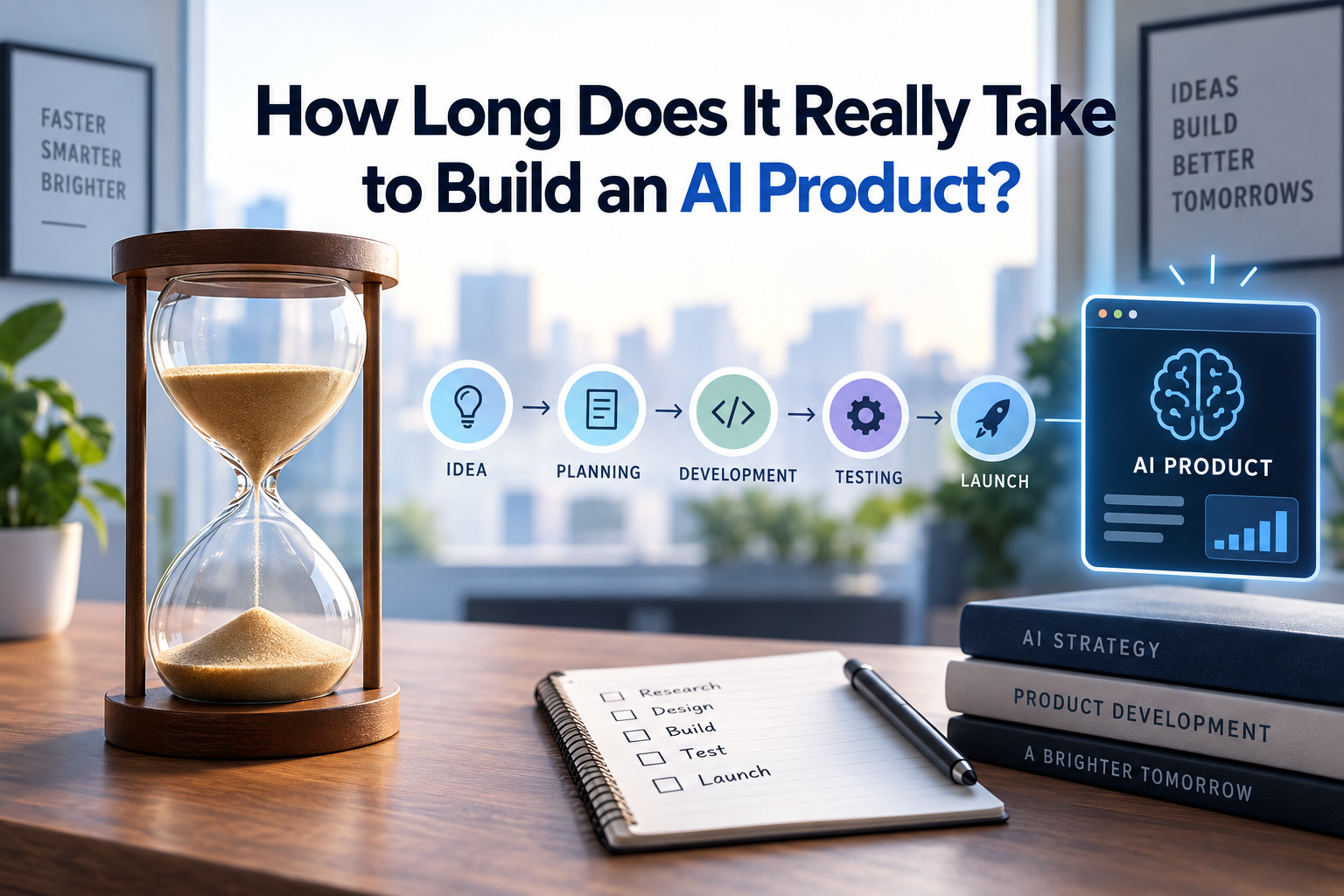
Most AI products take 3 to 9 months to go from idea to a working production release. A simple proof of concept can be ready in 4 to 8 weeks. An AI feature added to an existing app usually takes 2 to 4 months. A full custom AI platform with its own models, data pipelines, and compliance needs can take 9 to 12 months or longer.
Those numbers sound neat, but they hide a lot. Two teams building “an AI chatbot” can finish months apart because one has clean data and a clear goal, and the other doesn’t. This guide breaks down where the time actually goes, what pushes a schedule out, and how to plan a realistic timeline before you talk to an AI development company or start hiring.
AI Product Development Timeline by Product Type
The type of product you are building sets the baseline. Here are typical ranges for teams with access to usable data and a defined scope:
| AI product type | Typical timeline | What drives the time |
| Proof of concept (PoC) | 4 to 8 weeks | Testing one idea on a small data sample |
| GenAI chatbot or assistant (RAG-based) | 6 to 12 weeks | Document prep, retrieval quality, guardrails |
| AI feature inside an existing app | 2 to 4 months | Integration with current code and APIs |
| AI agent that takes actions across tools | 3 to 6 months | Permissions, error handling, human review steps |
| Predictive analytics or recommendation engine | 4 to 7 months | Data cleaning, model training, validation |
| Computer vision system | 5 to 9 months | Image labeling, edge cases, hardware testing |
| Full custom AI platform | 9 to 12+ months | Custom models, MLOps, security, compliance |
If your product sits between two rows, plan for the longer range. Teams rarely finish AI work faster than expected.
Where the Time Goes: AI Development Phases Explained
Every AI build follows roughly the same path. Knowing what each phase involves helps you spot delays early.
- Discovery and use-case validation (2 to 4 weeks). The team defines the business problem, success metrics, and whether AI is the right fix at all. Skipping this step is the most common reason projects restart halfway through.
- Data audit and preparation (3 to 8 weeks). Data collection, cleaning, labeling, and access approvals. This phase often takes 30 to 50 percent of total project time, and it is the one most teams underestimate.
- Model selection and prototyping (2 to 6 weeks). Choosing between a foundation model API, a fine-tuned open-source model, or a model trained from scratch. A working prototype is tested against real examples.
- Development and integration (6 to 12 weeks). Building the product around the model: backend, user interface, APIs, and connections to your CRM, ERP, or internal databases.
- Testing and evaluation (3 to 6 weeks). Accuracy checks, bias testing, security reviews, and edge-case handling. For GenAI products, this includes testing for hallucinations and prompt injection.
- Deployment and monitoring (2 to 4 weeks, then ongoing). Release to production, set up monitoring for model drift, and plan for retraining. AI products are never fully “done” after launch.
What Makes an AI Project Take Longer (or Shorter)?
The timeline tables above assume things go reasonably well. In practice, these five factors decide whether you land at the short or long end of the range.
Data readiness
If your data is scattered across spreadsheets, legacy systems, and team inboxes, expect weeks of cleanup before any model work starts. Companies with organized, labeled, and accessible data can cut their timeline by a third or more.
Scope clarity
“Build an AI assistant for customer support” is a direction, not a scope. A clear scope names the exact tasks the AI will handle, the tasks it won’t, and how success will be measured. Vague scope leads to rework.
Build approach: API, fine-tune, or train from scratch
Using an existing foundation model through an API is the fastest route. Fine-tuning adds a few weeks. Training a custom model from scratch can add months and needs far more data. Most business products in 2026 start with the first two.
Compliance and security needs
Healthcare, finance, and government projects need extra review for data privacy, audit trails, and explainability. Rules like the EU AI Act also add documentation work for higher-risk systems. Budget 3 to 8 extra weeks for regulated industries.
Team experience
A team that has shipped AI products before knows where the traps are. A team learning on the job will spend more time on trial and error, especially in evaluation and deployment.
2026 Trends That Are Changing AI Build Timelines
Some parts of AI development are getting faster. Others are getting slower. Here is what teams are seeing this year.
Prototypes are faster than ever. Strong foundation models, ready-made vector databases, and agent frameworks mean a working demo can appear in days. The catch is that a fast demo often creates false confidence about the full build.
Getting to production is still the hard part. In Deloitte’s State of AI in the Enterprise 2026 report, only 25% of surveyed organizations had moved 40% or more of their AI pilots into production. The gap between “it works in a demo” and “it works for real users” is where most months are spent.

Agentic AI adds governance time. AI agents that book meetings, update records, or approve requests need permission rules, audit logs, and human checkpoints. The same Deloitte survey found only 21% of companies have a mature governance model for autonomous agents, which means many teams are building those controls for the first time.
Smaller, task-specific models are gaining ground. Many businesses now pair a large model with smaller fine-tuned models for specific tasks. This lowers running costs but adds a few weeks of evaluation work.
Build In-House or Hire AI Developers: Which Is Faster?
Your team setup can change the timeline more than the technology does.
| Option | Time to start | Best for | Trade-off |
| In-house team | 2 to 4 months to hire | Long-term AI roadmap, core product IP | Slow start, high fixed cost |
| Hire AI developers (staff augmentation) | 1 to 3 weeks | Adding AI skills to an existing tech team | You still own planning and delivery |
| Custom AI development company | 1 to 2 weeks | Full builds with a fixed scope and deadline | Needs clear handover and knowledge transfer |
Hiring experienced AI engineers in 2026 is slow and expensive, and a new team still needs time to learn your systems. That is why many companies start with external custom AI development services for the first release, then grow internal capability once the product proves its value.
If you go this route, ask any partner three questions: How many AI products have you taken to production? How do you test model accuracy before launch? Who owns the code, data, and model weights after delivery?
How to Shorten Your AI Development Timeline
You can’t skip the hard parts, but you can avoid the delays that come from poor planning.
- Start with one narrow use case. Pick a task with clear inputs, clear outputs, and a measurable result, such as sorting support tickets or summarizing contracts.
- Audit your data before signing any contract. Know where your data lives, who controls access, and how much of it is labeled.
- Use existing models first. Begin with a foundation model API and only fine-tune or train custom models when testing shows you need to.
- Set evaluation criteria on day one. Decide what “accurate enough” means before development starts, so testing doesn’t drag on.
- Plan for launch, not just the demo. Budget time for security reviews, user training, and monitoring from the start.
- Ship in phases. Release a limited version to a small group, collect feedback, then expand.
Frequently Asked Questions
-
How long does it take to build an AI MVP?
An AI MVP usually takes 8 to 16 weeks. That covers discovery, data preparation, a working model, a basic interface, and initial testing with real users.
-
Can an AI chatbot be built in a month?
A basic chatbot connected to your documents can be ready in 4 to 6 weeks. A production-ready version with accuracy testing, security controls, and system integrations usually takes 8 to 12 weeks.
-
What is the longest phase of AI development?
Data preparation is typically the longest phase. Cleaning, labeling, and organizing data can take 30 to 50 percent of the total project time.
-
Is it faster to hire AI developers or use an AI development company?
An AI development company can usually start within 1 to 2 weeks with a full team in place. Hiring in-house AI developers often takes 2 to 4 months before work begins.
-
Does AI development continue after launch?
Yes. AI models need ongoing monitoring, retraining, and updates as data changes. Plan for continued support after the first release.
Final Thoughts: Plan for Months, Not Weeks
A realistic AI product timeline is 3 to 9 months for most businesses, with simple prototypes on the short end and regulated, custom platforms on the long end. The model itself is rarely what slows things down. Data readiness, unclear scope, and the jump from pilot to production are where projects lose time.
The teams that ship on schedule do the unglamorous work first: they define one clear use case, check their data honestly, and pick a build approach that matches their goals. Whether you build in-house, hire AI developers, or bring in a partner with production experience, that groundwork decides your timeline more than anything else. A good place to start is a short discovery phase with an experienced custom AI development company, so your first estimate is based on your data and goals rather than a generic range.