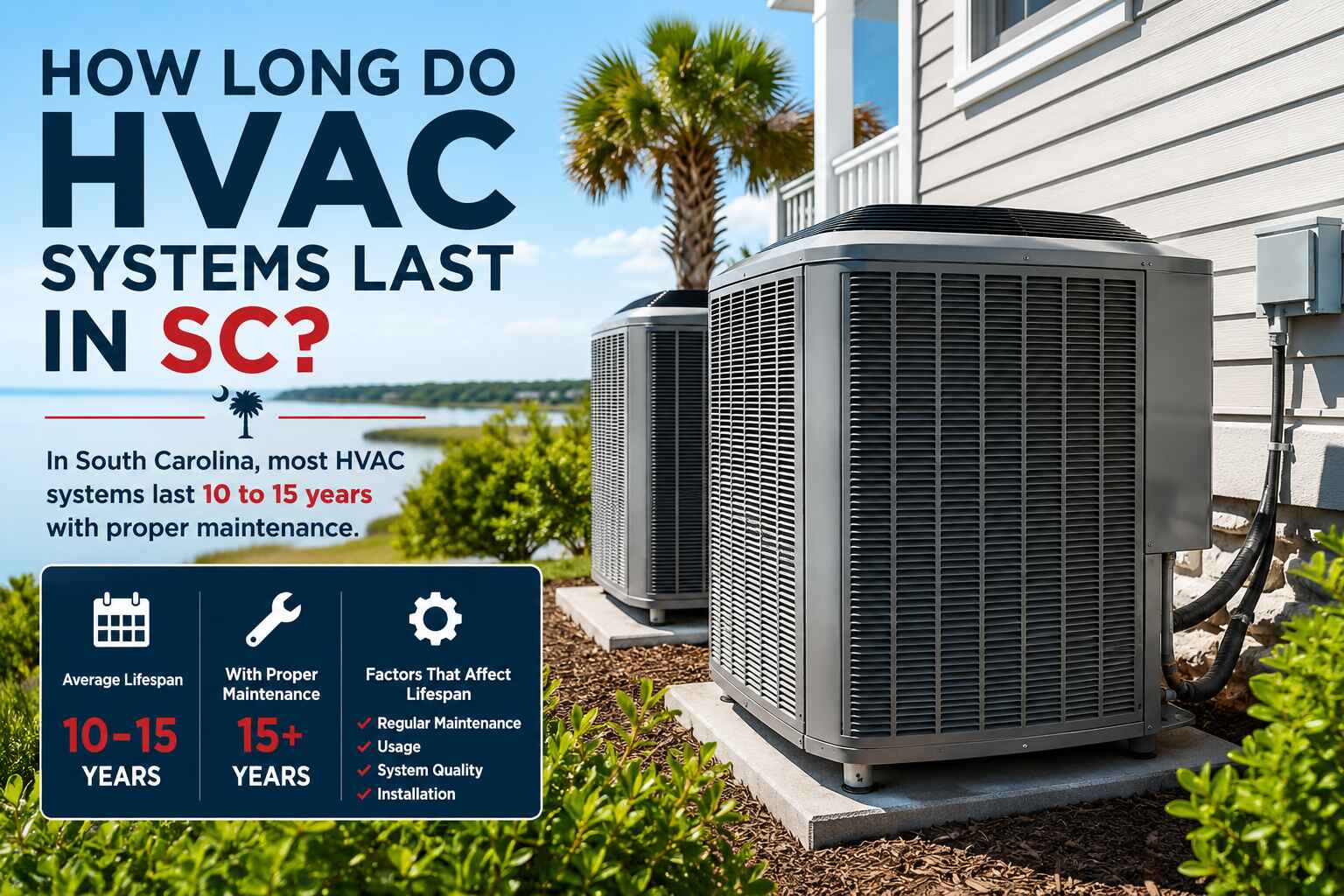
If you live anywhere near Rock Hill, Fort Mill, or the rest of York County, you already know our summers don’t play fair. On a typical service call in July, we’re pulling filters caked in three weeks of pollen and humidity buildup, not three months. The air conditioner runs from April clear through October some years, and that kind of workload takes a toll most homeowners in cooler states never have to think about. So when a customer asks us how long their HVAC system is actually going to last, the honest answer is this: it depends on where you live just as much as what brand you bought.
Below is what we tell customers who call us for HVAC Rock Hill SC, based on the units we’ve opened up, repaired, and replaced ourselves, not generic averages pulled from a brochure.
Why South Carolina Weather Ages Your HVAC System Faster
The Humidity Problem
South Carolina doesn’t just get hot, it gets sticky. That thick, soupy air forces your air conditioner to work overtime pulling moisture out, not just cooling it down. Every extra hour the compressor runs is wear you don’t get back. We’ve pulled coils out of units here that look decades older than their actual age, simply from the moisture load they’ve handled. Homeowners in Ohio or Minnesota aren’t putting their systems through this kind of grind.
Long Cooling Seasons Mean More Run Hours
In a lot of the country, air conditioners get a real break for five or six months a year. Around here, that’s rare. Between early spring and late fall, plenty of Carolina systems barely get to rest. More run hours mean more mechanical stress on the compressor, the fan motor, and the electrical connections, which is exactly why a unit that might coast to 20 years in Vermont could be tapping out closer to 12 or 13 in York County.
Average HVAC Lifespan by System Type
Central Air Conditioners
Most manufacturers advertise 15 to 20 years, and technically that’s not wrong. But based on what we see in homes across Rock Hill, realistic expectations sit closer to 12 to 15 years for a well-maintained unit. Skip maintenance, and we’ve seen homeowners shopping for a replacement well before year 10.
Furnaces and Heat Pumps
Furnaces have it a little easier here since our winters are mild compared to most of the country, so a well-kept furnace can often reach 18 to 20 years. Heat pumps handle both heating and cooling, so they run nearly year-round in this climate. That extra duty usually puts heat pumps in the same 12 to 15 year window as central AC units. A heat pump is basically doing double the work, so it makes sense it wears at a similar pace.
Water Heaters (Since They’re Part of the Conversation Too)
Traditional tank water heaters generally last 8 to 12 years before they start showing their age, sometimes announced by a puddle on the garage floor rather than a polite warning sign. If you’re weighing your options, our guide to hybrid heat pump water heaters at atlasheatcool.com/hybrid-heat-pump-water-heaters-rock-hill-sc walks through whether the upgrade actually makes financial sense for a Rock Hill home.
What Actually Determines How Long Your System Lasts
Installation Quality
Here’s something most homeowners never hear: a poorly installed system can lose years off its lifespan before it ever runs a single cycle. Wrong refrigerant charge, sloppy ductwork, an undersized breaker, any one of these quietly grinds down a brand-new unit. We’ve been called out to fix systems less than two years old that were failing purely because of how they were installed the first time. This is the biggest factor nobody talks about, and it’s exactly why the company doing the work matters more than the brand sticker on the box.
Maintenance Habits
Think of your HVAC system like a car engine. Change the oil regularly and it runs for 200,000 miles without much complaint. Ignore it, and you’ll be stranded on the side of the road far sooner than the manual promised. HVAC systems behave the same way.
What a Twice-a-Year Tune-Up Actually Prevents
A proper spring and fall tune-up catches the small stuff before it turns into the expensive stuff: dirty coils that force the compressor to strain, low refrigerant that makes the system run longer than it should, worn electrical connections that eventually fail outright. On more than one visit, we’ve caught a refrigerant leak during a routine check that, left alone, would have burned out a compressor within a season. Two tune-ups a year is a small ask for years of added system life.
System Sizing
Bigger is not better here. An oversized unit cools a home too fast and shuts off before it has pulled the humidity out, which causes it to short-cycle constantly. All that starting and stopping wears components down faster than steady, properly sized operation ever would.
Signs Your HVAC System Is Nearing the End
Rising Utility Bills
If your power bill has crept up despite similar weather and similar habits, your system is likely losing efficiency. Aging components can’t move air or heat as effectively as they once did, so the unit compensates by burning more energy for the same result.
Frequent Repairs
One repair call a year is normal, nothing to lose sleep over. Two or three calls in a single season is your system waving a white flag. At some point the math stops making sense, and that’s usually when customers start asking us about ac repair rock hill sc that keeps turning into a repeat visit rather than a one-time fix.
Age Plus a Failed Major Component
A 13-year-old AC unit with a healthy compressor is one thing. A 13-year-old unit whose compressor just died is a completely different conversation. When age and a major failure show up together, replacement usually wins out over another repair.
Repair or Replace? A Simple Rule of Thumb
Here’s a quick gut check we use out in the field: multiply the age of the system by the cost of the repair. If that number tops $5,000, replacement is generally the smarter move. A $600 repair on a 6-year-old unit? Fix it, no question. An $1,800 repair on a 14-year-old unit? That math clears the threshold by a wide margin, and you’re likely better off putting that money toward something new. For a deeper breakdown of this logic, our furnace repair-or-replace guide at atlasheatcool.com/when-to-replace-furnace-not-repair covers it in more detail. For general efficiency benchmarks outside of what we see locally, the U.S. Department of Energy at energy.gov/energysaver/air-conditioning is a solid, unbiased reference point.
How to Stretch the Life of Your System in the Carolinas
A few habits go a long way here. Change your air filter every 60 to 90 days, more often if you have pets shedding into the return vents. Keep the outdoor unit clear of leaves, pollen buildup, and overgrown shrubs, since restricted airflow is one of the most common causes of early compressor failure we see on service calls. Don’t set the thermostat to extremes just to cool the house faster, it doesn’t actually work that way and it only adds strain. And get on a maintenance plan if you can. It’s the closest thing to insurance against a surprise breakdown in July. Our preventative maintenance program at atlasheatcool.com/preventative-maintenance is built around exactly this kind of climate, with twice-a-year visits scheduled ahead of our busiest seasons.
Conclusion
So, how long do HVAC systems last in SC? Based on what we see week to week, plan on 12 to 15 years for AC units and heat pumps, and closer to 18 to 20 years for furnaces, assuming decent installation and consistent upkeep. Our humidity and long cooling season push systems harder than most of the country ever experiences, so treating maintenance as optional is a gamble that rarely pays off. Keep an eye on your bills, don’t ignore repeat repairs, and when the numbers stop making sense, replacing sooner rather than later usually saves money in the long run. If you’re not sure where your system stands, a local technician who works on hvac rock hill sc systems every day can usually tell you within a few minutes of looking at it.
FAQs
Does a bigger HVAC system last longer than a smaller one?
No, actually the opposite tends to be true. An oversized system short-cycles, meaning it turns on and off more frequently, and that extra wear shortens its life rather than extending it.
Can I extend my HVAC system’s life past 15 years in South Carolina?
Yes, with consistent maintenance, clean filters, and prompt repairs, some homeowners get 18-plus years out of a unit. It’s not the norm here, but we’ve seen it happen with customers who never skip a tune-up.
Is it worth repairing a 10-year-old AC unit?
Usually, yes, especially for smaller repairs. A 10-year-old system still has real life left in it if it’s been maintained, so don’t rush to replace it over a single moderate repair bill.
Do heat pumps wear out faster than traditional AC units in the Carolinas?
They can, simply because they run more months out of the year handling both heating and cooling duties. Regular maintenance matters even more for heat pumps here.
How often should I really get my system serviced living in York County?
Twice a year is the sweet spot, once in spring before cooling season ramps up, and once in fall before heating season begins. It catches small issues before they turn into full breakdowns and, in our experience, adds years to the system overall.