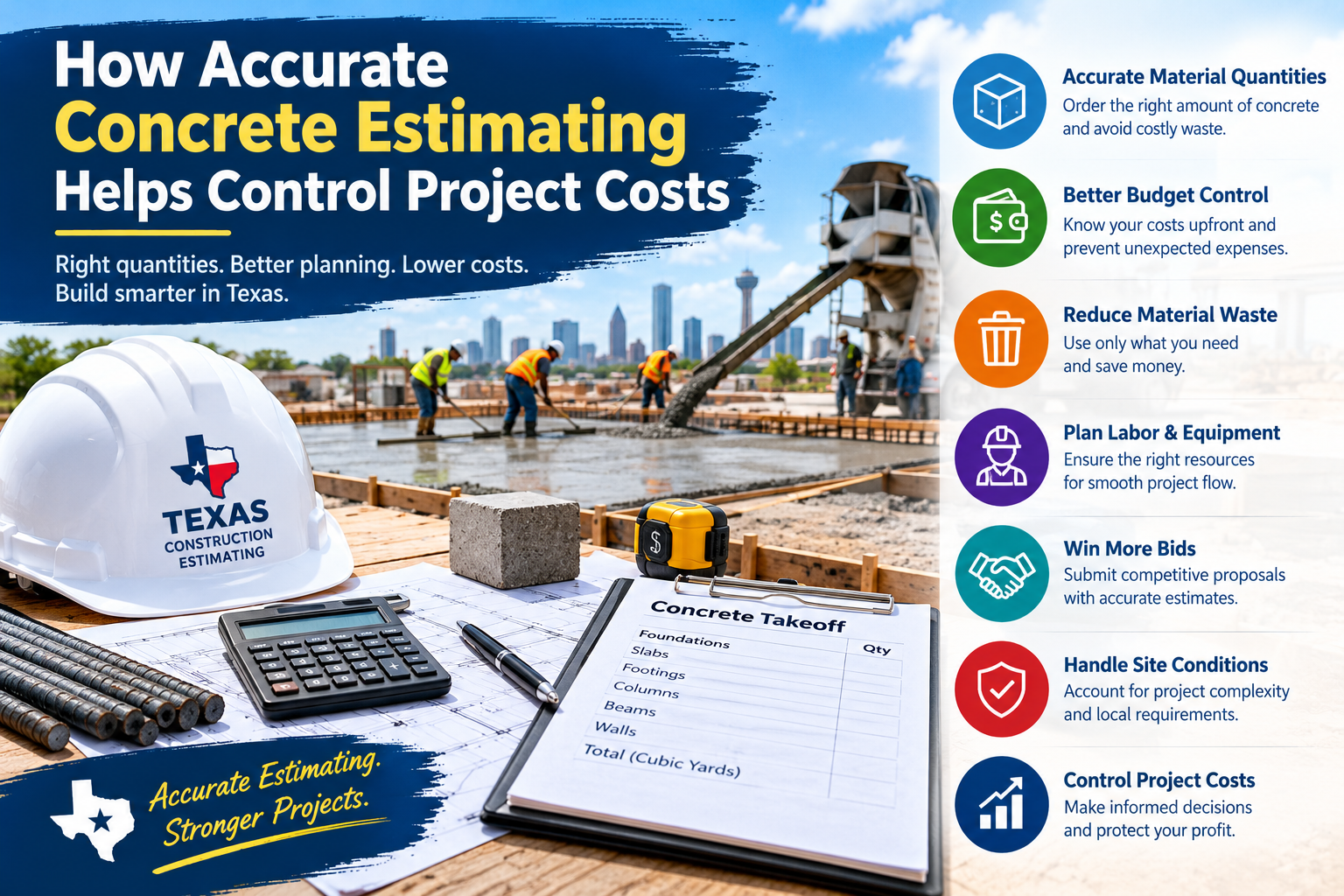
Concrete is one of the most widely used materials in construction. From residential foundations and driveways to commercial buildings, parking structures, and sidewalks, concrete plays an essential role in modern construction projects. However, managing concrete expenses can be challenging because even small estimating errors may lead to material waste, labor overruns, and unexpected project costs.

Accurate concrete estimating helps contractors calculate the materials, labor, equipment, and other resources required before construction begins. With a detailed estimate, builders can prepare realistic budgets, make better purchasing decisions, and reduce financial risks. For contractors working in Texas, reliable concrete cost estimating is especially valuable when planning projects with different site conditions, labor requirements, and material prices.

Provides Accurate Material Quantities
One of the most important benefits of concrete estimating is determining the correct quantity of concrete required for a project. Contractors need to calculate the volume of concrete based on the dimensions of foundations, slabs, footings, columns, beams, and other structural elements.
Concrete volume is generally calculated by multiplying length by width and depth. For example, a rectangular slab measuring 20 feet long, 10 feet wide, and 6 inches thick requires approximately 3.7 cubic yards of concrete before adding an appropriate allowance for waste and site conditions.
Accurate calculations help contractors order the right amount of ready-mix concrete. Ordering too little may cause delays and additional delivery expenses, while ordering too much can increase costs and create disposal challenges.
A detailed concrete estimate helps reduce these problems and supports efficient material management throughout the construction process.
Helps Control Construction Budgets
Every construction project operates within a financial plan. If concrete costs are underestimated, contractors may struggle to cover expenses without reducing their expected profit.
Concrete estimating provides a clearer picture of the project’s expected costs. It includes material quantities, supplier prices, transportation, labor, equipment, formwork, reinforcement, and finishing requirements where applicable.
By identifying these expenses before work begins, contractors can establish a realistic budget and allocate funds more effectively. They can also compare supplier quotations and evaluate different construction methods without overlooking important cost components.
For Texas construction projects, estimates should use current local supplier pricing and applicable labor rates. Prices can vary by location, project size, concrete mix specifications, and delivery requirements. Updating estimates regularly helps contractors avoid relying on outdated cost information.
Reduces Material Waste
Material waste is a common source of unnecessary construction expenses. Excess concrete may require additional handling and disposal, while insufficient quantities can lead to rushed deliveries and interruptions.
Accurate estimating helps contractors plan material orders according to project drawings and specifications. It also allows them to consider factors such as excavation dimensions, slab thickness, reinforcement placement, and expected site variations.
An appropriate waste or contingency allowance should be based on the project’s specific conditions rather than using the same percentage for every job.
In addition, accurate estimates help contractors coordinate concrete deliveries with site preparation and placement schedules. This reduces the likelihood of ordering materials before the site is ready and helps prevent avoidable losses.
Improves Labor and Equipment Planning
Concrete construction involves more than purchasing the concrete itself. Projects may require workers for formwork installation, reinforcement placement, concrete pouring, leveling, finishing, and curing activities.
Contractors also need to plan for equipment such as concrete pumps, mixers, vibrators, screeds, and other tools depending on the project’s requirements.
An accurate concrete estimate identifies the expected labor and equipment needs. This makes it easier to calculate labor hours, schedule workers, and arrange equipment rentals before construction begins.

Better planning can reduce overtime, equipment downtime, and scheduling conflicts. It also helps contractors coordinate concrete placement with other trades, improving overall productivity and reducing the risk of costly delays.
Supports More Competitive Construction Bids
Contractors must submit bids that are competitive while still covering their actual expenses. If a concrete estimate is too high, a contractor may lose the opportunity to win the project. If it is too low, the contractor may experience financial losses after work begins.
Accurate concrete estimating helps strike a balance between competitive pricing and profitability.
A detailed estimate gives contractors a reliable breakdown of material quantities, labor costs, equipment expenses, and other project requirements. This information supports more confident bidding and helps contractors explain their pricing to clients.
It also makes it easier to identify missing items before submitting a proposal. As a result, contractors can reduce the risk of overlooked expenses and prepare bids based on the actual project scope.
Accounts for Site Conditions and Project Complexity
Not every concrete project has the same requirements. Soil conditions, site accessibility, foundation depth, weather, reinforcement specifications, and the complexity of the structure can all affect project costs.
For example, a site with difficult access may require a concrete pump or additional labor. A foundation project may involve excavation, formwork, reinforcing steel, and specialized concrete specifications.
Accurate estimating considers these factors when calculating expected expenses. Contractors should review architectural and structural drawings, project specifications, and relevant site information before finalizing their estimates.
Texas projects may also require consideration of local building codes, drainage requirements, and soil conditions. Reviewing these factors early helps reduce the likelihood of unexpected expenses during construction.
Helps Manage Changes and Unexpected Costs
Construction plans can change because of design revisions, client requests, material price changes, or unforeseen site conditions. These changes may affect concrete quantities, labor requirements, and project schedules.
A detailed initial estimate provides a useful baseline for evaluating revisions. Contractors can compare the original quantities and costs with the updated requirements to determine how a change affects the budget.
Maintaining clear quantity records also improves communication between contractors, suppliers, project managers, and clients. When everyone understands the cost implications of a change, decisions can be made more efficiently.
Although estimating cannot eliminate every unexpected expense, it helps contractors identify risks earlier and respond with better financial planning.
Conclusion
Accurate concrete estimating is essential for controlling construction costs and improving project performance. By calculating material quantities correctly, planning labor and equipment, reducing waste, and preparing realistic budgets, contractors can manage their resources more efficiently.
For Texas builders, using current local pricing and reviewing project-specific requirements can further improve estimating accuracy. Whether planning a residential foundation, a concrete driveway, or a large commercial structure, a detailed estimate helps contractors prepare competitive bids and protect project profitability.
Investing time in accurate concrete cost estimating allows construction professionals to make informed decisions, reduce avoidable expenses, and complete projects with greater confidence.