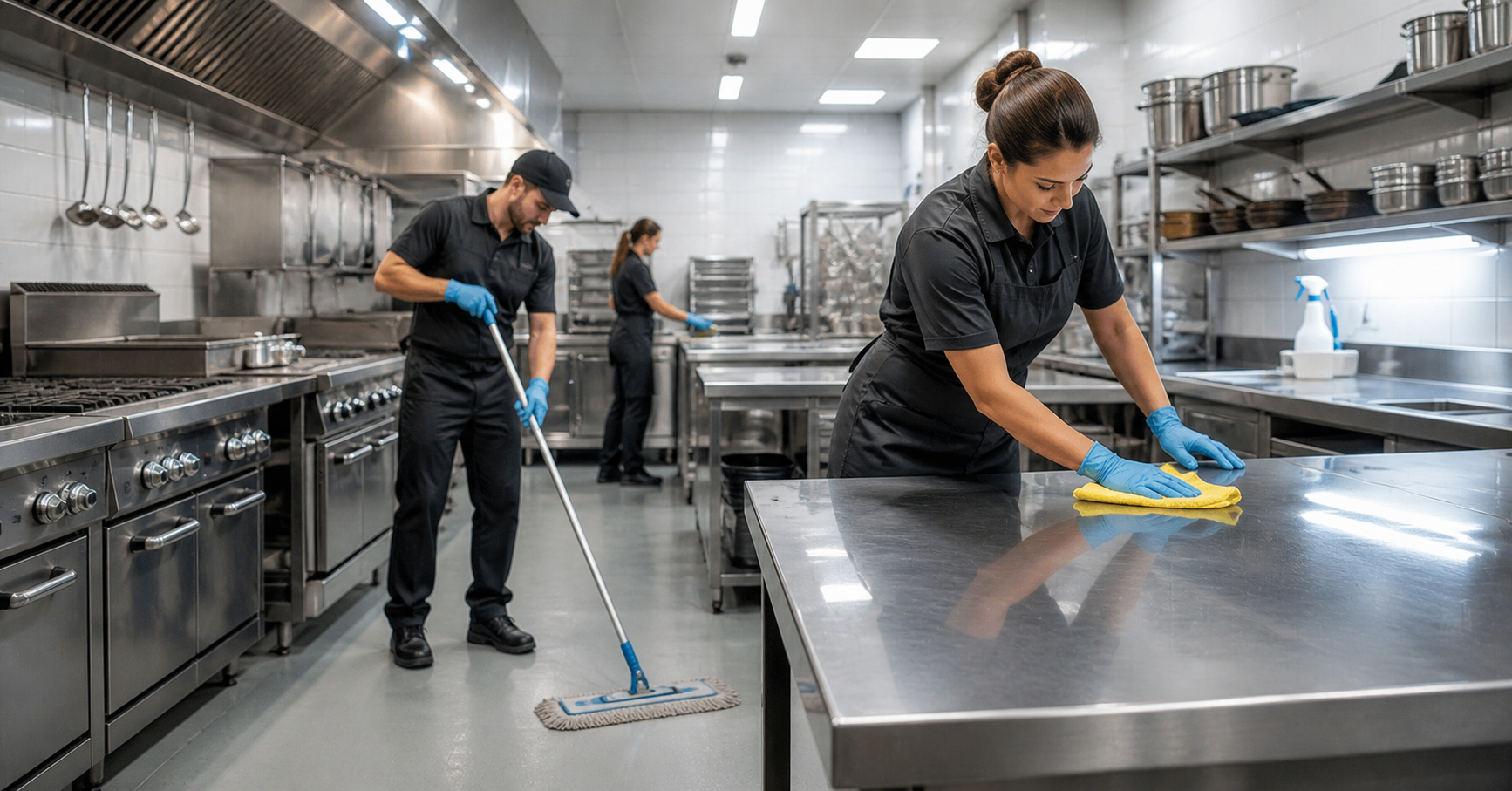
Every food business owner knows the feeling of an unannounced visit from an inspector, and the best way to stay calm is to have a clear routine in place long before anyone knocks. A practical approach to commercial kitchen cleaning Birmingham UK turns cleaning from a rushed end-of-shift chore into a repeatable system that protects your customers, your staff and your food hygiene rating.

This guide gives you the checklists, the common blind spots and the record-keeping habits that keep a kitchen consistently ready for inspection. It is written for restaurants, takeaways, cafés, hotels and catering units, and it is based on current UK food-safety practice.

Quick Answer: What Makes a Kitchen Inspection-Ready?
An inspection-ready kitchen has four things in place. First, surfaces and equipment are visibly clean and in good repair. Second, there is a written cleaning schedule that staff actually follow. Third, cleaning records are up to date and easy to find. Fourth, the right products are used correctly, with allergen and cross-contamination controls built into the routine.
Why a Structured Commercial Kitchen Cleaning Birmingham UK Plan Beats Last-Minute Scrubbing
Cleaning in a rush before an inspection usually fixes what is visible and misses what matters. Grease inside an extraction canopy, a dirty fridge gasket or a damp floor gully will not be solved by a quick wipe-down. A structured plan spreads the workload across the day, week and month, so no area depends on someone remembering at the last minute.
A plan also makes training easier. When each task has an owner, a method and a frequency, new starters learn quickly and standards stay the same whoever is on shift. Under UK food hygiene law, food businesses must keep premises clean and manage food safety through documented procedures, and a schedule is the simplest way to show that you do.
The Daily Closing Checklist
Daily tasks keep food residue and bacteria from building up overnight.
Cooking Line
- Clean hobs, grills, griddles and fryer surrounds once cooled.
- Filter or change fryer oil according to your usage.
- Wipe down handles, knobs and control panels, which are touched constantly.
Prep and Storage
- Clean and disinfect chopping boards, knives and prep tables.
- Wipe fridge door handles and check that stored food is covered and labelled.
- Return ingredients to the correct shelves, with raw foods below ready-to-eat items.
Floors and Waste
- Sweep, then mop floors with a suitable degreaser.
- Empty bins, wash them and sanitise lids and handles.
- Clean sinks and drainer areas, including taps and plugholes.
The Weekly and Monthly Checklist
Some jobs do not need doing every night but cannot be left for long.
Weekly
- Empty and clean fridges and freezers, including shelves and seals
- Descale dishwashers and clean their filters
- Clean the interior of microwaves and combi ovens
- Wash walls and splashbacks near the cooking area
Monthly
- Pull out equipment where it is safe to do so and clean behind and underneath it
- Clean shelving, racks and dry-storage areas
- Check and clean extraction filters
- Deep clean floor gullies and drains
Hidden Problem Areas Most Kitchens Miss
Inspectors and pest controllers often find trouble in the places daily teams overlook:
- Fridge and freezer door seals: Food debris and mould collect in the folds.
- Ice machines: These need regular cleaning and sanitising according to the manufacturer’s instructions.
- Behind and beneath equipment: Warm, greasy gaps are attractive to pests.
- Can openers, slicers and mixers: Food residue hides in moving parts.
- Light switches, door handles and tablet screens: These are high-touch points that spread bacteria.
- Bin areas and yard space: Odours and spills outside can undo good work inside.
Cleaning Records and Documentation
Cleaning that is not recorded is difficult to prove. A simple log showing what was cleaned, when and by whom gives inspectors confidence in your management. For smaller caterers, the Food Standards Agency’s Safer Food, Better Business pack is a widely used starting point for building a food safety management system.

Good records also support allergen control. The 14 major allergens must be managed carefully, and shared surfaces, utensils and fryers are common routes for cross-contact. Many owners underestimate how much recording matters to commercial kitchen cleaning Birmingham UK, yet a tidy folder of schedules, sign-off sheets and deep-clean certificates is often what separates a smooth inspection from a stressful one.
In-House Cleaning or Professional Deep Cleans?
Your own team is best placed to handle daily and weekly tasks because they know the kitchen’s rhythm. Professional deep cleans cover the heavy-duty jobs that routine staff time rarely allows, such as degreasing extraction systems, stripping back cooking equipment and treating floors and drains.
Many Birmingham businesses combine the two. Staff handle the daily routine, and a specialist team such as The Pristine Team Ltd carries out scheduled deep cleans outside trading hours. This keeps standards high without taking chefs away from service. If your premises include offices or dining areas, it can also help to coordinate with office cleaning in Birmingham so everything is handled in one visit.
Common Cleaning Mistakes to Avoid
- Skipping contact time: Disinfectants need to stay on a surface for the time stated on the label. Wiping them off immediately reduces their effect.
- Mixing chemicals: Combining products, especially bleach and acid-based cleaners, can release dangerous fumes.
- Cleaning and disinfecting in one step: Remove grease and dirt first, rinse, then apply disinfectant.
- Using the wrong product: Look for disinfectants that meet recognised standards such as BS EN 1276 or BS EN 13697.
- Reusing dirty cloths: Use colour-coded cloths and replace them regularly.
- Cleaning while food is exposed: Cover or remove food before you spray or scrub.
Preparing for Busy Periods
Pressure on kitchens rises at certain times of year, including the run-up to Christmas, wedding season, Eid celebrations and university term starts. Equipment works harder, grease builds up faster and cleaning time shrinks. Booking a deep clean just before a peak period gives you a fresh start, and a second visit afterwards clears the build-up. Educational sites with canteens can follow a similar pattern around term dates alongside their regular school cleaning services.
Frequently Asked Questions
What should be on a commercial kitchen cleaning schedule?
Include daily, weekly and monthly tasks, the person responsible, the product and method, and a sign-off column. Add periodic deep cleans and extraction cleaning.
How do I prepare for a food hygiene inspection?
Keep your cleaning records current, check that staff follow the schedule, tidy storage areas and make sure sinks, handwash stations and bins are clean and stocked.
Can I do all the cleaning myself?
Daily cleaning can be done in-house. Extraction systems and heavy grease removal are better handled by trained professionals with the right equipment.
How often should floor drains be cleaned?
Most kitchens benefit from weekly attention and a deeper monthly clean, with extra care in high-volume sites.
Do I need to keep cleaning records?
You must be able to show that food safety procedures are followed. Written cleaning records are a practical way to demonstrate this.
Conclusion
Inspection readiness is built through habits, not heroics. A clear checklist, honest record-keeping and regular professional deep cleans make commercial kitchen cleaning Birmingham UK manageable even in the busiest weeks. To discuss a schedule that fits your kitchen, get in touch with The Pristine Team Ltd and ask for a quote.