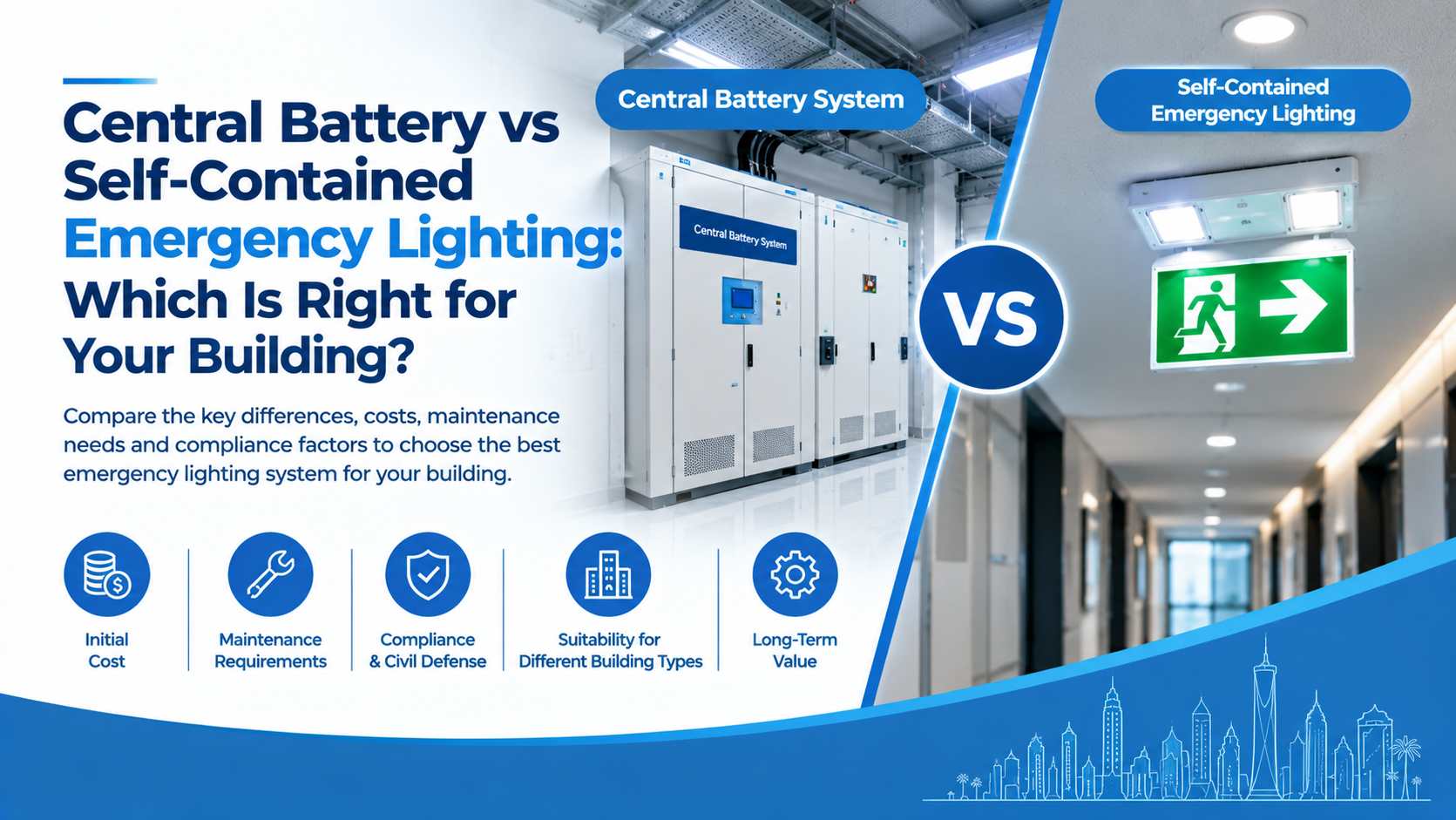

If you’re planning or upgrading a building in Saudi Arabia, one of the first emergency lighting decisions is also one of the biggest: should each light have its own battery, or should one central battery power them all?

Both approaches are legitimate and widely used. The right answer depends on your building’s size, layout, budget and maintenance capacity. This guide compares them honestly, including the downsides of each, so you can decide with confidence.
The Short Answer
- Small buildings, simple layouts, tight upfront budgets: self-contained units are usually the practical choice.
- Large, high-occupancy or long-life buildings: a central battery system usually works out cheaper and easier to run over time.
- Everything in between: it comes down to a lifecycle cost comparison, not just the purchase price.
What Is a Self-Contained System?
In a self-contained system, each emergency luminaire or exit sign has its own battery, charger and control circuit built in. When mains power fails, each unit switches on independently.
Where it works well:
- Installation is simple, since no dedicated battery room or special wiring is needed
- Upfront cost is lower
- It is easier to add to an existing building
What Is a Central Battery System?
In a central battery system, one centrally located battery and charger unit powers all the emergency luminaires across the building. The lights themselves have no battery of their own.
A government guide on building conversion describes the standard split: central systems suit larger buildings, while self-contained units suit smaller ones. It also notes that the luminaires used with central systems tend to be more discreet and compact.
Where it works well:
- Battery maintenance happens in one place
- Longer battery life is typically possible
- Monitoring and testing can be centralised and automated
- Slimmer fittings suit hotels, malls and offices where appearance matters
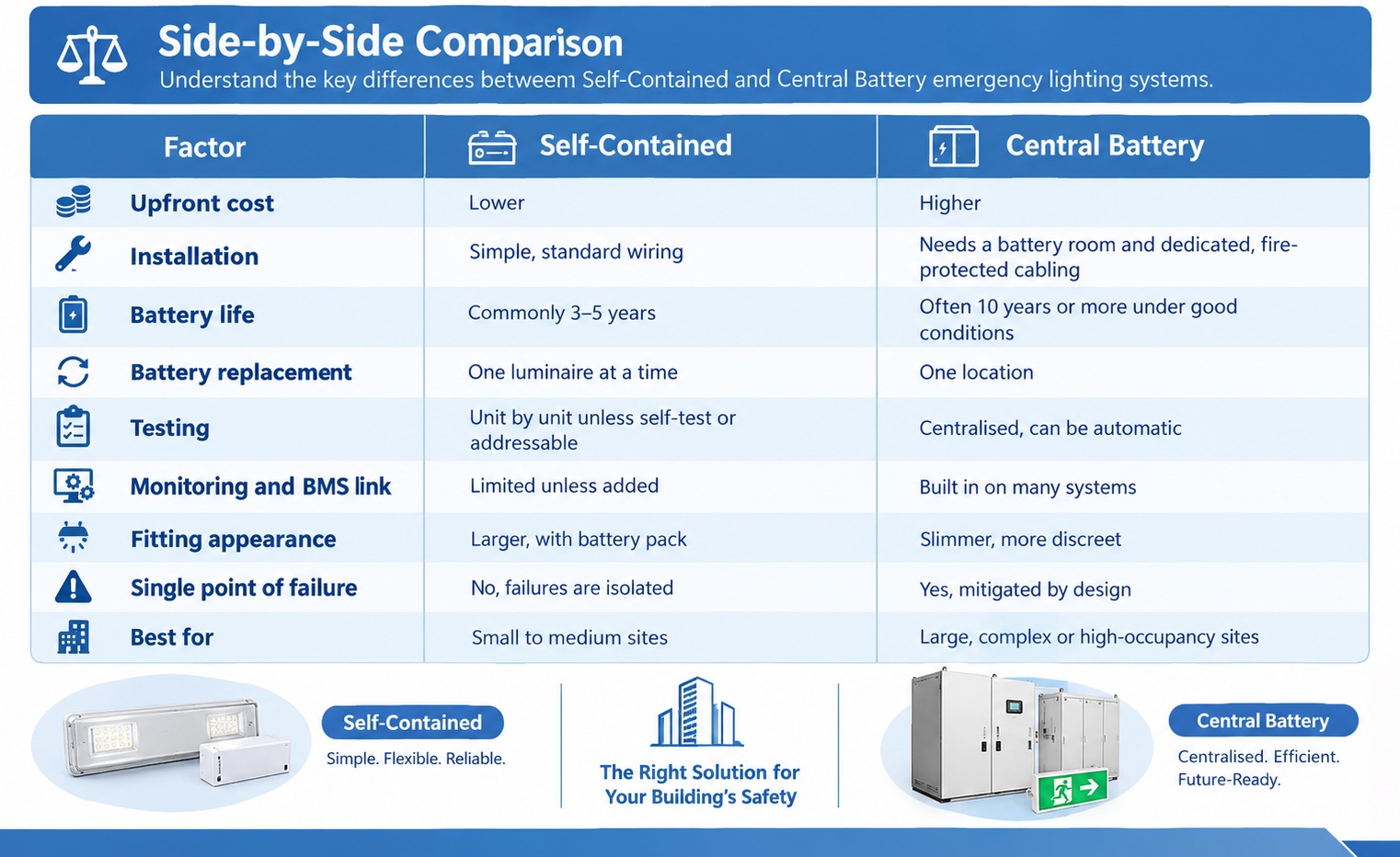
Side-by-Side Comparison
Battery Life and Maintenance: The Biggest Difference
This is where most owners feel the difference over time.
Industry guidance puts the life of self-contained batteries at around three to five years, with replacement costs recurring across the building. A university technical officer quoted in a trade article explained that with hundreds of self-contained units, each one has to be checked regularly and batteries are changed often, while central batteries can last ten years or more and are replaced quickly in one spot.
One caution: a ten-year figure is not guaranteed. A manufacturer comparing options points out that advertised ten-year life only holds in ideal conditions. In hot environments, which includes much of Saudi Arabia, battery room ventilation and temperature control matter a great deal. Ask any supplier what battery life they assume and under what conditions.
The Honest Downsides of Central Battery Systems
You’ll get the best decision if you hear the weak points too.
Higher upfront cost. The same manufacturer notes that purchase and installation cost more than self-contained units, and that replacement batteries can be a significant share of the original unit cost.
Single point of failure. One battery source means a serious failure there affects the whole system. Good designs reduce this risk with monitoring, redundancy, correct sizing and regular testing.

Cabling. A common objection is that if the cabling is badly damaged in a fire, the lighting could fail. Fire-resistant cabling, proper routing and compliant installation address this, which is why cable specification matters as much as the battery itself.
Retrofits can be harder. Central systems need dedicated wiring, which is more difficult in an existing building. Patent literature itself acknowledges that this can make central systems impractical in existing buildings because of conduit and wiring costs. In older buildings, a hybrid or phased approach may suit better.
The Honest Downsides of Self-Contained Systems
Hidden maintenance workload. A facilities engineer on an engineering forum described a roughly 20% failure rate on annual 90-minute tests across several facilities, split between batteries and chargers, and noted that unit-based systems stop making sense beyond a small number of fittings.
Harder access. Luminaires in high ceilings or restricted areas are time-consuming to reach.
Heat sensitivity. Individual batteries sitting in warm ceiling voids age faster.
Less visibility. Without self-testing or addressable features, you may not know a unit has failed until someone checks.
Which Is Right? A Practical Decision Checklist
Choose self-contained if most of these are true:
- Fewer than roughly 20–30 emergency fittings, or a single small floor
- Existing building with limited ability to add cabling
- Short-term ownership or a tight capital budget
- Staff available for regular manual testing
Choose central battery if most of these are true:
- Large floor area, multiple floors or a campus
- Hotels, hospitals, malls, towers, warehouses or other high-occupancy buildings
- New construction or major refurbishment where cabling can be planned
- You want centralised testing, BMS integration and lower long-term maintenance
- A ten-year-plus ownership horizon
Consider a hybrid if:
- Some zones suit central power and others, such as remote outbuildings or retrofit areas, suit self-contained units
Compliance Considerations in Saudi Arabia
Whichever system you choose, the lighting must meet the applicable Saudi Building Code and Civil Defense requirements for your building type, including duration, lighting levels, testing and records. Certification matters too. Products used in the Gulf are commonly expected to carry Civil Defence approvals, so confirm certification with your supplier before ordering.
Always verify the exact requirements for your project with your consultant and the relevant authority.
Questions to Ask Any Supplier
- What battery life do you assume in Saudi climate conditions?
- What are the replacement costs and intervals?
- How are tests carried out, recorded and reported?
- Can the system connect to our BMS?
- What happens if the central unit fails?
- How is the cabling specified and protected?
- What certification does the system hold?
- What support is available after installation?
How Aala Tech Can Help
Aala Tech designs and supplies central battery emergency lighting for large and complex projects across Saudi Arabia. If you’re comparing options for a specific building, you can see how a system would be specified in our emergency lighting central battery system overview, or look at city-specific options in Riyadh, Jeddah, Madinah and Dammam.
Final Thought
Self-contained lighting wins on simplicity and upfront cost. Central battery wins on lifecycle cost, maintenance and monitoring in larger buildings. Neither is “better” in every case, so choose based on your building’s size, how long you will own it and who will maintain it.
Not sure which suits your project? Share your building type and layout with Aala Tech and we’ll recommend an approach.