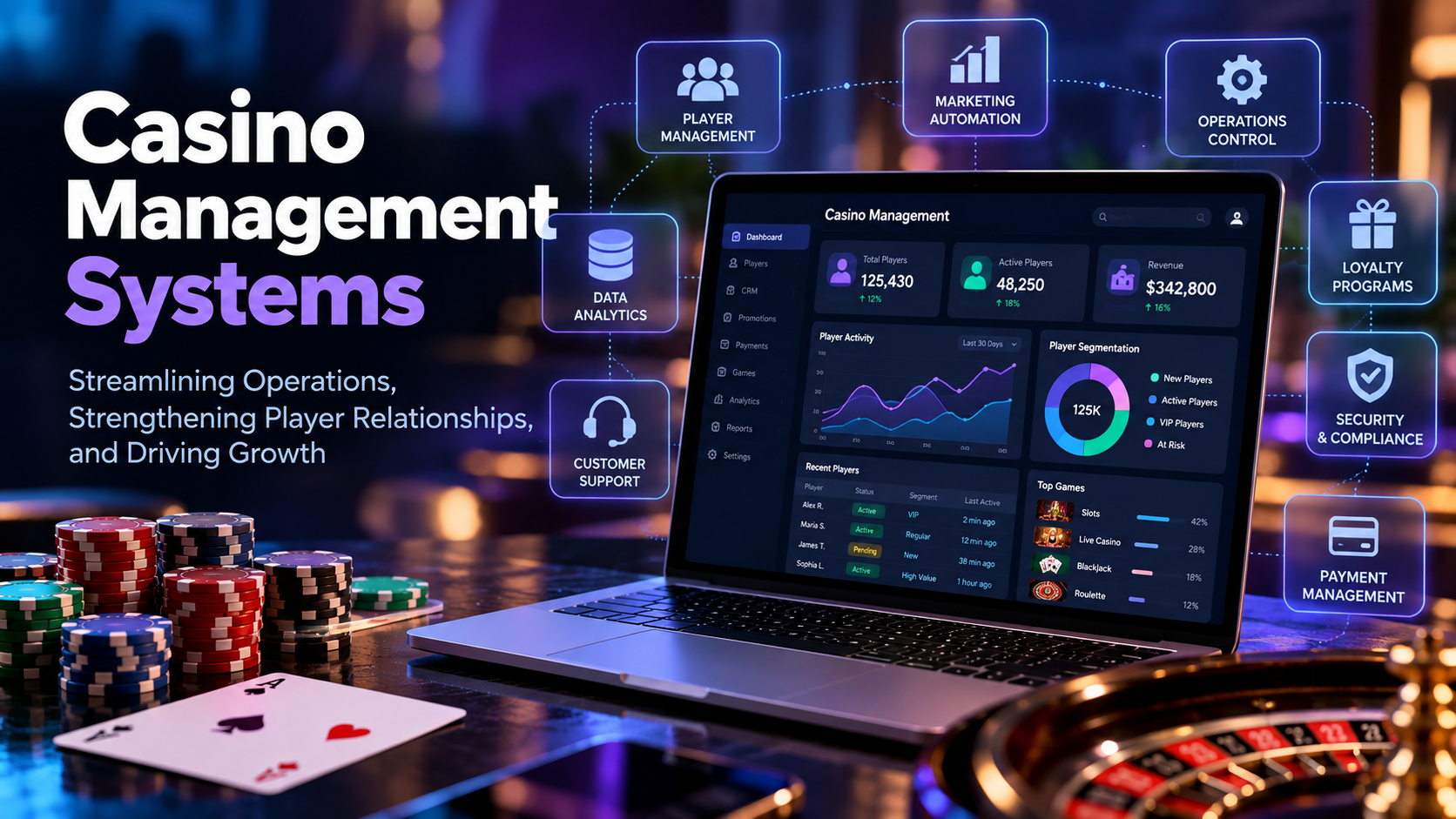
Running an online casino involves managing far more than games and transactions. Operators must coordinate player accounts, marketing campaigns, payments, customer support, loyalty programs, and regulatory responsibilities across a connected digital environment. Modern casino management systems help bring these activities together, giving businesses better visibility into operations and the tools to manage player relationships more effectively.
As competition increases, operational efficiency alone is no longer enough. Operators also need to understand player behaviour, recognize service issues, and deliver relevant experiences without creating unnecessary friction. Disconnected systems can make these goals difficult to achieve, particularly when teams rely on separate dashboards, manually maintained spreadsheets, or incomplete customer records.
The solution isn’t necessarily to add more software. It’s to build an integrated management environment in which information flows between departments, routine processes are automated, and decisions are supported by reliable data.
Understanding how these systems work—and where they create the most value—can help operators make better technology decisions as their businesses develop.
Why Casino Management Has Become More Complex
An online casino may appear straightforward to its users, but its underlying operations involve multiple processes running simultaneously.
A player might register through a marketing campaign, complete identity verification, make a deposit, explore different games, contact customer support, and later become eligible for a loyalty reward. Each interaction creates information that could help the operator improve the experience.
When these interactions are recorded across disconnected systems, the complete picture becomes difficult to maintain. Marketing teams may not know whether a player has completed verification, support agents may lack the context needed to resolve a query, and managers may struggle to connect promotional expenditure with business outcomes.
This fragmentation can create several operational challenges:
- Inconsistent player information: Different teams may work with incomplete or outdated records.
- Slow decision-making: Staff may need to collect data manually before responding to a problem.
- Repetitive administrative work: Routine reporting, campaign setup, and account reviews can consume valuable time.
- Limited performance visibility: Managers may struggle to understand how individual activities affect overall results.
- Difficult expansion: Adding new brands, products, or markets can increase the number of systems and processes that require coordination.
These issues are not always caused by inadequate software. Sometimes the problem lies in how existing tools are configured, how data is shared, or how responsibilities are divided between teams.
Effective casino operations software should therefore be evaluated according to how well it supports the entire business, not simply the number of features it offers.
Understanding the Different Layers of Casino Management
The term casino management system can refer to several types of software. Understanding the differences is important because not every platform performs the same role.
Casino CRM Software
Customer relationship management software focuses on understanding and managing interactions with players. It helps operators organize player profiles, build audience segments, coordinate communications, and measure the performance of engagement activities.
For example, a CRM may identify players who registered but haven’t completed onboarding, allowing the marketing team to send an appropriate reminder where permitted. It may also help organize loyalty communications or identify customers who need assistance from the support team.
The main purpose is to turn player information into useful, controlled interactions.
Player Account Management Systems
Player Account Management (PAM) systems typically handle core account-related functions, including registration, authentication, wallet management, and the recording of player activity. Depending on the platform, they may also support identity verification workflows and responsible gambling controls.
A CRM may use information from a PAM to determine which communication is relevant, but the two systems serve different purposes. The account platform generally maintains authoritative account and transaction information, while the CRM uses suitable data to coordinate engagement.
Casino Back-Office Software
Back-office tools help teams manage operational tasks such as reporting, payment oversight, administrative permissions, and business monitoring. Their scope depends on the platform and the operator’s requirements.
These systems are particularly important for maintaining visibility across day-to-day operations. Managers need access to accurate information without relying on fragmented reports from multiple departments.
Bonus and Loyalty Management Tools
Bonus engines and loyalty systems manage promotional rules, reward eligibility, loyalty points, and related activities. They may integrate with a casino CRM so that campaigns and rewards follow defined business rules.
For example, a campaign might be configured for a particular player segment, while the bonus engine checks eligibility before applying a reward. The exact workflow depends on the platform, the offer terms, and the applicable regulations.
Together, these components can form a connected management environment. However, operators should confirm which functions are native to their chosen platform and which require separate integrations.
The Role of CRM in Building Stronger Player Relationships
A casino CRM becomes more useful when it helps teams understand what players need at different stages of their relationship with the platform.
Consider the difference between sending every registered user the same promotional email and communicating based on relevant account events. The first approach treats all users alike. The second can account for differences in onboarding status, communication preferences, game interests, and previous interactions.
Personalization should not mean collecting every possible piece of information or contacting players as frequently as possible. It means using appropriate data to make interactions more relevant while respecting consent, privacy, and responsible gambling requirements.
Making Player Segmentation More Meaningful
Segmentation allows operators to organize player records into groups based on relevant characteristics or activity.
Depending on the business model, segments might include newly registered users, players who have completed onboarding, customers with unresolved support issues, or users who have opted into particular communications.
Segments can be based on fixed criteria or updated dynamically when new information becomes available.
The value comes from connecting each segment to a clear purpose. An onboarding segment might receive guidance about account verification, while a support-related segment could be excluded from promotional communications until an issue is resolved.
This approach helps teams avoid treating segmentation as a marketing exercise alone. It can also improve service coordination and reduce irrelevant messaging.
Coordinating Communication Across Channels
Online casino operators may communicate through email, SMS, push notifications, in-app messages, and customer support channels.
Without a coordinated system, different teams may send overlapping messages or use inconsistent information. A player could receive a promotional notification shortly after contacting support about a payment problem, creating a poor impression of the business.
A well-configured CRM can help manage communication schedules, maintain appropriate preferences, and coordinate messages across supported channels.
Operators should establish clear rules around consent, frequency, message purpose, and suppression. Marketing communications must also comply with local requirements, and promotional targeting should never override responsible gambling safeguards.
Connecting Engagement With Measurable Outcomes
CRM reporting helps operators understand whether their communication strategy is achieving its intended purpose.
Rather than measuring success solely through email opens or notification clicks, teams can examine relevant outcomes such as onboarding completion, support resolution, campaign cost, or changes in retention.
These measures need clear definitions and reliable data. If a campaign is credited with every deposit made after a message is sent, its reported contribution may be misleading. Attribution methods should account for the possibility that some users would have taken the same action without the campaign.
Better measurement helps operators distinguish genuine improvements from activity that merely looks successful.
Automation Can Reduce Manual Work Without Removing Oversight
Automation is one of the most practical benefits of an integrated casino management platform.
Many operational processes follow predictable patterns. New registrations generate onboarding tasks, failed transactions require investigation, and support requests need to be assigned to the appropriate team. Automating suitable steps can improve consistency and free employees to focus on more complex work.
However, automation is only as reliable as the rules and data behind it.
Start With Repetitive, Clearly Defined Processes
Operators should identify workflows that consume substantial time but follow consistent rules.
Examples include routing support tickets, generating routine reports, notifying staff about unresolved payment issues, and updating internal task statuses when an event occurs.
These workflows are often easier to automate safely than decisions involving complicated customer circumstances or regulatory interpretation.
Before implementing automation, document the existing process. Identify its inputs, expected outcomes, exceptions, and the person responsible for resolving failures.
This prevents businesses from simply transferring an inefficient process into software.
Use Event-Based Workflows Carefully
An event-based workflow responds to a defined activity, such as registration, a verification status change, or a support ticket being created.

For instance, a new registration could trigger an internal onboarding workflow. If required verification remains incomplete, the system might send an appropriate service reminder where legally permitted. Once the status changes, the workflow can stop sending reminders and update the relevant task.
The benefit is consistency. Teams don’t need to monitor every record manually to determine which action should happen next.
However, safeguards are essential. The system should account for duplicate events, failed integrations, outdated records, and situations requiring human review.
Keep Human Oversight Where It Matters
Not every decision should be automated.
Sensitive account actions, unusual financial activity, complex complaints, and potential responsible gambling concerns may require trained staff and established escalation procedures.
Automation should make the right information available at the right time, not remove accountability from the people responsible for decisions.
A reliable management environment combines automated routine tasks with clear procedures for exceptions.
Bringing Data Together Without Compromising Quality
Integrating systems is often more challenging than selecting them.
A casino may use separate tools for account management, payments, games, analytics, communications, and customer support. Each system may record information differently, update at a different frequency, or use its own identifiers.
Connecting these tools requires more than making data technically accessible. The information must also be accurate, consistent, and suitable for its intended use.
Establish a Reliable Source for Each Data Type
Operators should define which system is authoritative for important information.
For example, the player account platform may be the source of truth for account status, while the payment system maintains transaction processing details. The CRM can use relevant information from these systems without becoming the authority for every underlying record.
Clear ownership helps prevent conflicting values and makes it easier to investigate discrepancies.
Standardize Events and Definitions
Different systems may use different names for similar activities. One platform might record a registration as an account creation, while another records it as a signup event.
Agreeing on common definitions helps teams interpret reports consistently. It also makes automated workflows easier to maintain.
The same principle applies to business metrics. Teams should define exactly how they calculate active users, retention, campaign conversion, and other key measures before comparing performance across reports.
Protect Data Throughout the Integration Process
Player information requires careful handling. Access should be restricted according to job responsibilities, sensitive information should be protected, and data should only be collected and used for appropriate purposes.
Operators should review integration permissions, audit logging, retention policies, and third-party data-processing arrangements. Applicable privacy and security obligations must be considered when selecting providers and designing workflows.
Data integration creates value only when it improves decision-making without introducing unnecessary privacy or security risks.
How to Evaluate a Casino Management Platform
Choosing a platform involves balancing operational needs, integration requirements, cost, and future flexibility. A structured evaluation can make the decision more objective.
Functional coverage: Identify the capabilities your team needs immediately and those that may become important later. Avoid paying for complex functionality that doesn’t support a defined business requirement.
Integration depth: Confirm how the platform connects with account management, payment providers, game systems, analytics, and communication tools. Ask which integrations are native and which require additional development.
Reporting and visibility: Check whether reports provide the information your teams need and whether metric definitions can be documented consistently.
Automation controls: Evaluate workflow configuration, error handling, audit trails, permissions, and the ability to pause or modify automated processes.
Scalability: Understand how the system performs as transaction volumes, player records, communication activity, and the number of brands increase.
Security and compliance: Review access controls, data protection practices, incident-response procedures, and support for the obligations relevant to your jurisdiction.
Commercial terms: Examine implementation costs, recurring fees, usage charges, support arrangements, maintenance, and contract termination conditions.
Vendor support: Ask about implementation assistance, technical documentation, response commitments, and how the provider manages software updates.
A demonstration should reflect realistic workflows rather than just showcase a list of features. Ask the provider to show how the system handles a failed integration, an outdated player record, or a workflow that requires manual approval.
These scenarios can reveal more about operational suitability than a standard product presentation.
Measuring Whether Your Systems Are Delivering Value
Technology investment should be evaluated against measurable business and operational objectives.
Before implementing a new platform or automation workflow, establish a baseline. Record how the process currently performs, including the time required, frequency of errors, and resources involved.
After implementation, compare the results using consistent definitions.
Useful measures may include:
- Workflow completion time: How long does a routine task take from initiation to completion?
- Manual workload: How much staff time is spent on repetitive administrative activity?
- Data accuracy: How often do teams encounter missing, duplicated, or conflicting records?
- Integration reliability: How frequently do data transfers fail or require intervention?
- Support resolution: Are requests being assigned and resolved more consistently?
- Reporting efficiency: Can managers access reliable information without extensive manual preparation?
- Campaign effectiveness: Do communications achieve their defined objectives at an acceptable cost?
The appropriate metrics depend on the problem being solved. A platform introduced to improve reporting should be evaluated differently from one designed to reduce support delays.
It’s also important to distinguish correlation from causation. If retention improves after a CRM rollout, other changes may have contributed to the result. Where practical, compare similar groups, use controlled experiments, or examine performance across a suitable period.
A measurement framework helps ensure that software decisions remain tied to business needs instead of assumptions about what technology should deliver.
Where Casino Management Is Heading
Casino management technology is moving toward more connected data environments, flexible automation, and increasingly sophisticated analytics. These developments can help operators identify operational issues earlier and coordinate decisions across departments.
Artificial intelligence may also support tasks such as classifying support requests, summarizing operational information, identifying unusual patterns, and assisting with analysis. However, AI-generated recommendations require validation, particularly when they involve sensitive personal information, financial activity, or player welfare.
More advanced technology doesn’t automatically produce better outcomes. Inconsistent data can undermine predictive models, excessive automation can create new problems, and poorly governed personalization can damage trust.
Operators should introduce new capabilities gradually, define how success will be measured, and retain appropriate human oversight.
The most valuable systems will not necessarily be those with the greatest number of features. They will be the ones that help teams make reliable decisions, respond to users appropriately, and maintain control over increasingly complex operations.
Final Thoughts
Effective casino management depends on coordination between people, processes, and technology. Player relationship tools, account management platforms, payment systems, and back-office software each serve different purposes, but their value increases when they work together reliably.
For operators, the priority should be to identify operational bottlenecks, establish clear data ownership, automate well-defined tasks, and measure improvements against specific objectives. Security, privacy, and responsible gambling safeguards must remain central to these decisions.
A thoughtful approach to casino management creates more than administrative efficiency. It gives teams better information, improves consistency across customer interactions, and provides a stronger foundation for adapting as business requirements change.
Ultimately, the goal is not to automate every process or consolidate every tool into one platform. It is to build an operating environment in which the right information reaches the right people, decisions are made responsibly, and technology supports a dependable player experience.