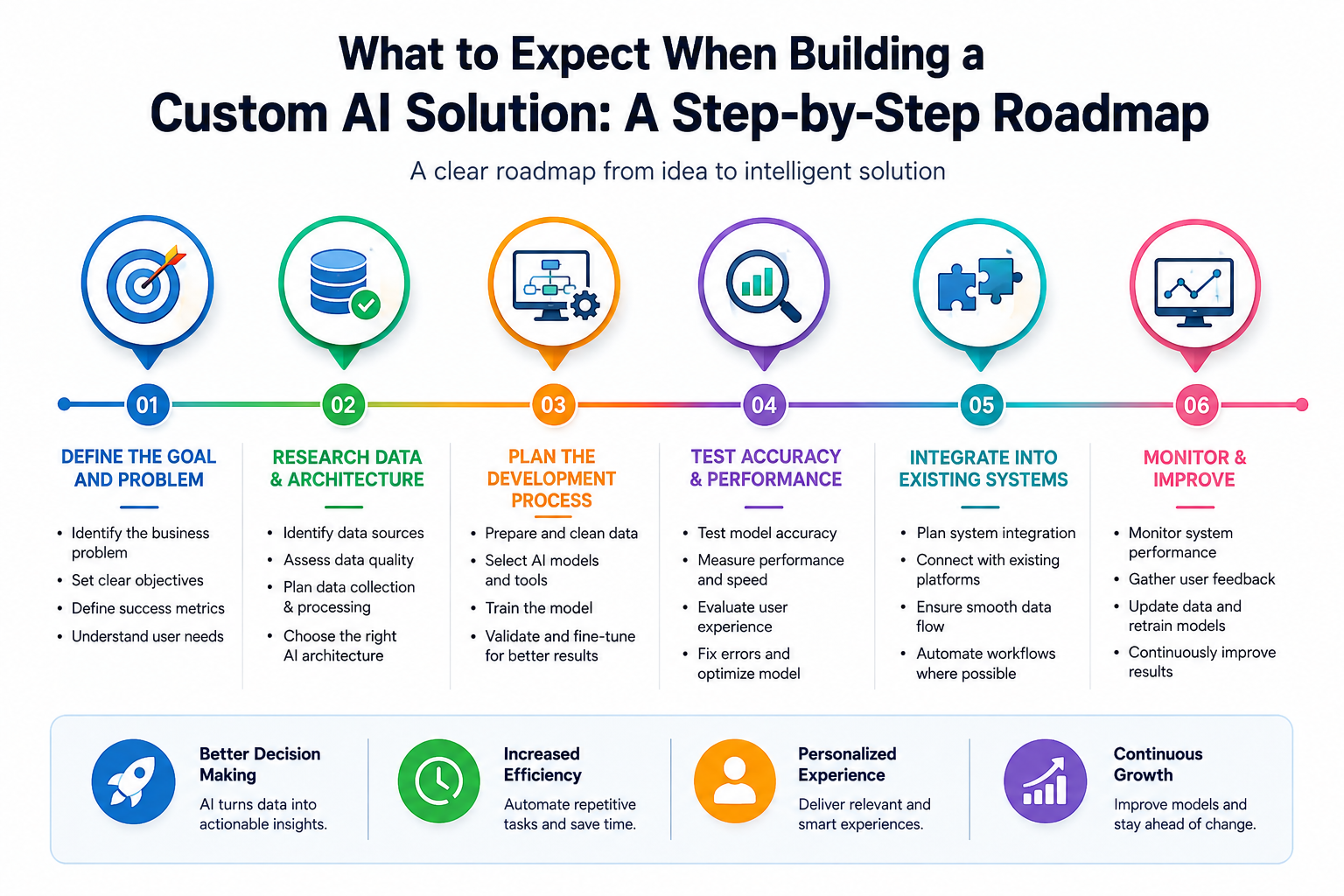
Artificial intelligence is no longer limited to research labs or large technology companies. It has become part of everyday digital operations, from search engines understanding user intent to businesses predicting customer behavior. For SEO professionals, marketers, and technology teams, AI is changing how content is created, analyzed, optimized, and delivered.

But building an AI solution is not simply about adding a chatbot or connecting an API. A successful AI system requires planning, quality data, clear objectives, testing, and continuous improvement. If you are exploring how AI can support your business process, understanding the development journey helps you make better decisions.

This roadmap explains what happens during the creation of a custom AI solution and how AI development connects with modern SEO strategies.
Why Custom AI Solutions Matter in the Modern SEO Landscape
Search behavior has changed significantly. Users no longer search only with short keywords. They ask complete questions, expect personalized answers, and interact with search platforms in more conversational ways.
AI helps businesses understand these changes by analyzing:
- Search intent patterns
- User behavior data
- Content performance metrics
- Customer interactions
- Market trends
For example, an SEO team can use AI models to identify content gaps by analyzing thousands of search results, competitor pages, and user queries. Instead of manually reviewing data for hours, AI can highlight opportunities faster.
However, AI is not replacing SEO strategy. It is becoming a tool that improves decision-making.
A modern SEO workflow may include AI-based keyword clustering, automated content analysis, predictive ranking insights, and personalized user experiences.
Step 1: Define the AI Goal and Business Problem
Every successful AI project starts with one question:
What problem should the AI system solve?
Many projects fail because teams begin with technology instead of purpose.
A clear AI objective could be:
- Reducing customer support response time
- Predicting customer purchasing behavior
- Automating data analysis
- Improving content recommendations
- Detecting patterns in large datasets
For SEO-related applications, the goal might be creating a system that identifies ranking opportunities, monitors content quality, or analyzes search trends.
A simple example:
Instead of saying:
“Build an AI tool for marketing.”
A better objective is:
“Create an AI system that analyzes organic traffic data and recommends content improvements based on search performance.”
The second approach gives developers and analysts a measurable direction.
Step 2: Research Data Requirements and AI Architecture
AI depends heavily on data. The quality, structure, and availability of information directly influence the final result.
During this stage, teams evaluate:
- What data sources are available?
- Is the data accurate?
- How frequently should it update?
- Does it require cleaning?
For example, an AI SEO analysis platform may use:
| Data Source | Purpose |
|---|---|
| Google Search Console data | Understand keyword performance |
| Website analytics | Analyze user behavior |
| Competitor pages | Identify content opportunities |
| Customer feedback | Improve recommendations |
The architecture decision comes next.
A basic AI workflow may look like this:
User Input → Data Processing → AI Model → Analysis → Recommendation
Different solutions may use machine learning models, natural language processing systems, recommendation engines, or large language models depending on the goal.
Step 3: Planning the Development Process
The development phase converts the idea into a working system.
This is where custom ai software development becomes an important part of modern technology discussions because organizations are increasingly creating AI systems designed around specific workflows instead of relying only on general-purpose tools.
A structured development roadmap usually includes:
Data Preparation
Raw data often contains errors, duplicates, or missing information.
Example:
A keyword dataset may include:
AI SEO tools
ai seo tool
AI SEO software
AI optimization platform
The system may normalize these variations to understand they represent similar search intent.
Model Training
The AI model learns patterns from prepared data.
A simplified example:

from sklearn.linear_model import LinearRegression

data = [[10], [20], [30], [40]]
ranking_scores = [50, 60, 70, 80]

model = LinearRegression()

model.fit(data, ranking_scores)

prediction = model.predict([[50]])

print(prediction)
This example shows how a machine learning model can identify relationships between input data and predicted outcomes.
Real AI systems are much more complex, but the concept remains similar: provide data, train the model, evaluate results.
Step 4: Testing Accuracy and Performance
AI systems need continuous testing.
A model that works well in a controlled environment may behave differently with real users.
Testing usually focuses on:
- Accuracy
- Response speed
- Data handling
- User experience
- Error management
For example, an AI content recommendation system should not only suggest topics. It should provide useful recommendations that match search intent.
Teams may track metrics such as:
| Metric | Purpose |
| Accuracy rate | Measures prediction quality |
| Response time | Checks system speed |
| User engagement | Evaluates practical usefulness |
| Error rate | Identifies problems |
Testing is not a one-time step. AI models often improve through repeated feedback.
Step 5: Integrating AI Into Existing Systems
A custom AI solution usually needs to connect with existing platforms.
Common integrations include:
- Websites
- Mobile applications
- CRM systems
- Analytics platforms
- Content management systems
For SEO teams, integration can help automate repetitive activities such as:
- Content audits
- Internal linking suggestions
- Keyword grouping
- Performance reporting
The goal is not automation for the sake of automation.
The goal is creating smoother workflows where humans focus on strategy while AI handles complex analysis.
Step 6: Monitoring and Improving the AI System
AI is not a “build once and forget” technology.
Search trends change. User behavior changes. Data changes.
A model trained today may become less accurate months later.
Regular monitoring includes:
- Updating training data
- Reviewing model output
- Measuring business impact
- Improving system responses
This is especially important in SEO because search algorithms, competition, and audience expectations continue evolving.
The Role of a Custom AI Development Company in the Industry Ecosystem
As AI adoption grows, a custom ai development company represents one approach organizations explore when building specialized systems for unique operational requirements.
The industry is moving toward AI solutions that are connected with specific business data rather than generic tools. For example, an ecommerce company may need AI recommendations based on customer behavior, while a media website may need AI systems focused on content discovery and personalization.
The key factor is understanding the problem first and selecting the right AI approach.
Common Mistakes to Avoid When Building AI Solutions
Many AI projects face challenges because of poor planning.
Common mistakes include:
Starting without clear objectives
AI should solve a measurable problem.
Ignoring data quality
Poor data creates poor results.
Expecting immediate perfection
AI systems improve through testing and feedback.
Focusing only on technology
User experience and business needs matter equally.
Future of AI, SEO, and Digital Strategy
The connection between AI and SEO will continue becoming stronger. Search engines are using more advanced systems to understand content, context, and user needs.
Future SEO strategies will likely focus more on:
- Helpful content experiences
- Semantic understanding
- Personalization
- Data-driven optimization
- AI-assisted analysis
The businesses that adapt will not simply use AI tools. They will understand how AI fits into their broader digital strategy.
Building a custom AI solution is a journey involving research, planning, development, testing, and improvement. When approached correctly, AI becomes more than a technology upgrade. It becomes a system that helps organizations understand information, make better decisions, and respond faster in an increasingly digital world.