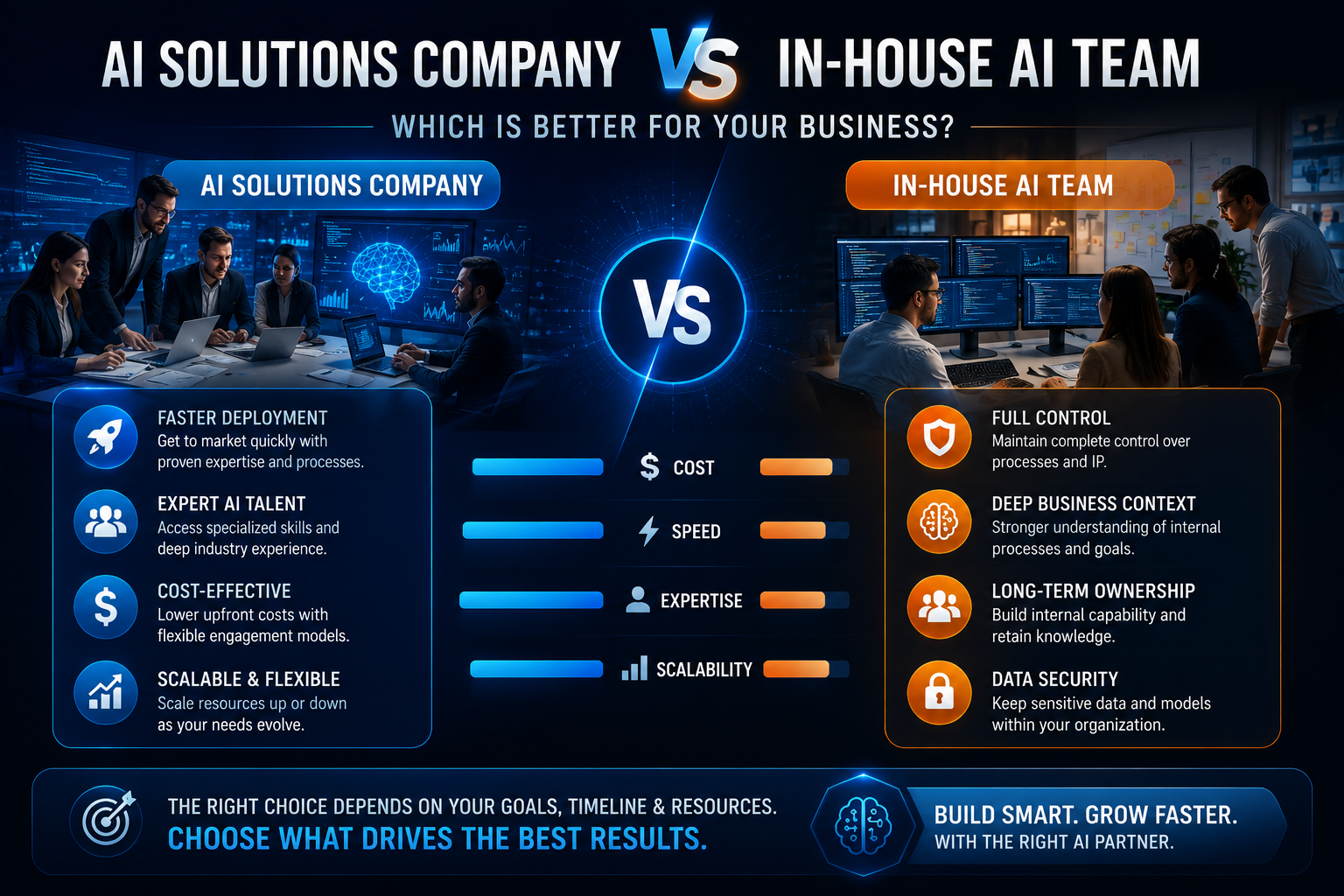
Artificial intelligence has moved far beyond experimentation. According to McKinsey’s State of AI Report, organizations across industries are increasing investments in AI to improve efficiency, automate processes, and create new revenue opportunities. Yet a major decision often emerges before any model is trained or software is deployed: should a business build an internal AI team or partner with an AI solutions company?

Many executives assume an in-house team automatically provides greater control. Others view outsourcing as the faster path to results. The reality is more nuanced. Both approaches offer advantages, but each comes with trade-offs that can significantly affect costs, implementation speed, and long-term outcomes.
The right choice depends on business goals, internal capabilities, project complexity, and available resources. Understanding where each model performs best can help organizations avoid expensive mistakes and accelerate AI adoption.
Why Does This Decision Matter More Than Ever?
AI projects rarely fail because of technology alone.
Most failures occur because organizations underestimate the resources required to build, deploy, and maintain AI systems. Hiring data scientists, machine learning engineers, AI architects, and product specialists requires substantial investment.
At the same time, businesses face increasing pressure to adopt AI faster than competitors.
Choosing the wrong delivery model can delay projects, increase costs, and limit business impact.
That’s why organizations must evaluate both options strategically rather than treating them as purely staffing decisions.
What an In-House AI Team Brings to the Table?
An internal AI team provides direct access to resources dedicated exclusively to the organization.
These teams often develop a deeper understanding of:
- Internal processes
- Business objectives
- Customer behavior
- Company culture
- Proprietary data
This familiarity can improve collaboration between departments and help align AI initiatives with long-term business priorities.
For organizations planning extensive AI investment over several years, building internal expertise may create a sustainable competitive advantage.
The Challenges of Building Internal AI Capability
There’s a catch.
AI talent is expensive and increasingly difficult to recruit.
According to LinkedIn’s Emerging Jobs Report, AI-related roles remain among the fastest-growing and most competitive positions in the technology sector.
Building a complete AI team often requires:
- Data scientists
- Machine learning engineers
- MLOps specialists
- AI architects
- Product managers
Hiring and retaining this talent can take months before development even begins.
What an AI Solutions Company Offers?
An AI solutions company provides immediate access to multidisciplinary expertise.
Instead of assembling a team from scratch, organizations gain access to professionals experienced in:
- AI strategy
- Machine learning development
- Data engineering
- Cloud infrastructure
- AI deployment
This often accelerates project timelines significantly.
Many companies choose a software developoment company because expertise is available immediately rather than after a lengthy recruitment process.
Speed Often Determines Business Value
Timing matters.
In many industries, the first organization to successfully deploy AI gains operational advantages that competitors struggle to match.
An AI solutions company can typically begin planning and development much faster than a newly formed internal team.
Experienced providers have established workflows, proven implementation methodologies, and existing technical frameworks.
As a result, businesses frequently move from concept to deployment in a fraction of the time.
Faster implementation often translates directly into faster ROI.
Comparing Costs Beyond Salaries
Many organizations evaluate costs incorrectly.
They compare vendor fees against employee salaries.
That comparison ignores several significant expenses associated with internal teams:
- Recruitment costs
- Benefits
- Training
- Software licenses
- Infrastructure
- Employee turnover
An internal AI department may cost substantially more than initial salary estimates suggest.
An AI solutions company typically provides predictable project costs and flexible engagement models, making budgeting easier for many organizations.

Scalability Creates a Major Difference
AI requirements rarely remain static.
Projects evolve.
Data volumes increase.
New business opportunities emerge.
An internal team may struggle to scale quickly when demand changes.
Hiring additional specialists often requires significant time and investment.
An AI solutions company can typically expand resources much faster because specialists are already available within the organization.
This flexibility becomes particularly valuable during large implementation phases.
Where Do In-House Teams Have a Clear Advantage?
Despite the benefits of outsourcing, internal teams are not obsolete.
Organizations with highly specialized requirements often benefit from maintaining internal AI expertise.
Examples include:
- Proprietary research initiatives
- Sensitive intellectual property
- Long-term AI product development
- Highly regulated environments
In these situations, direct control may justify higher costs and longer timelines.
The value comes from ownership rather than speed.
The Hybrid Model Is Becoming More Common
Many businesses no longer view the decision as one or the other.
Instead, they combine both approaches.
A common model involves partnering with an AI solutions company during strategy, development, and deployment phases while gradually building internal capabilities.
This approach delivers immediate expertise while creating long-term organizational knowledge.
It also reduces implementation risk because experienced specialists guide critical early decisions.
The hybrid approach often provides the best balance between speed, control, and scalability.
Which Option Delivers Better Business Outcomes?
There is no universal answer.
Businesses seeking rapid implementation, specialized expertise, and predictable costs often achieve stronger results through an AI solutions company.
Organizations pursuing extensive long-term AI initiatives may benefit from developing internal capabilities over time.
The deciding factor is usually not technology.
It is business strategy.
Companies that align AI delivery models with organizational goals tend to achieve better outcomes regardless of which approach they choose.
Conclusion
The debate between an AI solutions company and an in-house AI team is not really about outsourcing versus ownership. It is about choosing the structure that best supports business objectives. Internal teams offer control, organizational knowledge, and long-term capability development. External partners provide speed, expertise, scalability, and lower operational complexity.
As AI adoption continues to accelerate, organizations should focus less on which model appears superior in theory and more on which model fits their current stage of growth. For many businesses, the most effective path may involve combining both approaches. The organizations that move quickly while building sustainable AI capabilities are likely to gain the greatest competitive advantage over the next decade.
FAQs
Is an AI solutions company cheaper than hiring an internal AI team?
In many cases, yes. External providers eliminate recruitment costs, employee benefits, training expenses, and long-term staffing commitments.
When should a company build an in-house AI team?
Organizations planning extensive long-term AI investment or managing highly specialized intellectual property often benefit from internal expertise.
Why do businesses choose AI solutions companies?
Businesses often choose external partners for faster implementation, specialized expertise, scalability, and predictable project costs.
Can companies use both models together?
Yes. Many organizations use a hybrid model where external specialists help launch projects while internal teams gradually assume responsibility.
Which option provides faster AI implementation?
An AI solutions company typically delivers faster implementation because experienced specialists, frameworks, and processes are already in place.