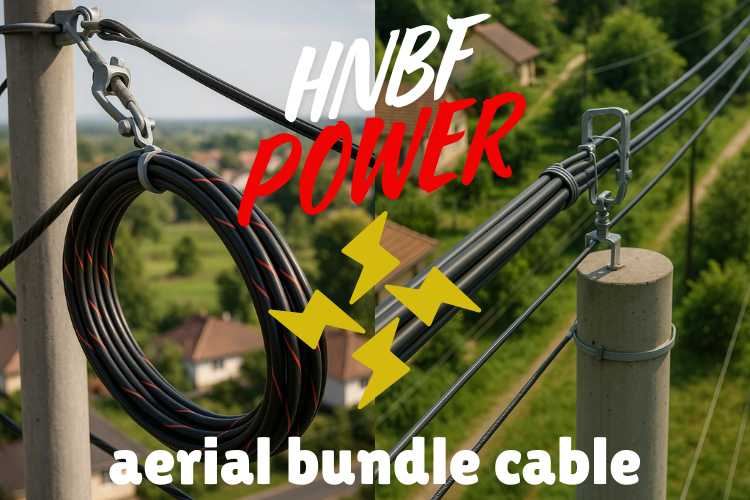
In today’s rapidly expanding power distribution networks, utilities and EPC contractors are under constant pressure to deliver safer, more reliable, and cost-efficient overhead lines especially in dense urban areas and challenging environments. Aerial bundle cable has emerged as one of the most practical alternatives to traditional bare conductors for low- and medium-voltage distribution systems.
This article explains what aerial bundle cable is, how it works, and why engineers and procurement teams increasingly specify it for modern grid projects.
What Is Aerial Bundle Cable?
Aerial bundle cable (ABC) is an overhead insulated conductor system in which several phase conductors are twisted together with a neutral messenger conductor to form a compact bundle. Unlike conventional overhead lines that rely on bare aluminum conductors and wide phase spacing, aerial bundle cable uses fully insulated cores, significantly improving operational safety and network reliability.
In typical distribution applications, the bundle includes:
-
Insulated aluminum phase conductors
-
An insulated or bare neutral messenger
-
Weather-resistant outer layers designed for outdoor operation
This compact structure makes aerial bundle cable ideal for congested distribution corridors and service connections in residential and commercial networks.
Why Utilities Are Shifting from Bare Conductors to Aerial Bundle Cable
1. Enhanced Safety and Reduced Fault Risk
The most critical advantage of aerial bundle cable is its insulation system. The insulated phase conductors drastically reduce the risk of:
-
Phase-to-phase contact
-
Accidental contact with trees or buildings
-
Public safety incidents
For utilities operating in populated areas, this feature alone justifies the transition from conventional bare overhead conductors to ABC cable systems.
2. Superior Reliability in Harsh Environments
Aerial bundle cable performs particularly well in regions with:
-
Dense vegetation
-
High wind loads
-
Salt fog or industrial pollution
The insulated design reduces flashovers and minimizes interruptions caused by environmental interference. This translates into improved SAIDI and SAIFI performance for distribution utilities.
3. Compact Line Design and Easier Route Planning
Because the conductors are bundled tightly together, line corridors can be narrower. This enables:
-
Installation along streets and narrow rights-of-way
-
Deployment close to buildings where traditional overhead lines are restricted
-
Simplified network expansion in urban redevelopment projects
Typical Construction and Technical Characteristics
Phase and Neutral Arrangement
Most aerial bundle cable designs include three aluminum phase conductors and one neutral messenger. The neutral core also serves as the mechanical support element of the line, carrying most of the tensile load.
Insulation System
High-quality aerial bundle cable uses cross-linked polyethylene (XLPE) or similar thermoplastic insulation systems that provide:
-
High electrical strength
-
Excellent UV resistance
-
Resistance to moisture and tracking
This insulation ensures long-term performance under continuous outdoor exposure.
Mechanical Strength
The neutral messenger conductor is designed to withstand the full mechanical tension of the span. This allows the phase conductors to remain electrically insulated without being subjected to excessive mechanical stress.
Key Engineering Benefits for Distribution Projects
Improved Network Continuity
Aerial bundle cable reduces unplanned outages caused by conductor clashing and vegetation contact. For utilities operating mixed urban and rural networks, this significantly improves operational stability.
Reduced Line Maintenance
Since the conductors are insulated, vegetation trimming cycles can be extended in many areas. This lowers routine maintenance costs and reduces service interruptions during line works.
Lower Installation Complexity
Compared with traditional overhead line construction using multiple insulators and crossarms, aerial bundle cable systems:
-
Require fewer line hardware components
-
Allow faster stringing and tensioning
-
Simplify service drop connections
This results in shorter project schedules and lower labor costs for EPC contractors.
Where Aerial Bundle Cable Is Commonly Used
Low-Voltage Distribution Networks
Aerial bundle cable is widely applied in 0.6/1 kV distribution systems for residential and commercial supply, especially in:
-
Urban distribution feeders
-
Residential service drops
-
Street-side pole lines
Rural and Semi-Urban Electrification
In electrification and network expansion projects, ABC cable is ideal where right-of-way access is limited and fast installation is essential.
Temporary and Redevelopment Power Networks
Because of its flexible routing and compact structure, aerial bundle cable is frequently specified for temporary power distribution and redevelopment zones.
Manufacturing Quality Matters – Why HNBF Power Makes a Difference
Selecting the right aerial bundle cable supplier is as important as selecting the cable design itself. HNBF Power is a global manufacturer of overhead conductors and power cables, supplying utilities and EPC contractors with certified solutions including AAC, AAAC, ACSR, ABC, low-voltage power cables, and concentric cables.
HNBF Power’s aerial bundle cable solutions are engineered with:
-
Precisely controlled aluminum conductor stranding
-
High-performance insulation materials
-
Consistent electrical and mechanical properties across production batches
This ensures stable installation performance, predictable sag-tension behavior, and long-term network reliability for utility operators.
How to Select the Right Aerial Bundle Cable for Your Project
Consider the Electrical Load Profile
Conductor cross-section must be selected based on:
-
Maximum operating current
-
Future load growth
-
Ambient temperature conditions
Proper sizing avoids overheating and extends service life.
Evaluate Mechanical Requirements
Span length, wind loading, and installation tension directly influence the selection of neutral messenger size and overall cable construction.
Environmental Exposure
For coastal, industrial, or high-pollution zones, enhanced insulation and sheath performance should be specified to protect against tracking and surface degradation.
Working with an experienced manufacturer allows utilities and consultants to optimize both electrical and mechanical design parameters.
Frequently Asked Questions (FAQs)
What is the main difference between aerial bundle cable and traditional bare conductors?
Aerial bundle cable uses insulated phase conductors twisted together, while bare conductors are uninsulated and require wide spacing and multiple insulators. ABC offers higher safety and better resistance to environmental interference.
Is aerial bundle cable suitable for long distribution spans?
It is mainly designed for short to medium spans in low-voltage and compact distribution networks. For long transmission spans, conventional overhead conductors are usually more suitable.
Can aerial bundle cable be used in high-vegetation areas?
Yes. One of the main advantages of aerial bundle cable is its excellent performance in tree-rich environments, where insulation significantly reduces outage risks.
Does aerial bundle cable require special installation tools?
Standard overhead line stringing tools are generally sufficient. However, dedicated accessories such as suspension clamps and insulation piercing connectors are recommended for optimal installation quality.
Final Thoughts – Power Your Network with Proven Aerial Bundle Cable Solutions
Aerial bundle cable is no longer just an alternative it is becoming a standard solution for modern low-voltage overhead distribution systems. Its safety, compact design, and operational reliability make it an ideal choice for utilities, EPC contractors, and infrastructure developers seeking long-term performance and reduced maintenance costs.
If you are planning new distribution lines or upgrading existing overhead networks, contact HNBF Power today to discuss your project requirements and receive customized aerial bundle cable solutions tailored to your electrical, mechanical, and environmental conditions.