In an industry defined by rapid change, the persistence of the CompTIA A+ certification as an entry point into IT may seem surprising. New roles emerge, cloud platforms evolve, and automation reshapes daily work, yet A+ continues to hold relevance. Its endurance is not accidental. The certification addresses a foundational problem in IT careers: how to validate baseline technical competence before specialization begins.
This article examines why A+ remains the first step for many IT professionals, not as a matter of tradition, but because of what it reveals about readiness, learning behavior, and long-term career progression.
Establishing a Common Technical Language
One of the most important functions of the A+ certification is standardization. Entry-level IT roles often attract candidates from diverse backgrounds, including self-taught learners, career switchers, and recent graduates. This diversity creates inconsistency in how basic concepts are understood and applied.
A+ addresses this by defining a shared technical language. Hardware components, operating systems, networking basics, and troubleshooting processes are framed in consistent terms. Candidates who complete A+ demonstrate not just exposure to these topics, but an ability to communicate about them clearly and accurately.
In professional environments, this shared language reduces friction. Teams function more effectively when foundational assumptions align, and A+ helps establish that alignment early in a career.
Measuring Troubleshooting Mindset Rather Than Memorization
Although A+ covers broad technical ground, its deeper value lies in how it frames problem-solving. The certification emphasizes diagnostic thinking: identifying symptoms, isolating causes, and applying structured resolution steps.
This mindset is critical across all IT roles, even those that later become highly specialized. Whether managing cloud infrastructure or securing enterprise networks, professionals are constantly troubleshooting systems under constraints.
A+ preparation reveals whether a candidate approaches problems methodically or reacts impulsively. This distinction matters to employers because troubleshooting behavior is often more predictive of job performance than raw technical knowledge.
Reducing Risk in Entry-Level Hiring
From an organizational perspective, entry-level hiring carries inherent risk. Employers invest time and resources in onboarding, yet cannot easily assess practical readiness from resumes alone. A+ reduces this uncertainty by signaling baseline competence.
The certification does not claim expertise, but it demonstrates that a candidate can operate within structured technical environments, follow best practices, and understand escalation boundaries. These traits are especially valuable in support and junior infrastructure roles, where mistakes can disrupt operations. As a result, A+ functions as a risk-mitigation credential. Its continued use reflects employer preference for predictable foundational capability rather than untested potential.
Supporting Career Exploration Without Early Lock-In
Another reason A+ remains relevant is its neutrality. Unlike role-specific certifications, it does not force candidates into a narrow path prematurely. Instead, it exposes them to multiple IT domains, including hardware, operating systems, networking, and security fundamentals.
This exposure allows candidates to explore interests before committing to specialization. Someone who begins with A+ may later discover an affinity for networking, cybersecurity, or cloud operations. The certification provides enough breadth to inform these decisions without requiring early commitment. In a career landscape where flexibility matters, this exploratory function has lasting value.
Aligning With Learning Progression in IT
IT careers typically develop in layers. Foundational understanding precedes specialization, which later evolves into design or strategic responsibility. A+ fits naturally into this progression because it focuses on the operational layer where systems are used, maintained, and supported.
Candidates who skip foundational learning often struggle later when advanced concepts assume implicit knowledge. Gaps appear in areas like system interactions, hardware constraints, or basic networking behavior. A+ helps prevent these gaps by reinforcing core concepts early.
This alignment with learning progression explains why many professionals, even those pursuing advanced roles, still recommend A+ as a starting point.
Reflecting Real-World Entry-Level Responsibilities
The content of A+ maps closely to real-world entry-level tasks. Installing systems, configuring devices, resolving user issues, and maintaining operational stability are central to many junior IT roles.
The certification’s emphasis on procedures, documentation, and safety mirrors workplace expectations. Candidates who perform well typically show readiness for environments where adherence to process matters as much as technical ability.
This realism reinforces the certification’s credibility. It does not attempt to predict future specialization, but validates competence in the work many professionals actually perform at the start of their careers.
How A+ Fits Into Broader Certification Pathways
While A+ stands alone as an entry credential, it also functions as a foundation for further certifications. Its concepts support progression into networking, security, and vendor-specific tracks.
Some learning platforms, including Cert Empire, position A+ within a broader certification ecosystem to help candidates understand how foundational skills connect to later career stages without treating it as an endpoint.
This connective role strengthens A+’s relevance by embedding it within long-term professional development rather than isolating it as a one-time requirement.
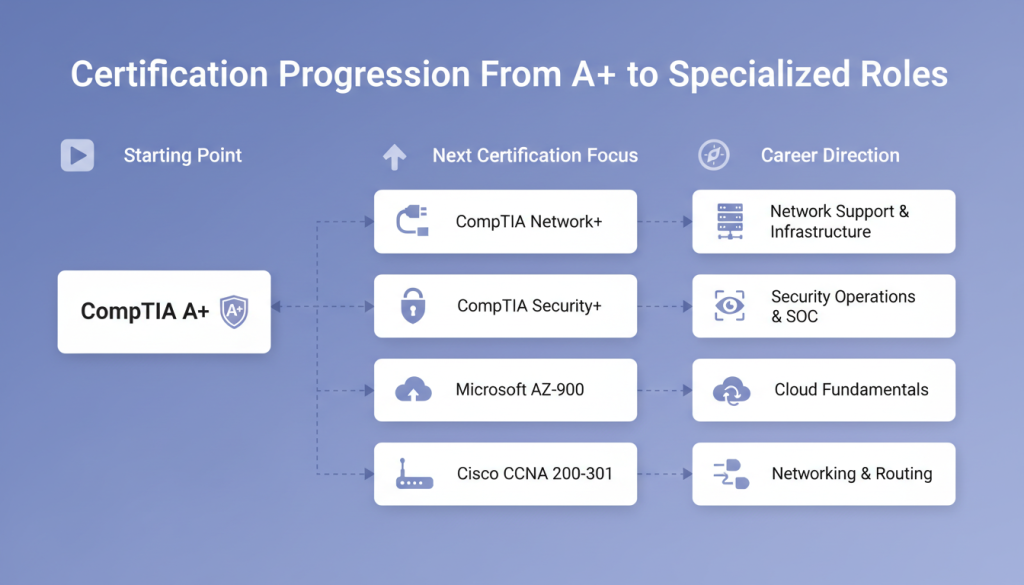
Certification Progression From A+ to Specialized Roles
The table below illustrates how A+ commonly supports progression into more specialized IT certifications and roles.
| Starting Point | Next Certification Focus | Career Direction |
|---|---|---|
| CompTIA A+ | CompTIA Network+ | Network Support, Infrastructure |
| CompTIA A+ | CompTIA Security+ | Security Operations, SOC |
| CompTIA A+ | Microsoft AZ-900 | Cloud Fundamentals |
| CompTIA A+ | Cisco CCNA 200-301 | Networking and Routing |
This progression highlights A+ as a structural foundation rather than a terminal credential.
Operational Discipline as a Career Signal
Beyond technical coverage, A+ reinforces the importance of operational discipline in IT environments. Entry-level roles demand consistency, procedural accuracy, and awareness of downstream impact. The certification emphasizes structured workflows, documentation awareness, and controlled problem resolution. These qualities translate directly into workplace reliability, where small configuration or handling errors can create disproportionate operational consequences.
What A+ Validates at an Entry Level
-
It confirms the ability to work across mixed environments where hardware, operating systems, and basic networking intersect rather than exist in isolation.
-
It demonstrates awareness of escalation boundaries, showing when an issue should be resolved locally versus passed to higher-level teams.
-
It reflects readiness to operate in user-facing scenarios where communication, documentation, and prioritization matter as much as technical accuracy.
-
It signals familiarity with standard workplace constraints such as time pressure, limited access, and the need to balance speed with stability.
Early Commitment and Professional Alignment
A+ preparation also functions as an early indicator of professional alignment with IT work. The breadth of required study exposes candidates to routine, repetitive, and detail-oriented tasks that characterize many early-career roles. Candidates who persist demonstrate readiness for sustained learning and operational responsibility, while those who disengage often gain clarity before investing further time in a mismatched career path.
Concluding Thoughts
The continued relevance of the A+ certification reflects its role in validating foundational readiness rather than outdated tradition. It establishes a common technical language, measures troubleshooting behavior, reduces hiring risk, and supports informed career exploration. In an industry where specialization is inevitable, A+ provides the grounding that makes specialization effective. For many IT careers, the first step remains foundational, not because change has slowed, but because strong foundations remain essential. Readers can explore a step-by-step breakdown in Cert Empire’s YouTube Videos.
FAQs
Is A+ certification still relevant for modern IT roles?
Yes, it validates foundational skills and troubleshooting behavior that remain essential across support, infrastructure, cloud, and security roles despite ongoing technological change.
Does A+ limit career specialization options?
No, it provides broad exposure that supports informed specialization later, allowing candidates to transition into networking, security, or cloud paths more effectively.
Can experienced professionals benefit from A+ knowledge?
Experienced professionals often rely on A+ concepts implicitly, especially when diagnosing system-level issues or mentoring junior staff in foundational troubleshooting practices.
Is A+ necessary before advanced certifications?
It is not mandatory, but it significantly reduces knowledge gaps that can hinder understanding of more advanced networking, security, or cloud certifications.