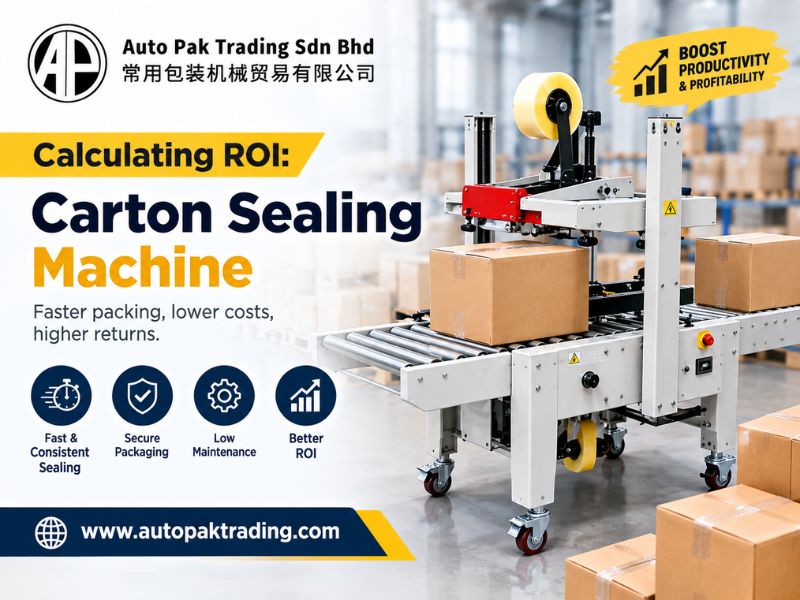
A carton sealer machine should be purchased when the total manual carton sealing cost (including labor, tape waste, and downtime) is higher than the annualized cost of the machine. Most mid to high volume operations, sealing 200 or more cartons a day or more, will return a measurable, recurring return in 12 to 24 months, a financial return which is good value.

If you’re a CFO or procurement officer evaluating capital expenditure on packaging equipment, the question isn’t really “can we afford it?” – it’s “can we afford not to?” The answer lives in the numbers. A carton sealer machine isn’t just an operational upgrade. It’s a financial instrument that directly impacts labor spend, consumable costs, and throughput capacity every single working day.

Let’s walk through the math.
What Does Manual Carton Sealing Actually Cost You?
Most finance teams underestimate the true cost of manual sealing because it hides in plain sight. It’s not just the hourly wage of the person applying tape — it’s the compounding inefficiency of that process across every shift, every day, every year.
Here’s how the cost stack builds up:
- Labor cost per carton: At PKR 35,000–50,000/month for a packaging worker in Pakistan, sealing 300 cartons per shift translates to roughly PKR 6–9 per carton in labor alone.
- Tape consumption: Manual application typically uses 15–25% more tape than machine application due to overlaps, errors, and inconsistent pull lengths.
- Rework and damage: Poorly sealed cartons lead to returns, damage claims, and repackaging — costs that rarely appear on a packaging budget but consistently appear on a P&L.
- Speed bottleneck: A trained worker seals roughly 4–6 cartons per minute. An automated case sealer operates at 15–25 cartons per minute without fatigue.
When you run those numbers across a 250-day working year, the delta between manual and automated sealing becomes very difficult to ignore.
The ROI Formula: Breaking Down Carton Sealer ROI
ROI calculation for packaging automation doesn’t require a finance degree. It requires honest inputs and a structured framework.
Step 1 – Quantify Your Current Annual Sealing Cost
Add up: total labor hours spent on sealing × hourly cost + tape consumption cost + estimated rework/damage costs. For a facility sealing 500 cartons per day with two workers, annual labor costs on this task alone can reach PKR 840,000–1,200,000.
Step 2 – Estimate Post-Automation Costs
After deploying a carton sealer, you typically need one operator for oversight rather than two dedicated sealers. Tape consumption drops by 15–20%. Throughput increases, which may allow labor reallocation rather than redundancy — an important distinction for workforce planning.
Step 3 – Apply the Payback Period Formula
The standard formula is straightforward:
Payback Period = Machine Cost ÷ Annual Cost Savings
If the machine costs PKR 850,000 and your annual savings in labor and tape total PKR 600,000, your payback period is just over 17 months. Beyond that point, every month is pure margin improvement.
| Cost Category | Manual Sealing (Annual) | Automated Sealing (Annual)
|
|---|---|---|
| Labor Cost | PKR 1,200,000 | PKR 600,000 |
| Tape Consumption | PKR 180,000 | PKR 144,000 |
| Rework / Damage | PKR 120,000 | PKR 20,000 |
| Total Annual Cost | PKR 1,500,000 | PKR 764,000 |
Note: Figures are illustrative estimates based on mid-sized Pakistan-based packaging operations. Actual numbers will vary by facility size, shift structure, and carton volume.
Where Packaging Automation Pays Beyond the Obvious
Labor and tape are the headline numbers. But there are secondary financial benefits that procurement teams should factor into the business case.
Throughput Capacity and Revenue Ceiling
Packaging automation removes a common operational bottleneck. If your sealing line is the slowest point in the fulfillment process, you’re capping your own shipment capacity — and therefore, your revenue per shift. A case sealer operating at 20 cartons per minute can process what a two-person team handles in an hour, in under 15 minutes.

Consistency Reduces Downstream Costs
Every carton sealed by a machine is sealed to the same specification. That uniformity matters to retailers, 3PLs, and logistics partners who may charge back for non-compliant packaging. It also reduces the probability of in-transit damage, which carries both direct and reputational costs.
Workforce Flexibility
Redirecting sealing labor to higher-value tasks — quality inspection, order verification, inventory management — improves overall workforce productivity without increasing headcount. This is a harder number to capture in an ROI model, but it’s real and it compounds over time.
What Is the Cost of a Case Sealer – and What Drives Price Variation?
Understanding the cost of case sealer options is essential for building an accurate investment case. Prices in the Pakistani market vary based on automation level, carton size range, and build quality.
- Semi-automatic sealers: Lower entry cost, require an operator to feed and position cartons. Suitable for lower-volume lines or irregular carton sizes.
- Fully automatic sealers: Higher upfront cost, minimal operator intervention, best suited for high-volume or continuous-run operations.
- Adjustable vs. fixed-size models: Adjustable-size machines carry a premium but eliminate the need for multiple machines across varied SKUs.
When evaluating price, factor in total cost of ownership: installation, training, spare parts availability, and after-sales service. A lower sticker price with poor local support can erode ROI quickly through unplanned downtime.
Is Your Volume High Enough to Justify the Investment?
Volume is the single biggest variable in the ROI equation. As a general benchmark:
- Under 100 cartons/day: Manual sealing is likely more cost-effective. Review again as volume grows.
- 100–250 cartons/day: Semi-automatic equipment typically delivers ROI within 18–30 months.
- 250+ cartons/day: Fully automatic equipment often pays back within 12–18 months and delivers compounding savings thereafter.
These are directional thresholds. Your actual break-even depends on local labor rates, current tape spend, and shift structure. Build a model with your own inputs before signing off on any procurement decision.
Making the Business Case to Stakeholders
Procurement officers often have the operational conviction but need a financial narrative that resonates with the CFO. Frame the investment this way: it’s not a cost, it’s a cost-reduction asset with a defined payback horizon and ongoing yield.
Structure your internal proposal around three pillars:
- Current-state cost documentation – labor hours, tape invoices, rework logs
- Post-automation projections – conservative, base, and optimistic scenarios
- Risk factors – downtime probability, maintenance cost estimates, vendor support quality
Present payback period alongside a 3-year and 5-year NPV calculation. In most mid-to-high-volume facilities, the 5-year return on a quality carton sealer investment is 3x to 5x the initial outlay.
For businesses in Pakistan evaluating packaging automation, Autopak Trading offers a range of carton sealing solutions designed for varying production scales. Exploring their equipment lineup is a practical starting point for building a vendor comparison and finalizing your capital expenditure proposal.
Thank you to Press Bulletin for providing us with the opportunity to share this informative content with your readers. We appreciate your platform for helping businesses and brands share valuable insights and industry updates with a wider audience.
FAQ
How do I calculate the ROI of a carton sealer machine?
Divide the total machine cost by your annual savings from reduced labor and tape consumption. If a machine costs PKR 850,000 and saves PKR 600,000 per year, the payback period is approximately 17 months. Beyond that, the savings become direct margin improvement for the business.
What is the typical payback period for a carton sealing machine in Pakistan?
The payback time may be 12-24 months for 250+ cartons/day operations. Lower volume semi-automatic systems can take 24-30 months to pay for themselves depending on the local rates of labor and tapes.
What factors affect the cost of a case sealer?
Automation level (semi vs. fully automatic), carton size range, build quality and after-sales support are all key factors. The total cost of ownership, including installation, training, and spare parts, should always be taken into consideration when considering options, in addition to the purchase price.
At what production volume does packaging automation make financial sense?
Generally, packaging automation becomes financially justifiable at 200 or more cartons per day. Below that threshold, manual sealing may still be more cost-effective. As volume increases, the financial case for automation strengthens significantly due to compounding labor and consumable savings.
How much tape does a carton sealer machine save compared to manual sealing?
Automated carton sealers can save up to 15 to 25 per cent on the amount of tape used when compared to conventional manual application. This is because machines use a calibrated amount of tape on every carton, thus avoiding overlaps and mistakes that would occur during manual sealing.
Can a carton sealer machine improve throughput speed?
Yes. A standard automated case sealer operates at 15 to 25 cartons per minute, compared to 4 to 6 per minute for a trained manual worker. This speed improvement directly expands fulfillment capacity and can remove a critical bottleneck in high-volume packaging lines.