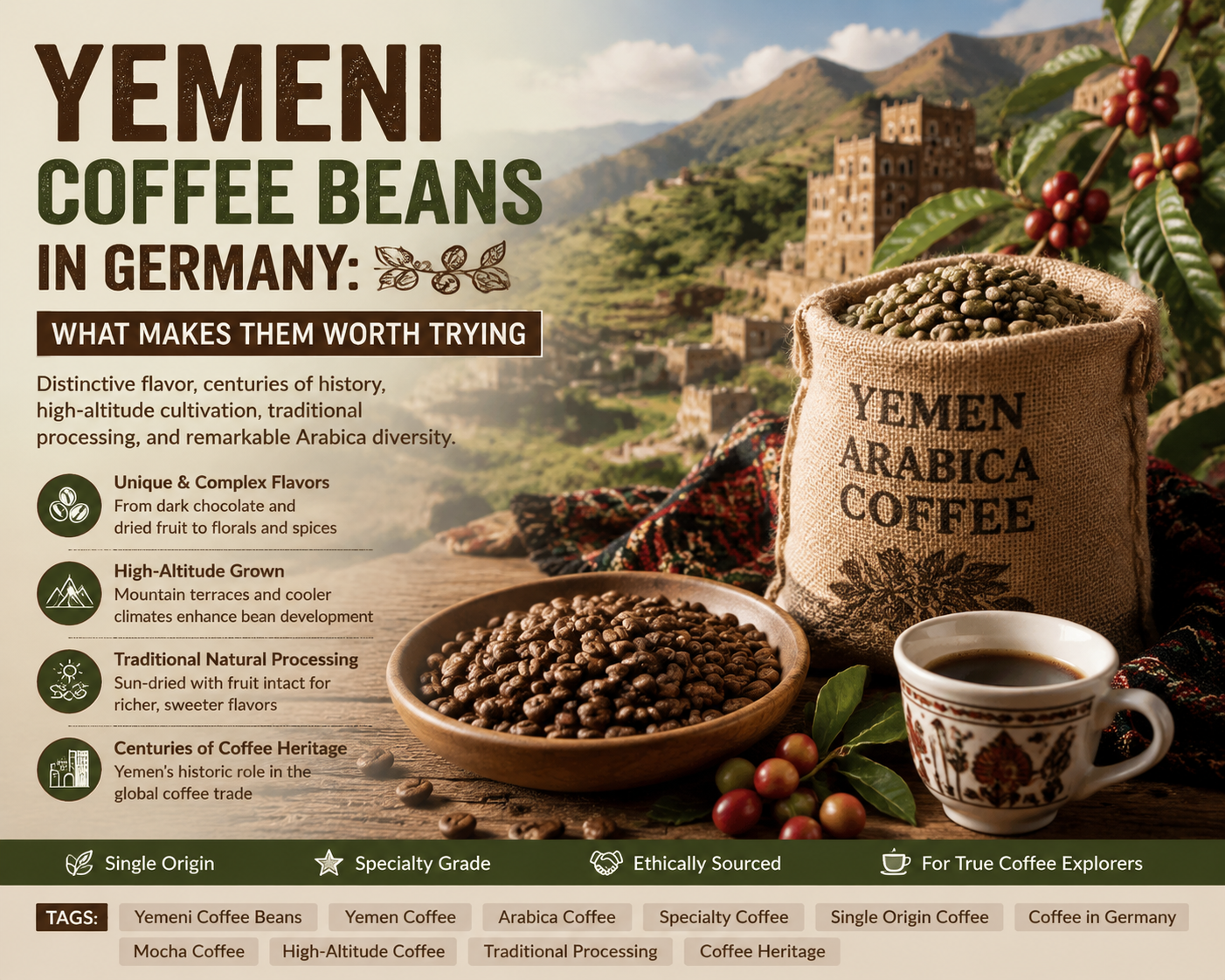
Yemeni coffee beans are worth trying in Germany because they offer a combination of distinctive flavor, centuries of coffee history, high-altitude cultivation, traditional processing, and remarkable Arabica diversity. Grown across Yemen’s mountainous highlands, these coffees can produce flavors ranging from dried fruit and dark chocolate to berries, caramel, florals, and warm spices. For German coffee drinkers accustomed to exploring specialty origins, Yemen offers something genuinely different from a conventional everyday blend.
Germany already has a strong appreciation for quality coffee, from traditional filter coffee to modern specialty roasters and carefully prepared espresso. As interest in origin, processing, and traceability grows, Yemeni coffee provides another opportunity to discover how dramatically geography can influence a cup.

But before buying a bag, it helps to understand why these beans are different and what you should look for.
What Are Yemeni Coffee Beans?
At their simplest, Yemeni coffee beans are coffee beans grown and harvested in Yemen. The country has a centuries-old relationship with Arabica coffee and played an important role in its early cultivation and international trade.
Much of Yemen’s coffee is associated with mountainous growing areas rather than large, flat plantations. Coffee trees can be cultivated on agricultural terraces built along steep slopes, where farming requires considerable manual work.
This challenging geography is part of the coffee’s identity.
It also means Yemeni coffee cannot easily be produced using the same large-scale mechanized methods found in some major coffee-producing countries.
For consumers looking for Yemeni Coffee Beans in Germany, understanding this production background makes it easier to appreciate why Yemeni coffee can differ in both price and character from mainstream supermarket coffee.
Why Yemen Matters to the History of Coffee
Any discussion of Yemeni coffee eventually reaches an important question: Did coffee originate in Yemen?
Not exactly.
Ethiopia and Yemen Have Different Roles in Coffee History
Coffea arabica has its biological origins in Ethiopia. Coffee plants later crossed the Red Sea into Yemen, where systematic cultivation and commercial coffee production developed centuries ago.
Yemen then became an important center for the early international coffee trade.
The historic port of al-Makha, commonly known as Mocha, became so closely associated with exported coffee that its name entered coffee vocabulary around the world.
Today, “mocha” usually makes people think of chocolate and espresso.
Historically, however, the name points back to Yemen.
That gives Yemeni coffee an unusual position: Ethiopia is central to Arabica’s biological origin, while Yemen played a major role in its cultivation and movement toward international markets.
What Makes Yemeni Coffee Beans Taste Different?
There is no single flavor that defines every Yemeni coffee.
That is actually one of the best reasons to explore the origin.
Depending on growing region, plant genetics, altitude, harvest, processing, roast, and brewing method, Yemeni coffee beans can offer very different sensory experiences.
Common tasting descriptions include:
- Dark chocolate and cocoa
- Raisins and dates
- Dried berries
- Caramel
- Nuts
- Warm spices
- Floral aromas
- Wine-like fruitiness
A particular coffee might emphasize chocolate and dried fruit, while another may be brighter and more floral.
Why Tasting Notes Change as Coffee Cools
One simple way to explore these characteristics is to drink the coffee slowly.
Coffee aroma and flavor perception change with temperature.
When a freshly brewed Yemeni coffee is very hot, chocolate or roast characteristics may dominate. As the cup cools, fruit sweetness, acidity, florals, or spice can become easier to notice.
Try taking a sip immediately after brewing and another five or ten minutes later.
You may feel as though you are drinking a slightly different coffee.
Yemen’s Mountain Terraces Shape the Beans
The landscapes where coffee grows matter.
Yemen’s coffee-growing highlands include steep mountains where generations of farmers have used terracing to create cultivable land.
These terraces allow coffee and other crops to grow on slopes that would otherwise be difficult to farm.
High Altitude Can Influence Coffee Development
Many coffee professionals pay attention to altitude because cooler conditions at higher elevations can slow coffee cherry development.
Under suitable conditions, slower maturation can contribute to dense beans and complex sensory potential.
However, altitude is not a quality guarantee.
Good coffee still requires suitable plant material, careful farming, ripe cherry selection, appropriate processing, drying, storage, roasting, and brewing.
What makes Yemen particularly interesting is how altitude interacts with its dry climate, traditional agriculture, and Arabica diversity.
Traditional Natural Processing Adds Character
Processing is another reason Yemeni coffee can taste so distinctive.
Yemen has a long history of natural, or dry, coffee processing.
How Natural Processing Works
Coffee beans are actually seeds found inside coffee cherries.
With natural processing, the harvested cherries are dried with the fruit still surrounding those seeds. Once drying is complete, the outer material is removed and the green coffee beans are prepared for sorting and roasting.
This method requires considerably less water than washed processing, making it particularly appropriate for Yemen’s dry conditions.
Natural processing can also contribute to pronounced sweetness, body, and fruit character.
This helps explain why high-quality Yemeni Coffee Beans can display tasting notes reminiscent of raisins, berries, dates, chocolate, and wine.
The process still requires care. Poor drying can produce inconsistent or undesirable flavors, while careful drying and sorting can create an expressive, complex cup.
Important Coffee-Growing Regions in Yemen
Yemen should not be treated as one uniform coffee-growing area.
Regional differences matter.
Haraz
Haraz is one of Yemen’s most recognizable coffee regions. Its mountain terraces have become closely associated with Yemeni specialty coffee.
Coffees from Haraz can offer combinations of chocolate, dried fruit, sweetness, spice, and floral characteristics.
Individual lots still vary, so “Haraz” should be understood as geographical information rather than a guaranteed flavor profile.
Bani Matar
Bani Matar is another important highland coffee area.
Differences in elevation, microclimate, farming practices, plant populations, processing, and harvest conditions can distinguish its coffees from those grown elsewhere.
For consumers in Germany, this means buying coffee identified only as “Yemeni” is just the beginning.
Region, processing, roast, and traceability provide a much richer picture.
Why Yemeni Coffee Beans Can Look Unusual
Open a bag of traditional Yemeni coffee and you may notice that the beans do not always look as perfectly uniform as highly standardized commercial coffee.
That does not automatically indicate poor quality.
Yemen’s traditional coffee populations, small-scale farms, growing conditions, and processing methods can produce variation in bean size and appearance.
Visual perfection and cup quality are not the same thing.
What matters more is whether the coffee was carefully harvested, processed, sorted, stored, transported, and roasted.
A slightly irregular bean can still contribute to an excellent cup.
Why Yemeni Coffee Can Cost More in Germany
Price is another noticeable difference.
Yemeni specialty coffee can cost considerably more than conventional coffee available in German supermarkets.
There are practical reasons.
Mountain farming can require extensive manual labor. Production volumes may be relatively small, while transportation from remote growing areas can be challenging.
After harvesting, quality-focused coffee needs careful drying, sorting, storage, transportation, export handling, importing, and roasting.
By the time the coffee reaches Germany, many stages have contributed to its final price.
This does not mean every expensive Yemeni coffee is automatically excellent. Price should be supported by quality and traceability.
But comparing small-volume mountain-grown coffee directly with industrial commodity coffee overlooks how differently the two products are produced.
How to Choose Yemeni Coffee Beans in Germany
Start by reading beyond the front of the package.
A useful product description should ideally tell you where the coffee comes from and provide information about its flavor or processing.
Look for Useful Origin Information
Consider details such as:
- Country of origin
- Growing region
- Processing method
- Roast profile
- Tasting notes
- Whole bean or ground
- Sourcing information
- Freshness
The more meaningful information available, the easier it becomes to understand what you are buying.
Avoid choosing coffee solely because the package uses terms such as “rare,” “luxury,” or “authentic.”
Specific information is more useful than impressive adjectives.
When comparing Yemeni Coffee Beans, choose according to the flavors you actually enjoy rather than simply selecting the most expensive option.
How Should You Brew Yemeni Coffee?
One advantage of good Yemeni coffee is that you can explore it using several brewing methods.
Pour-Over
Pour-over brewing is useful when you want clarity.
It can emphasize aroma, acidity, fruit, and floral characteristics, making it particularly interesting for lighter or medium-roasted specialty coffees.
French Press
A French press can produce greater body.
It works particularly well when the coffee has chocolate, caramel, dried-fruit, or spice characteristics that benefit from a fuller texture.
Espresso
Yemeni coffee can also create an intense espresso.
Chocolate, fruit, sweetness, and spice become concentrated, although dialing in the grind and extraction may require some experimentation.
Whatever method you choose, grinding whole beans shortly before brewing can help preserve aroma.
Should You Drink Yemeni Coffee Black?
You should drink coffee however you enjoy it.
Still, when trying a new Yemeni coffee for the first time, tasting a few sips black is worthwhile.
You are not committing yourself to drinking black coffee forever.
You are simply giving yourself an opportunity to understand what you purchased before adding milk, sugar, or spices.
Taste the coffee hot, then let it cool.
Once you understand its natural flavor, add whatever you prefer.
This simple approach makes comparing different origins much easier.
Are Yemeni Coffee Beans Worth Trying in Germany?
For someone who views coffee purely as caffeine, specialty Yemeni coffee may seem unnecessary.
But for drinkers interested in origin and flavor, it offers something different.
Yemeni coffee beans connect several fascinating parts of coffee culture: mountain agriculture, natural processing, Arabica diversity, regional flavor, and centuries of trade history.
They also provide an interesting contrast to coffees from other origins commonly available in Germany.
An Ethiopian coffee may emphasize florals and bright fruit. A Brazilian coffee might lean toward chocolate and nuts. Certain Central American coffees can offer clean sweetness and citrus-like acidity.
Yemeni coffee can move in another direction, combining dried fruit, chocolate, berries, spice, and wine-like characteristics in ways that can be difficult to reproduce elsewhere.
That does not make it objectively better.
It makes it worth exploring.
For German specialty coffee drinkers who enjoy understanding what is behind their cup, Yemeni coffee beans offer much more than an unusual country of origin. They provide an opportunity to taste how geography, agricultural tradition, processing, genetics, and history can come together in a single cup—and why Yemen remains one of the coffee world’s most intriguing origins.