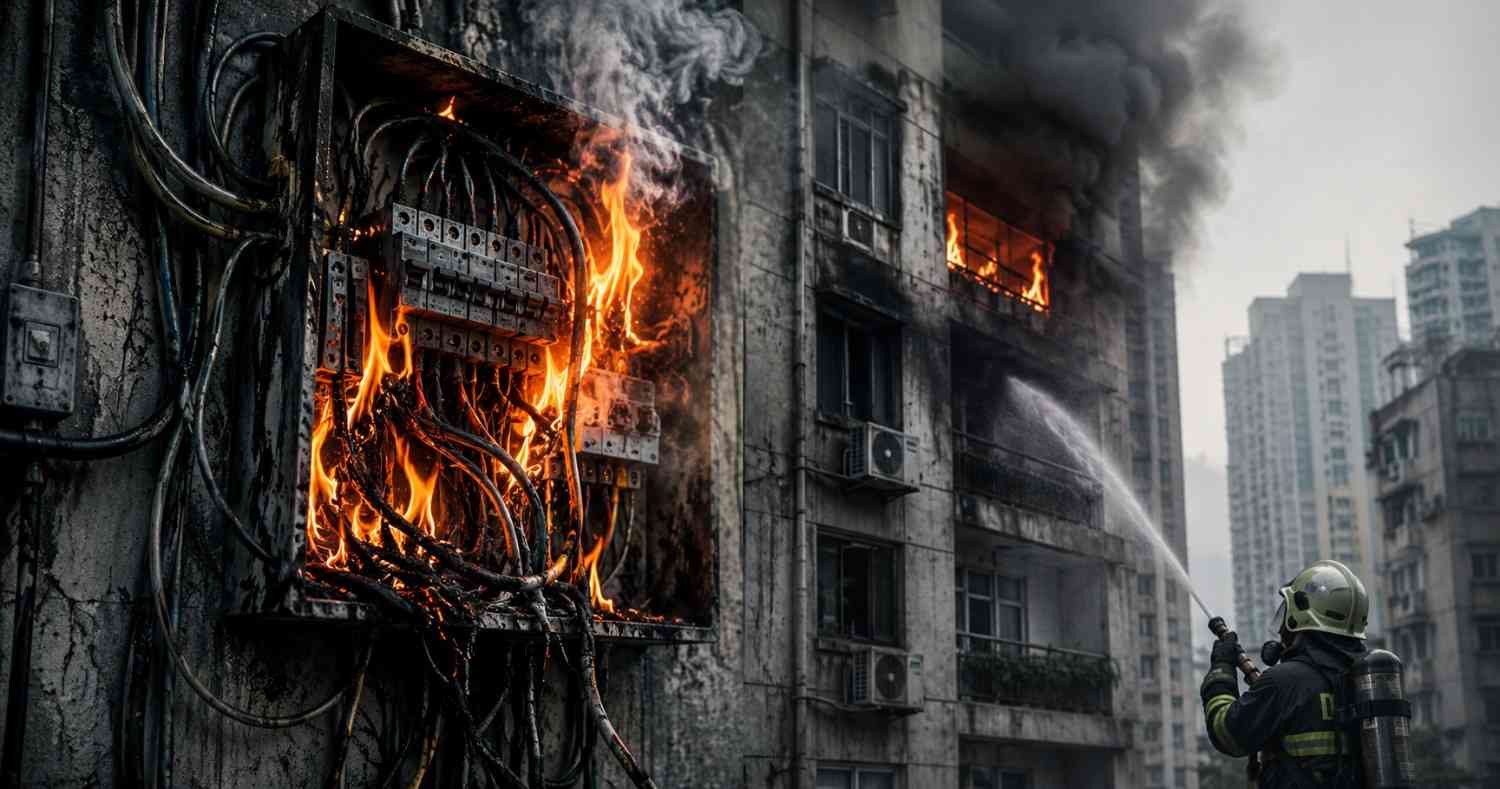
Electrical failures are responsible for approximately 70% of all fire incidents in Indian buildings, driven by overloading, ageing wiring, and poor maintenance practices. That single statistic reframes how building owners and facility managers should think about their fire safety setup.
Most fire safety planning in India focuses on general-purpose coverage — an ABC dry powder extinguisher on every floor, visible from the corridor, in the right place for the fire inspector. That approach works for Class A fires in solid combustible materials. It is the wrong approach for the most common fire risk in the building.
Why Electrical Fires Are Different
An electrical fire does not announce itself with smoke from a wastepaper basket. It starts inside a wall, inside a distribution board, or inside an overloaded power strip running three air conditioners on a circuit designed for two. By the time it is visible, it has been burning for long enough to have compromised the structure around it.
The AC surge is making this worse. According to the International Energy Agency, India’s installed base of air conditioners is expected to grow from 93 million in 2024 to around 240 million by 2030. Buildings designed in the 1980s for fans and tube lights are now running 1.5-tonne inverter ACs, EV chargers, and induction equipment on circuits that were never designed for those loads.
The result is predictable: overheating, arc faults, short circuits, and fires that start inside electrical infrastructure before any detector can register them.
The Wrong Extinguisher Makes It Worse
The ABC dry powder extinguisher — India’s most widely installed unit — is suitable for Class A, B, and C fires. On a live electrical fire, it works technically to suppress the visible flame. But the powder it deposits on electrical equipment — servers, switchgear, control panels — is mildly corrosive and nearly impossible to fully clean from circuit boards and contacts. The equipment survives the fire only to fail from powder damage in the weeks that follow.
More critically: in a server room or data centre, using ABC powder means replacing everything the fire was going to destroy anyway. The extinguisher suppresses the fire but destroys the room.
The correct choice for electrical fire environments is a CO2 fire extinguisher. CO2 cuts off oxygen to the fire, discharges in seconds, and leaves absolutely no residue. Servers, panels, and equipment can be returned to service immediately after the fire is suppressed — provided the underlying electrical fault is addressed.
For occupied spaces like server halls or control rooms where CO2’s oxygen displacement creates a risk for personnel, a clean agent extinguisher is the better specification.
What Every Building Should Have in Its Electrical Zones
Every electrical panel room, server room, UPS room, and generator enclosure should have a dedicated CO2 or clean agent unit — not as a supplement to the floor-level ABC unit, but as the primary fire suppression tool for that specific space.
Placement matters too. The extinguisher should be positioned outside the door of the electrical room — accessible without entering the fire zone — so whoever responds can use it safely.
For a full breakdown of which fire extinguisher India regulations require for different fire risk environments, the selection framework is straightforward once the fire class for each zone is identified.
Three Practical Steps for Facility Managers
First — audit every electrical zone in your building for the correct extinguisher type. If you find ABC powder in your server room, replace it.
Second — check the service record on every CO2 or clean agent unit in electrical areas. These units are often overlooked in routine service visits because they are in locked rooms.
Third — review the electrical load on circuits serving high-draw equipment. An overloaded circuit that trips repeatedly is not a nuisance — it is an active fire risk.
Electrical fires are the most common fire in Indian buildings. Preparing for them specifically — with the right extinguisher type in the right location — is more effective than any general-purpose coverage strategy.
Read More Blog:
How to Choose the Best Fire Extinguisher Manufacturer in India Easily