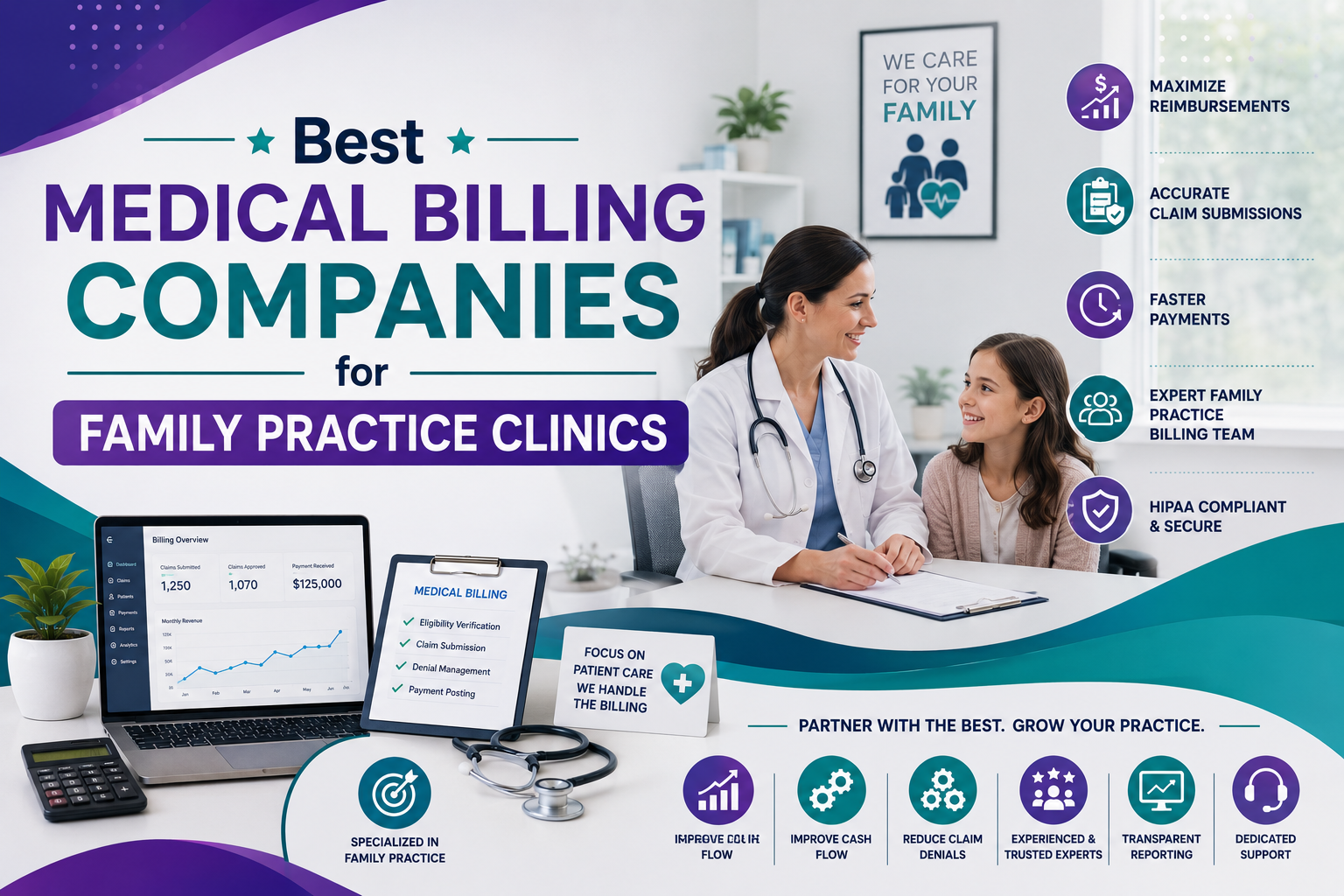
Best Medical Billing Companies for Family Practice Clinics
Family practice clinics occupy a unique position in healthcare. They’re often the first point of contact for patients, handling everything from routine checkups and chronic disease management to acute care visits and preventive screenings. That breadth is exactly what makes family practice billing so uniquely challenging; a single day’s claims might include wellness visits, vaccination codes, chronic care management billing, behavioral health screenings, and minor procedures, each governed by different payer rules.
Given that complexity, choosing the right billing partner isn’t a decision to take lightly. The best medical billing companies don’t just process claims; they understand the specific rhythm of family medicine, from high patient volume to the wide variety of services delivered under one roof. Many clinics start their search by looking into established medical billing services in New Jersey that have a demonstrated track record across primary care settings, since general billing experience alone often isn’t enough to handle the nuances family practices face every day.
This guide walks through what separates a great billing company from an average one, the qualities family practices should prioritize, and how to evaluate your options with confidence.
Why Family Practice Billing Is More Complex Than It Looks
On the surface, family medicine might seem more straightforward than a surgical specialty or a high-acuity hospital department. In reality, the opposite is often true. Family practice clinics deal with an extraordinarily wide range of CPT and ICD-10 codes because they treat patients across every age group and condition type.
A single family medicine visit might involve an annual wellness exam, a separately billable problem-focused visit, an immunization, and lab work all bundled into one encounter that needs to be coded with precision to avoid bundling errors or under-billing. Add chronic care management (CCM) and transitional care management (TCM) billing, which have their own time-based documentation requirements, and the coding complexity multiplies quickly.
On top of that, family practices typically deal with one of the broadest payer mixes in healthcare commercial insurance, Medicare, Medicaid, and increasingly, value-based care contracts that require entirely different billing and reporting structures. A billing company that hasn’t specifically worked within this environment often misses revenue opportunities or triggers avoidable denials.
This is precisely why one of the most important factors for family practices is finding a primary care billing specialist rather than a generic billing vendor, someone who understands the coding nuances, documentation requirements, and payer behavior specific to family medicine. Specialized family practice billing services can help clinics reduce avoidable denials, capture missed revenue opportunities, and manage complex payer requirements more accurately.
What Separates the Best Billing Companies From the Rest
Not every billing company performs equally, and the differences become obvious once a clinic experiences a string of denials or a slow-moving accounts receivable balance. Here are the qualities that consistently separate top-tier billing companies from mediocre ones.
1. Deep Familiarity with Family Medicine Coding
The best billing partners understand the specific coding challenges of primary care including how to properly bill preventive visits alongside problem-oriented visits on the same day, how to document and bill chronic care management time accurately, and how to apply modifiers correctly to avoid bundling denials.
2. Proven Clean Claim Rates
Ask any prospective billing company for their average clean claim rate, the percentage of claims accepted and paid on first submission. Top-performing companies routinely achieve rates above 95%, compared to an industry average closer to 75-80%. This single metric says a lot about how rigorous their pre-submission processes are.
3. Transparent Reporting and Communication
A high-quality billing partner doesn’t operate as a black box. They provide regular, detailed reporting on key performance indicators: days in accounts receivable, denial rates by category, collection percentages, and aging reports. Clinics should expect visibility into their financial performance at any time, not just at the end of the month.
4. Real Denial Management, Not Just Claim Submission
Submitting claims is the easy part. What separates great billing companies is what happens when a claim is denied. Look for partners who categorize denials by root cause, correct and resubmit promptly, and pursue formal appeals when warranted rather than simply writing off denied claims as a loss.
5. Technology Integration
The best billing companies integrate smoothly with whatever EHR or practice management system your clinic already uses, minimizing disruption and ensuring that clinical documentation flows directly into the billing process without manual re-entry errors.
6. Compliance and Data Security
Given the sensitivity of patient health information, any billing partner must maintain strict HIPAA compliance, secure data handling practices, and clear audit trails. This isn’t optional, it’s foundational to a trustworthy billing relationship.
7. Scalability
As family practices grow, adding providers, expanding locations, or incorporating new service lines like behavioral health integration the billing partner should be able to scale alongside that growth without a drop in performance or service quality.
Key Questions to Ask When Evaluating Billing Companies
When narrowing down your options, asking the right questions upfront can save significant frustration later. Consider asking prospective billing companies:
- What percentage of your current clients are family practice or primary care clinics specifically?
- What is your average clean claim rate and average days in accounts receivable across your client base?
- How do you handle chronic care management and transitional care management billing?
- What does your denial management and appeals process look like step by step?
- Can you provide references from family practice clients of similar size to ours?
- How do you structure your fees, flat rate, percentage of collections, or hybrid?
- What reporting will we receive, and how often?
- How do you handle the transition period when onboarding a new client?
A confident, detail-oriented answer to each of these questions is a strong signal that you’re dealing with a billing company that genuinely understands family practice operations, not one that’s simply applying a generic billing template to your clinic.
Red Flags to Watch For
Just as there are signs of a strong billing partner, there are warning signs worth taking seriously:
Vague Performance Metrics — If a billing company can’t or won’t share specific data on clean claim rates or days in A/R, that’s a sign they either don’t track performance rigorously or don’t want to share unfavorable numbers.
One-Size-Fits-All Approach — Billing companies that claim to handle “every specialty equally well” often lack the deep, specialty-specific knowledge that drives real performance improvements for family practices.
Poor Communication — If response times are slow or reporting is inconsistent during the sales process, that pattern will likely continue once you’re a client.
No Clear Denial Management Process — A billing company that can’t clearly explain how they handle denials is likely just submitting claims and hoping for the best, rather than actively managing your revenue cycle.
The Value of Specialty-Specific Experience
It’s worth emphasizing one more time: family practice billing has its own rhythm, its own common denial triggers, and its own documentation expectations. A billing company that primarily serves specialty surgical practices, for example, may not have deep experience with the preventive care billing, annual wellness visit documentation, or chronic care management time-tracking that family medicine requires daily.
When evaluating companies, prioritize those who can speak fluently and specifically about family practice billing scenarios not just general medical billing principles. The right partner should be able to discuss, in detail, how they handle the exact coding and documentation challenges your clinic faces on a routine basis.
Final Thoughts
Choosing the right medical billing company is one of the most consequential operational decisions a family practice clinic can make. The right partner reduces denials, accelerates payments, and gives clinic leadership the financial visibility needed to make confident decisions about staffing, growth, and patient care investment.
Take the time to evaluate potential partners thoroughly, ask hard questions, request real performance data, and prioritize companies with genuine, demonstrated experience in family medicine billing. That diligence upfront pays off many times over in the form of a healthier, more predictable revenue cycle for years to come.