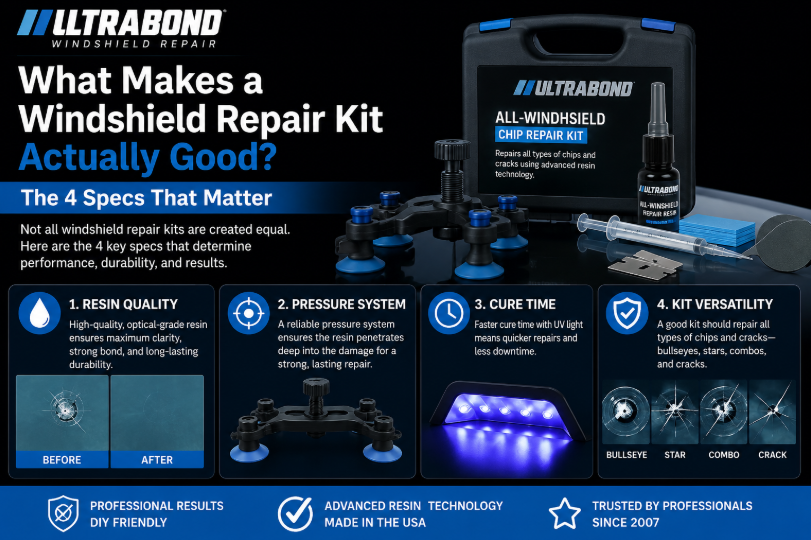
Walk into any auto parts store and the windshield repair kit section looks like a commodity aisle. Every product promises invisible repairs, professional results, and five-minute application. The reality is that the difference between a repair that holds and one that yellows, cracks, or peels within six months comes down to a small number of technical specifications that most product labels never discuss.
Why Most People Choose Wrong
Most buyers choose a windshield repair kit based on packaging and price. The specifications that determine repair quality, resin viscosity, UV cure compatibility, injection system design, and resin shrinkage on cure, are typically absent from consumer product descriptions. This leaves buyers comparing marketing claims rather than performance characteristics.
Specification 1: Resin Viscosity
Resin viscosity determines how well the repair material flows into and fills the damage cavity. A resin that is too viscous for a small chip will leave air pockets. A resin optimized for large star breaks may overflow a small bullseye before it cures. Quality kits specify resin viscosity and match it to the damage type the kit addresses. Generic kits use a single viscosity for all damage types.
Specification 2: UV Cure Performance
Windshield repair resins cure by UV light exposure. The cure time and completeness depend on UV intensity, which varies by sunlight conditions and UV lamp specifications. Resins that require extended UV exposure in cloudy conditions or that under-cure produce repairs that appear complete but soften, yellow, or crack under thermal cycling. Quality resins cure completely across a wider range of UV conditions.
Specification 3: Injection System Design
The injection system controls how resin is introduced into the damage. Vacuum-pressure injectors, which first draw air from the crack and then push resin in under pressure, produce better void elimination than gravity-feed systems. Consumer kits often use simplified injectors that reduce cost but compromise fill completeness in complex crack geometries.
Specification 4: Shrinkage on Cure
All resins shrink slightly as they cure. Resins with high shrinkage pull away from damage edges as they cure, creating visible gaps. Low-shrinkage formulations maintain better contact with the glass surface during the cure process, producing optically cleaner repairs. Professional-grade kits document shrinkage characteristics. Consumer kits rarely do.
The National Windshield Repair Association rates repair materials and equipment on optical clarity, structural integrity, and long-term durability. Products certified to NWRA standards have demonstrated performance above the minimum threshold required for repairs that remain structurally sound and visually acceptable after extended thermal and UV exposure.
According to the Auto Glass Safety Council, properly executed windshield chip repairs using quality materials prevent crack propagation in approximately 85 percent of cases where the damage would otherwise have required full windshield replacement, making material quality a direct factor in repair outcome.
One Last Thing
The best windshield repair kit for any specific damage type is the one that matches resin viscosity to damage geometry, uses a vacuum-pressure injection system, and employs a low-shrinkage resin with reliable UV cure performance. Products that publish these specifications are worth more attention than products that rely on packaging alone.