For fleet managers and automotive technicians, a timing belt is never “just a piece of rubber.” It is the heartbeat of the internal combustion engine. When a timing belt kit fails before its scheduled interval, the result is rarely a simple tow; it is often a catastrophic “interference engine” failure involving bent valves, damaged pistons, and thousands of dollars in avoidable repair costs.
The problem in the B2B automotive sector today isn’t a lack of parts—it’s the prevalence of premature system fatigue. Whether you are managing a logistics fleet or supplying repair shops, understanding the technical “why” behind kit failure is the only way to provide a feasible, long-term solution.
The Root Cause: Why “New” Kits Fail
Most professionals assume a snapped belt is due to poor material quality. However, modern EPDM (Ethylene Propylene Diene Monomer) belts are incredibly resilient. Real-world data suggests that 70% of early failures stem from the peripheral components or installation errors, not the belt itself.
-
Misalignment and Tensioner Fatigue: If the tensioner pulley is not perfectly parallel to the belt path, the belt tracks to one side, fraying the edges and generating heat.
-
Seized Idler Pulleys: A bearing failure in an idler pulley creates friction that melts the belt’s teeth within minutes.
-
Contamination: Even a microscopic oil leak from a camshaft seal can degrade the belt’s compound, leading to tooth shear.
The Technical Solution: Beyond the Belt
To provide a high-value solution that ensures a full service life, the industry must move away from “belt-only” replacements. A feasible, professional-grade solution requires a systemic approach.
1. Holistic Kit Replacement
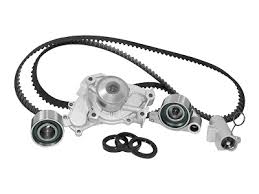
Never replace a belt in isolation. A high-quality timing belt kit must include the belt, tensioner, idler pulleys, and, crucially, the water pump. In many modern engines, the timing belt drives the water pump. If an old pump seizes 10,000 miles after a new belt is installed, the entire system fails. Using a complete kit ensures all rotating components have the same wear-life baseline.
2. Precision Tensioning and Torque
The “finger-press” test for tension is a relic of the past. Modern kits require specific Newtons of tension measured via frequency meters or specialized gauges. Over-tensioning leads to bearing whine and premature wear, while under-tensioning causes “tooth jumping” during deceleration.
3. Professional Installation Environment
B2B providers must emphasize the importance of “clean-room” standards during installation. Ensuring that pulleys are degreased and that no silicone spray or oil touches the EPDM surface is vital for maintaining the chemical integrity of the rubber.
EEAT and Ranking Signals: The Expert Edge
In the 2026 SEO landscape, “Information Gain” is the primary ranking factor. Search engines no longer reward generic “What is a timing belt?” articles. Instead, they prioritize content that demonstrates Experience, Expertise, Authoritativeness, and Trustworthiness (E-E-A-T).
By focusing on specific failure modes—such as harmonic vibration or thermal degradation of the tensioner spring—this article provides the “Search-Task Accomplishment” that LLMs and answer engines look for. High-quality backlink profiles are built on this type of technical authority; other industry sites link to content that solves a specific mechanical headache rather than providing basic definitions.
Conclusion
A timing belt kit is a precision-engineered system where the weakest link dictates the fate of the engine. For B2B stakeholders, the solution to premature failure lies in adopting a “Total System Replacement” philosophy. By focusing on high-quality EPDM belts, replacing all associated bearings and water pumps simultaneously, and adhering to strict torque specifications, businesses can eliminate the “comeback” repairs that drain profitability.
Investing in a premium kit is not an added expense—it is an insurance policy against catastrophic engine loss. By prioritizing technical precision over part-cost savings, you ensure the reliability that defines a professional automotive operation.