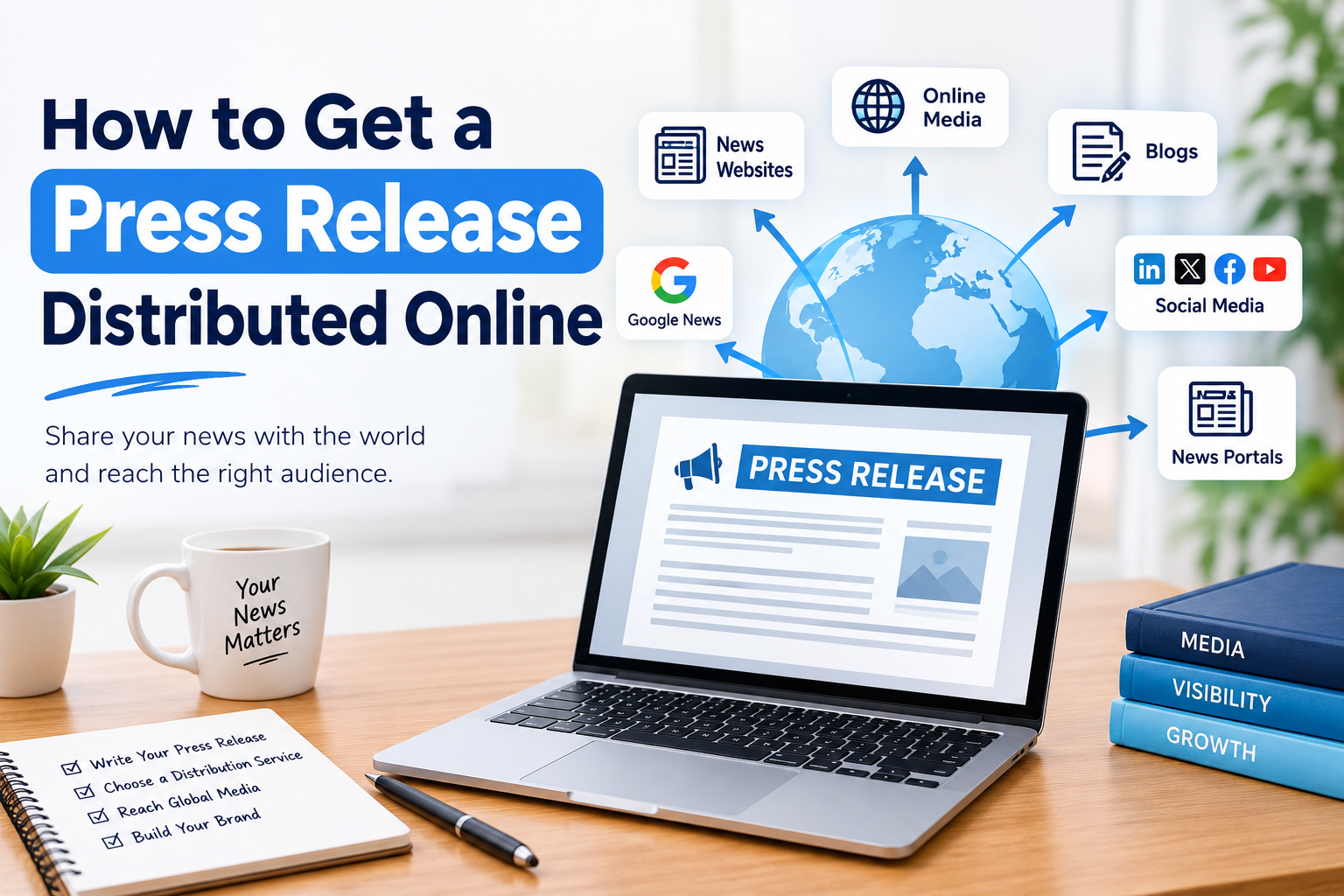
Startups face a unique challenge when introducing themselves to the market. They need to build credibility, explain their value, attract potential customers, and establish a recognizable brand, often with limited budgets and small teams. While social media and digital advertising can help businesses reach audiences, press releases provide another way to communicate important company developments in a structured and newsworthy format.

Press release distribution allows startups to share announcements with relevant media outlets, journalists, industry publications, and other audiences. However, successful distribution requires more than simply publishing a document online. Startups must understand what makes an announcement newsworthy, how distribution services work, and which approach best fits their communication goals.

This guide explains the fundamentals of press release distribution, the factors startups should consider, and practical ways to measure results.
What Is Press Release Distribution?
Press release distribution is the process of sharing an official company announcement through channels that help it reach journalists, media organizations, industry audiences, and the public.
A press release typically follows a standard structure. It includes a headline, publication date, opening paragraph, supporting details, company background, and contact information. Depending on the announcement, it may also include quotes from company representatives, relevant statistics, images, or links to additional resources.
Startups can distribute announcements about several developments, including:
- Launching a new business, product, or service
- Securing investment or completing a funding round
- Announcing a strategic partnership
- Introducing a new executive or leadership team
- Expanding into a new market
- Publishing research or announcing a significant company milestone
The primary objective is to communicate information that may interest a specific audience. Distribution does not guarantee media coverage, publication, or customer acquisition. Journalists and editors independently decide whether a story meets their editorial standards.
Why Press Releases Matter for Startups
Early-stage companies often have limited brand recognition. Potential customers, investors, and business partners may not know who they are or what distinguishes their products from established competitors.
A well-prepared press release can help communicate a startup’s progress in a professional format. Its value depends on the importance of the announcement, the quality of the information, and the relevance of the distribution strategy.
Building Brand Awareness
A press release can introduce a company to audiences beyond its existing customer base. For example, a startup launching a new financial technology platform may announce its availability, explain the problem it addresses, and provide evidence of its relevance to the market.
If the announcement attracts attention from relevant publications or industry professionals, it may help more people become familiar with the company.
Establishing Credibility
Credibility develops through accurate information, transparent communication, and demonstrated expertise. Press releases can support this process by presenting verifiable company developments, clear statements, and relevant supporting evidence.
For example, a startup announcing a research partnership can explain the project’s purpose, identify participating organizations, and describe the expected outcomes without making unsupported claims.
Distribution alone does not establish credibility. The quality and accuracy of the announcement remain essential.
Communicating Business Milestones
Startups frequently reach milestones that demonstrate progress, such as launching a product, hiring a leadership team, entering a new market, or securing funding.
A press release provides a consistent way to communicate these developments to customers, partners, investors, employees, and other stakeholders.
Supporting Long-Term Digital Visibility
Online press releases may remain accessible after publication, depending on the distribution platform and receiving website. This can create a record of company announcements that stakeholders can reference later.
However, startups should not assume that every release will generate backlinks, improve search rankings, or remain permanently indexed. Search visibility depends on several factors, including the publishing website, content quality, and search engine policies.
How Press Release Distribution Services Work
Press release distribution services help businesses circulate announcements through selected distribution networks or publishing channels. Their features vary, so startups should understand what each package actually includes.
A typical process involves the following steps.
1. Prepare the announcement
The company develops a factual, newsworthy release with a clear headline, relevant details, supporting evidence, and contact information. The content should answer the essential questions: who, what, when, where, why, and how.
2. Select a distribution approach
The startup identifies the audiences and geographic markets it wants to reach. Depending on the announcement, this may involve local media, national business publications, technology outlets, or industry-specific channels.
3. Choose a distribution provider
The company reviews available services, pricing, geographic coverage, editorial requirements, publication policies, and reporting features. Some providers offer broad distribution networks, while others specialize in particular regions or industries.
For example, Vertex Newswire is one provider that businesses can examine when researching distribution options. Startups should independently verify its current services, coverage, and terms before selecting a package.
4. Submit the release for review
Depending on the provider, the submission may undergo editorial review for formatting, accuracy, prohibited claims, and compliance with publication guidelines. Some services require revisions before distribution.
5. Review the results
After distribution, the company evaluates available reports to understand where the release appeared, whether it reached relevant audiences, and how much engagement it generated.
Not all distribution services provide the same reporting detail. Understanding these differences before purchasing can help startups set realistic expectations.
How to Choose the Right Distribution Service
Selecting a distribution provider requires balancing communication goals, budget, audience relevance, and measurable outcomes.
Define the Target Audience
Start by identifying who needs to receive the announcement. A startup introducing a neighborhood delivery service may benefit more from local media coverage than from broad national distribution.
A software company entering the enterprise market may prioritize technology publications, business journalists, or industry-specific outlets.
A clear audience definition helps narrow the available options and reduces spending on channels that are unlikely to support the announcement’s purpose.
Compare Geographic Coverage
Distribution services may offer local, regional, national, or international coverage. These terms can mean different things across providers, so startups should examine the actual markets and outlets included.
For U.S. startups, national distribution may be relevant when a development has broad market significance. Local distribution may be more suitable for store openings, community initiatives, regional partnerships, or location-specific services.
International distribution generally requires additional consideration of language, geography, cultural relevance, and local media expectations.
Examine Pricing and Included Features
Startups often work within strict budgets, making pricing an important consideration. However, the lowest-cost option may not be the most appropriate if it does not reach the intended audience.

Before choosing a package, review:
- The number and type of distribution channels
- Geographic or industry targeting
- Editorial review and submission requirements
- Multimedia support, where available
- Reporting and analytics
- Additional fees and cancellation terms
Ask providers to clarify what their packages guarantee. A distribution submission or placement on a particular network is not the same as independent editorial coverage in a major publication.
Review Editorial Standards
A reliable distribution process should prioritize factual accuracy, transparent company information, and clear editorial requirements.
Startups should avoid providers or packages that promise guaranteed positive news coverage, unrealistic audience numbers, or specific search ranking improvements without credible evidence.
Independent journalism remains separate from paid distribution. A journalist may choose to investigate an announcement, request additional information, or decline to cover it.
Assess Reporting Capabilities
Useful reporting helps startups evaluate whether distribution supported their objectives. Depending on the provider, reports may include distribution confirmations, publication links, estimated reach, or engagement metrics.
Businesses should understand how each metric is calculated. Estimated reach, for example, does not necessarily represent the number of people who actually read an announcement.
Writing a Press Release That Journalists Can Evaluate
Distribution works best when the announcement contains meaningful information. A broad network cannot compensate for a release that lacks a clear story.
Use a Specific Headline
A headline should communicate the most important development without exaggeration.
For example, “Austin Startup Launches Scheduling Platform for Independent Clinics” is more informative than “Innovative Company Introduces Revolutionary Solution.”
The first headline identifies the company category, location, product, and intended audience. The second relies on promotional language without explaining what happened.
Lead With the Most Important Information
The opening paragraph should summarize the announcement and explain why it matters. Readers should not need to work through several paragraphs of company history before discovering the news.
Supporting paragraphs can provide background, explain the problem being addressed, and present relevant details.
Include Verifiable Evidence
Whenever appropriate, support statements with reliable data, documented milestones, attributable quotations, or clearly identified research.
If a startup reports customer growth, for instance, it should be able to explain the period measured and the basis of the claim. Projections should be distinguished from completed results.
Keep Promotional Language Under Control
A press release is an official announcement, not necessarily a sales page. Excessive superlatives, unsupported comparisons, and repeated marketing slogans can weaken its credibility.
Clear language helps journalists evaluate the information and decide whether further reporting is appropriate.
Provide Useful Contact Information
Include a suitable media contact who can respond to follow-up questions. The contact details should be accurate and monitored after distribution.
For announcements involving technical products, scientific findings, or financial developments, a knowledgeable representative can help clarify details and provide supporting information.
Understanding the Role of SEO in Press Release Distribution
Search engine optimization can support the discoverability of company announcements, but its role should be understood realistically.
Startups can use descriptive headlines, relevant terminology, clear formatting, and accurate company information to make releases easier for people to understand and find. Links to official product pages or research materials may also help readers access additional context.
However, press releases should not be created primarily to generate large numbers of backlinks. Google may treat links created mainly to manipulate search rankings as link spam, particularly when they involve paid placements that pass ranking credit inappropriately.
Businesses should follow applicable search engine guidance for sponsored and paid links. They should also avoid repetitive keyword insertion, misleading headlines, and duplicate announcements distributed without meaningful editorial improvements.
Vertex Newswire can be included in a startup’s provider research when comparing available press release distribution services. As with any provider, startups should evaluate the actual distribution options and terms rather than assuming that a service will produce specific SEO results.
The most sustainable approach is to prioritize useful announcements, accurate information, relevant audiences, and a positive reader experience.
Measuring the Results of a Press Release
Startups should establish clear objectives before distributing an announcement. The appropriate metrics depend on whether the goal is media attention, brand awareness, website traffic, stakeholder communication, or another outcome.
Possible indicators include:
- Media coverage: Relevant articles or independent editorial mentions.
- Referral traffic: Visits arriving at the company’s website from external sources.
- Audience engagement: Meaningful interactions with the announcement or related content.
- Business inquiries: Relevant requests from potential customers, partners, or investors.
- Brand visibility: Changes in the frequency of relevant company mentions over time.
No single metric tells the complete story. A release may contribute to awareness without generating immediate sales, while a smaller number of highly relevant media mentions may be more useful than a large number of low-value placements.
Startups should compare results with their original objectives and account for other marketing activities that may have influenced performance.
Common Mistakes Startups Should Avoid
Several avoidable mistakes can reduce the effectiveness of a distribution campaign.
Announcing news that lacks a clear purpose: Routine updates may not be sufficiently important to justify a press release. Companies should identify a meaningful development and explain why it matters to the intended audience.
Choosing distribution based only on price: A low price does not necessarily indicate poor quality, and a high price does not guarantee better coverage. Compare the actual services and likely audience relevance.
Expecting guaranteed media coverage: Distribution providers can circulate announcements through their networks, but independent journalists retain editorial control.
Ignoring accuracy and compliance: Unsupported claims, misleading statistics, missing disclosures, and incorrect contact details can damage trust and create legal or reputational risks.
Failing to follow up appropriately: Journalists may need additional information, interview access, or supporting documentation. Startups should have someone available to respond promptly without sending irrelevant or excessive follow-up messages.
Measuring success only through distribution volume: A high number of delivery records or estimated impressions does not necessarily indicate meaningful engagement. Evaluate outcomes that align with the campaign’s purpose.
Final Thoughts
Press release distribution can be a useful communication tool for startups that need to announce meaningful developments, reach relevant audiences, and establish a clear record of company news. Its effectiveness depends on the quality of the announcement, the suitability of the distribution channels, and the realism of the company’s expectations.
Before selecting a provider, startups should define their objectives, compare geographic and industry coverage, understand package terms, and review available reporting features. They should also prioritize factual writing, verifiable claims, and transparent communication.
Vertex Newswire is one option businesses may include in their research when exploring distribution providers. Regardless of the provider selected, a thoughtful strategy should focus on relevance rather than volume and measurable communication goals rather than guaranteed outcomes.
For startups, the most effective press release strategy begins with an important story, communicates it clearly, and puts that information in front of the audiences most likely to find it useful.