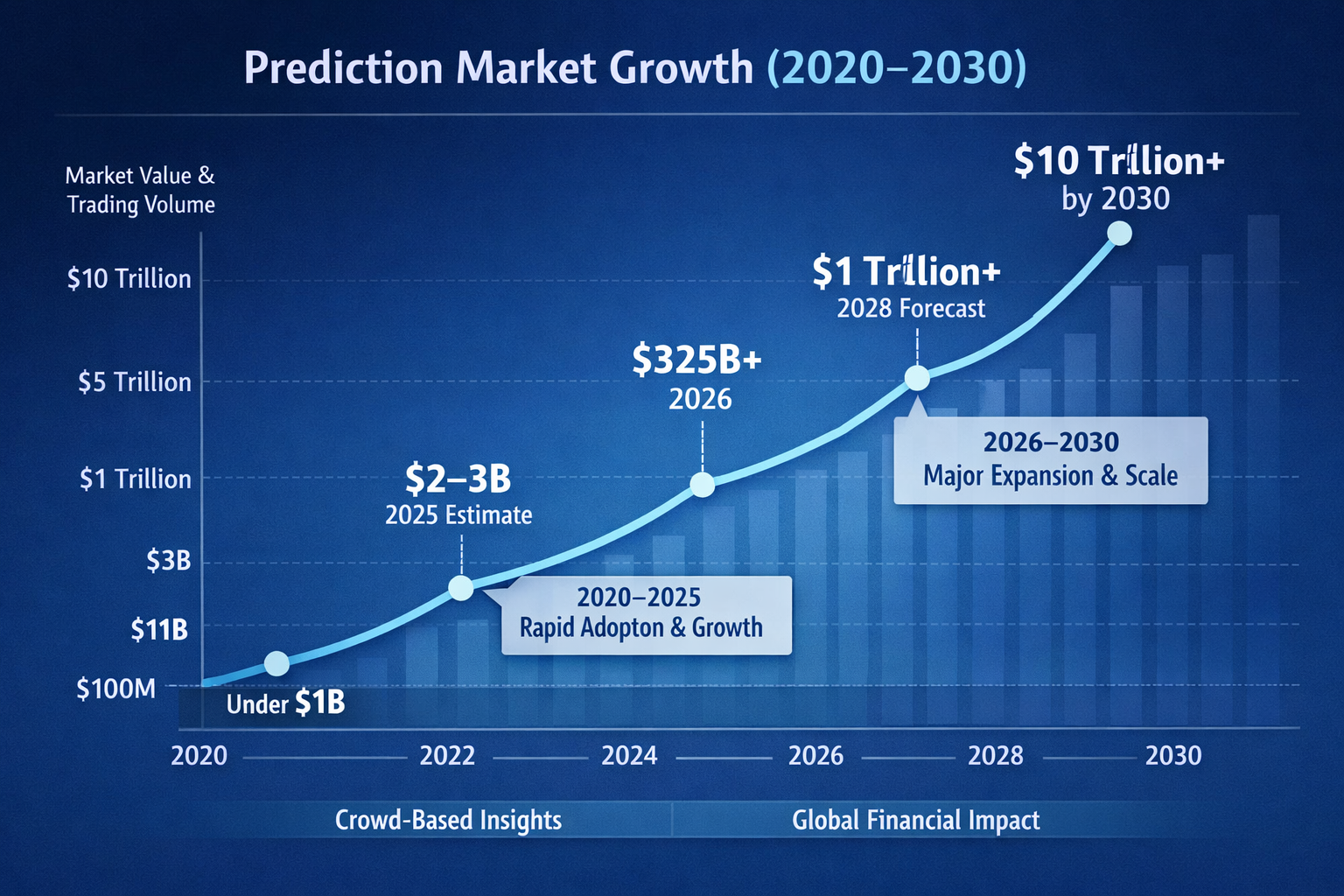
Prediction markets have become one of fintech’s breakout stories. By letting users trade on the outcome of real-world events — elections, sports, crypto prices, economic data — these platforms turn collective opinion into a live, tradable signal. Monthly volumes across the biggest players now run into the tens of billions of dollars, and the global market is projected to grow from roughly $20 billion toward nearly $95 billion within the decade.

For a startup, that’s a rare combination: strong user demand, a proven revenue model, and mature technology to build on. But “build on” is the operative phrase. A generic clone can get you to market; a custom platform built around your niche, your brand, and your business model is what lets you actually compete. This guide walks you through how to build one — the decisions, the features, the technology, and the partner that makes it possible.

Why Build Custom Instead of Off-the-Shelf
Templates are cheap and fast, but they trap you in someone else’s product. A custom platform lets you own three things that templates can’t give you: a differentiated niche, a monetization model tuned to your market, and the freedom to evolve as you grow.
That doesn’t mean building every component from scratch. The smartest path for most startups is a customizable foundation — a proven engine for order matching, wallets, and settlement that you then tailor heavily into your own product. You get the speed of a clone with the ownership of a custom build. Getting that balance right starts with choosing the right prediction market platform development company, because the partner shapes how far you can customize without reinventing the hard parts.
Step 1: Define Your Niche and Validate Demand
The platforms that win rarely try to be everything at once. Many succeed by going deep on one vertical first — sports, crypto, entertainment, politics, or finance — and expanding later.
Ask yourself:
- Who is my core user, and how do they behave? Sports fans trade very differently from crypto traders.
- Which events drive the most volume? High-frequency, high-interest events — daily matches, token prices — keep users active.
- What’s my regional focus? Regulations and payment preferences vary enormously by market.
A focused launch is cheaper to build, easier to market, and faster to profitability. You can always widen the catalogue once you have traction.
Step 2: Map Your Core Features
A prediction platform looks simple on the surface but hides real complexity. Your MVP needs, at minimum:
- Market creation and management — the engine that lists “yes/no” or multi-outcome questions with live pricing and clear resolution rules.
- Real-time order matching — the system that pairs buyers and sellers instantly.
- Live pricing and analytics — prices and probabilities that update the moment sentiment shifts.
- Wallet and payments — secure deposits, withdrawals, and balance management, fiat or crypto.
- KYC and verification — identity and location checks to stay compliant.
- Market resolution and settlement — reliable logic that decides outcomes and pays winners automatically.
- Profiles, rankings, feeds, and notifications — the engagement layer that drives daily retention.
The order-matching and settlement systems are where most generic developers struggle. These are financial-grade components; mispriced markets or failed payouts destroy trust instantly. This is precisely the work a specialist opinion trading platform developer has already solved and can ship far faster than an agency learning on your budget.
Step 3: Choose Your Model — Centralized, Decentralized, or Hybrid
This is a foundational decision that shapes your technology, cost, and compliance burden.
- Decentralized platforms settle on-chain through smart contracts, offering transparency and trustlessness — the approach behind Polymarket-style exchanges.
- Centralized platforms run like a regulated fintech exchange with fiat rails and strict compliance — closer to a Kalshi-style regulated exchange.
- Hybrid builds blend both, balancing speed and cost against transparency.
There’s no universally right answer — it depends on your market, your users’ payment habits, and your legal environment. A good development partner helps you choose rather than forcing you into their default.
Step 4: Get the Technology Stack Right
Prediction platforms live and die on performance. Yours might be quiet midweek and then see traffic spike 50x around a major election or match — and the architecture has to absorb that without slowing down.
A modern, battle-tested stack typically includes Node.js on the backend; React or Next.js on the web front end; native frameworks for mobile; and MongoDB, MySQL, and Redis handling data in real time, with message queues coordinating high-concurrency trading. Containerized deployment on AWS with Docker lets you scale horizontally as your user base grows. Just as important are the integrations that make the platform commercially viable: multiple payment gateways, wallet systems, KYC providers, and live sports and market-data feeds.

If a vendor can’t explain how they handle concurrency, caching, and database load during peak trading, keep looking.
Step 5: Build Compliance In From Day One
This is the step startups most often underestimate. Prediction markets sit in a sensitive legal space that varies sharply by jurisdiction. In some regions they’re regulated as financial exchanges; in others, anything resembling real-money gaming is restricted or banned outright. India’s Online Gaming regulations, for example, draw firm lines around real-money gaming features.
Your development partner doesn’t replace legal counsel, but a serious one architects the right controls from the outset — identity and age verification, geo-fencing, responsible-use limits, and transparent market-resolution rules. Retrofitting compliance after launch is painful, expensive, and sometimes fatal.
Step 6: Plan Your Monetization
The revenue model scales directly with trading activity, which is part of what makes the category so attractive. Your main levers are:
- Transaction fees — a small cut on each trade, usually your primary income.
- Platform fees — a fixed charge for using the service.
- Data and insights — aggregated, anonymized trend data has real commercial value.
- Advertising and sponsored markets — once you reach scale.
Because every stream depends on volume, everything comes back to liquidity and engagement. Seed popular markets, keep pricing tight, and use rankings and notifications to bring users back.
Step 7: Budget and Timeline
Costs vary with complexity. A straightforward custom build can start around $10,000, while a feature-rich platform with blockchain integration, advanced analytics, and multi-language support can run to $50,000 or well beyond. A clean MVP typically takes 4–8 weeks with an experienced team; heavier customization pushes that to 8–12 weeks.
Be cautious of quotes far below market — they usually hide missing scope, skipped security work, or inexperience that resurfaces as costly delays. For a startup watching its runway, transparency about cost, scope, and timeline matters as much as the price itself.
Step 8: Launch, Then Keep Iterating
Launch day is the beginning, not the finish line. Markets need creating and resolving, bugs need fixing, and features need adding to stay competitive. Before you go live, confirm what post-launch support covers and who responds when a production issue hits during a live event.
After launch, focus relentlessly on liquidity and retention — the two metrics that determine whether a prediction platform thrives or stalls. A partner offering true end-to-end delivery, from research through ongoing updates, is worth far more than a cheaper shop that vanishes after the invoice clears.
Why the Right Partner Decides Your Outcome
A startup can get the niche, monetization, and marketing right and still fail if the engine underneath is weak. The teams that succeed build prediction markets as a specialty — not as a side project — and understand the specific pressures founders face around speed, budget, and runway.
OpiniosLabs is built precisely for this. It’s a dedicated prediction market platform developer whose portfolio spans the full landscape — from Polymarket and Kalshi to Probo, Manifold, PredictIt, and Metaculus-style builds. Backed by the engineering depth of parent company Yudiz Solutions, the team pairs genuine domain knowledge with a production-grade stack, security-first development, and fully customizable solutions — and can take a well-defined platform live in roughly 60 days, which is often exactly the speed a startup needs. Their prediction-market development guides and resources are a strong place to start if you want to see how they approach platforms modeled on the biggest names in the space.
Final Thoughts
Building a custom prediction market platform is one of the most promising moves a fintech startup can make right now — the demand is real, the revenue model is proven, and the technology is mature. Your job is to pick a focused niche, nail the core trading experience, choose the right model and stack, build compliance in early, and partner with a team that has done this before. Get those right, and you won’t just launch a platform; you’ll launch one built to compete, scale, and last.