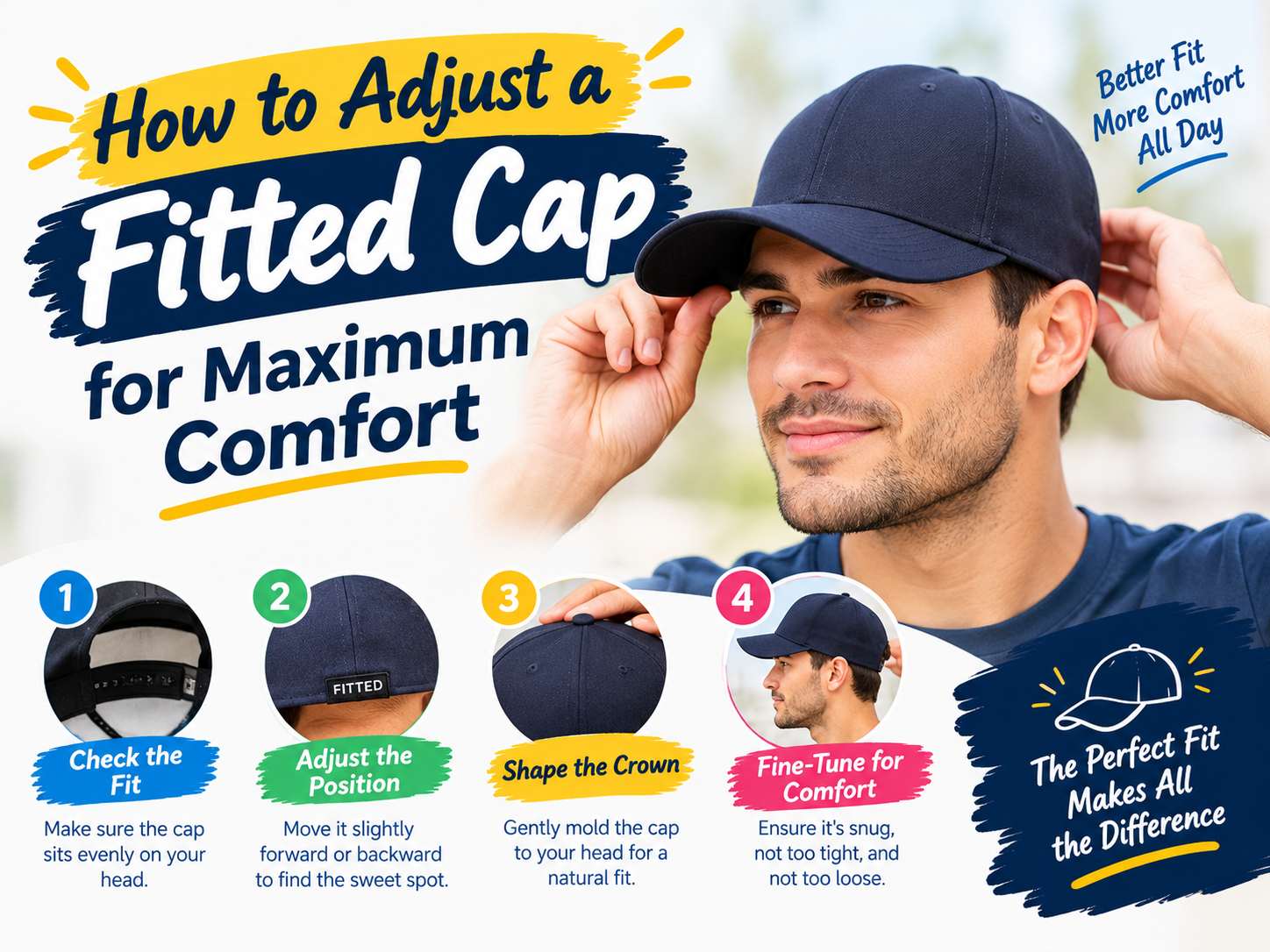
A fitted cap has no strap, snap or buckle, so you can’t loosen or tighten it the way you would a snapback. The size is set when the cap is made, which makes a loose or tight fit harder to deal with.

A small difference can often be fixed at home with a few careful steps. This guide shows how to tighten a loose cap, loosen a tight one, and protect the brim and embroidery while you do it. The steps work for standard and personalised fitted caps.

How Do You Know If a Fitted Cap Doesn’t Fit Right?
A loose fitted cap slips down toward your eyebrows or ears, moves when the wind picks up, or sits high on your head instead of settling in place.
A tight one feels different. You notice pressure on your forehead, and after an hour or two it can leave red marks or turn into a dull ache.
If you’re not sure, wrap a soft tape measure around your head, just above your eyebrows and ears. Then compare that number with the size on the cap, which is usually printed on the label inside.
Check the Fabric Before You Change Anything
Fitted caps don’t all react the same way to water and heat. The fabric decides which method is safe, so it’s worth checking before you try anything on the cap.
Read the Label
The care label inside the cap tells you what it’s made of. Personalised fitted caps may use different fabrics from one order to the next, so a method that worked on one cap may not suit another.
Common Fabrics
Cotton and wool are natural fibres, and both can react to hot water and heat. Polyester is a synthetic fibre and responds to water and heat differently. Stretch blends have some give built in, so they may behave differently when you try to resize them.
Brim and Panels
The stiff front panels and the brim have firm material inside. Too much water or heat can bend them out of shape, so keep both away from moisture and direct heat.
How to Fix a Loose-Fitted Cap
A loose fitted cap can often be made snugger without changing its shape. The key is to work slowly and only on the parts that need it, which is the inside band.
Dampen the Band
Lightly dampen only the inside band, not the whole cap. The band should feel damp, not wet. Put the cap on and wear it until it dries, so the fabric settles around your head.
Add Gentle Heat
If the cap is still loose once it’s dry, a little low heat on the damp band can help the fabric tighten. Keep it gentle and keep it away from the brim.
Use a Sizing Strip
For a small gap, a sizing strip or insert inside the band can take up the extra room without any water or heat. It’s useful when the cap is only slightly loose.
Check as You Go
- Try the cap on after each step.
- Stop as soon as it feels snug.
- If it still slips, repeat only one step at a time.
How to Loosen a Tight-Fitted Cap
A tight fitted cap can usually be given a little more room, but not a full size. The aim is to relax the band so it sits comfortably, without pulling the whole cap out of shape.
Wear It In
Lightly dampen the inside band, keeping the brim and crown dry. Put the cap on and wear it until it dries. The band slowly gives to the shape of your head.
Stretcher or Round Object
A hat stretcher holds the cap in an even shape while the band dries. If you don’t have one, a rounded object of a similar size can do the same job. Square or uneven objects can leave the crown looking squared off.

Go Slowly
Stretch in small steps and try the cap on between each one. Stop when:
- It no longer presses on your forehead
- It leaves no red marks after an hour or so
- The crown still looks even
How to Protect the Brim and Embroidery
Water and heat can damage more than the cap fabric. The brim and any embroidery need extra care, so think about them before you start on the band.
The Brim
Inside the brim is a stiff insert that holds its shape. Water and heat can warp it, leaving the brim wavy or bent. Keep the brim dry and away from any heat.
Embroidery
Personalised fitted caps usually carry embroidery or other custom details. The stitching and the backing behind it are different materials from the cap fabric, so heat and moisture can make them pucker even when the cap itself looks fine.
Test First
Try your method on a small spot on the inside band before using it on the whole cap. While the cap dries, keep the crown supported so it holds its shape.
Get the Right Size Next Time
Home methods only change the fit slightly. If a cap is far too big or too small, dampening and stretching won’t solve it, so the better fix is choosing the right size next time.
Measure Your Head
Measure around your head and compare the number with the cap’s size chart. Don’t assume your usual size will match, because cap manufacturers don’t all size their caps the same way. Check the chart for each brand you buy from.
Custom Orders
Check the chart carefully before ordering fitted caps. A wrong size can only be adjusted a little at home, so it’s worth getting right the first time.
Common Questions About Adjusting Fitted Caps
1- Are fitted caps adjustable?
No. There’s no strap, snap or buckle at the back, and the cap comes in set sizes. Stretch-fit versions use elastic or spandex blends and cover a small size range, but they don’t have an adjuster either.
2- How tight should a fitted cap feel?
Snug, but not tight. It should stay in place when you shake your head and leave no deep red marks or headache. You should also be able to slide a finger between your forehead and the inner band.
3- Do fitted caps stretch over time?
A little. Regular wear and the warmth and sweat from your forehead soften the inner band, so a cap that feels stiff at first can ease up. The change is small, so it won’t fix a cap that is clearly the wrong size.
4- Is it easier to stretch or shrink a fitted cap?
Stretching is usually easier. You can add a little room in small, controlled steps, while shrinking is harder to predict and can distort the crown if it goes too far.
5- Is it better for a cap to be too big or too small?
Slightly too big is easier to live with. A sizing strip can fill the extra space, but a cap that is too small keeps pressing on your forehead and is hard to stretch. If you’re between sizes when ordering fitted caps, the larger one leaves you room to adjust.
Getting a Comfortable Fitted Cap
A fitted cap that feels wrong can usually be improved with small changes. Dampen the band, wear the cap until it dries, and check the fit before trying anything else. Keep water and heat away from the brim and embroidery, especially when applying Iron on patches Australia to customise your fitted cap.
If the cap is far too big or too small, adjusting won’t be enough. Measure your head and check the size chart before you order again, especially with personalised fitted caps.