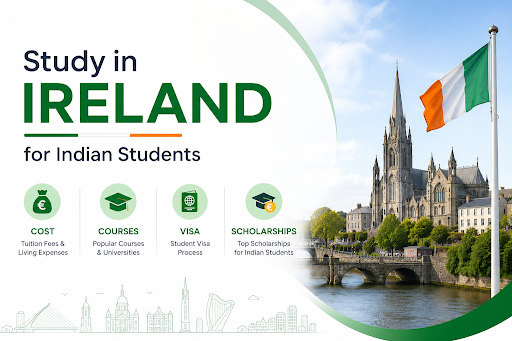
Ireland has quietly become one of the most attractive study destinations for Indian students – an English-speaking EU country, home to European headquarters of Google, Apple, Meta, and Pfizer, offering globally recognized degrees at a more affordable cost than the UK or USA. Here’s a complete, easy-to-follow guide covering everything you need to know before applying.
Why Choose Ireland?
Ireland combines top-quality education, industry exposure, and a clear post-study work pathway in one package. Universities like Trinity College Dublin, University College Dublin (UCD), and University College Cork rank among the world’s best, while over 1,800 multinational companies operating in Ireland create strong graduate hiring pipelines in tech, pharma, and finance. Add a 90%+ visa approval rate and a genuinely safe, welcoming environment, and it’s easy to see why more Indian students are choosing Ireland every year.
Cost of Studying in Ireland
Tuition Fees
- Undergraduate programs: €9,000–€15,000 per year for arts and humanities, rising to €20,000+ for business and technical fields
- Postgraduate programs: €12,000–€31,000 per year, depending on the course and university
- Specialist courses (Medicine, Dentistry): Can exceed €35,000 per year
Living Expenses
Total annual costs, including tuition and living expenses, typically range from €17,000 to €28,000+ per year (roughly ₹15–29 lakh). Dublin remains the most expensive city, while Cork, Galway, and Limerick offer more budget-friendly living costs, particularly for accommodation.
Popular Courses for Indian Students
Ireland’s economy runs heavily on technology, pharmaceuticals, finance, and healthcare – the four sectors that drive most of its GDP – making courses in these fields especially valuable:
- Data Science, Artificial Intelligence, and Cybersecurity – highly in-demand due to Ireland’s concentration of global tech companies
- Cloud Computing and Software Engineering – strong graduate hiring pipelines
- Business Analytics, Finance, and International Business – popular for students targeting Ireland’s financial services sector
- Pharmaceutical Sciences and Biotechnology – supported by Ireland’s status as a major European pharma hub
- Engineering – consistently strong demand across manufacturing and infrastructure
Ireland’s universities are also highly research-focused, making it a strong choice for students interested in R&D-driven careers.
Ireland Student Visa: What You Need to Know
Indian students studying for more than 90 days need a D-Type Long Stay Study Visa. Here’s what the process involves:
- Your chosen course must be listed on the Interim List of Eligible Programmes (ILEP) – always verify this before paying any tuition deposit
- You must pay a minimum of €6,000 toward tuition fees (or the full amount if total fees are below €6,000) before applying
- You must show access to €10,000 for living expenses for the first year, backed by clean bank statements covering the last six months
- English proficiency proof (IELTS 6.0–6.5+ or equivalent TOEFL/PTE score) is mandatory, since all programs are taught in English
- Apply through the online AVATS system, ideally 8–10 months in advance, and no later than 3 months before your travel date
Visa decisions typically take around 40 working days from document submission, though the busiest processing window falls between May and August – so applicants targeting the September intake should aim to complete their VFS appointment by late April to avoid delays.
Post-Study Work: The Third Level Graduate Scheme
One of Ireland’s biggest advantages is its post-study work pathway under Stamp 1G:
- Level 8 (Honours Bachelor’s) graduates: 12 months of post-study work
- Level 9 (Master’s) and Level 10 (PhD) graduates: 24 months of post-study work
No job offer or employer sponsorship is required to access this window, giving graduates genuine time to find skilled employment and eventually transition to a Critical Skills Employment Permit (CSEP) and, later, long-term residency (Stamp 4).
Scholarships to Reduce Your Costs
Several scholarship options can meaningfully lower your financial burden:
- Government of Ireland International Education Scholarship (GOI-IES): Offers a €10,000 stipend plus a full tuition fee waiver, though highly competitive
- University merit-based scholarships: Typically reduce tuition by €2,000–€10,000, awarded based on academic performance
- IRC Postgraduate Scholarships: Provide research stipends for master’s and PhD students
Working While You Study
International students on a valid visa and enrolled in an ILEP-listed course can work up to 20 hours per week during term time and up to 40 hours per week during holidays – a helpful way to offset living costs while studying.
Step-by-Step Application Process
- Research universities and courses matching your goals
- Check requirements – academic eligibility and English proficiency
- Apply with transcripts, SOP, and LORs
- Accept your offer and pay the required deposit
- Arrange accommodation in advance, especially in Dublin
- Apply for your D-Type student visa through AVATS
- Gather visa documents – passport, offer letter, fee payment proof, financial evidence, insurance, and police clearance certificate
Final Thoughts
Studying in Ireland offers Indian students a genuinely strong combination – quality education, a thriving multinational job market, affordable costs relative to the UK or US, and a clear, sponsorship-free path to post-study work. With careful planning around your course choice, financial documentation, and visa timeline, Ireland can be both an academically rewarding and strategically smart choice for building a global career.